

 EN
EN
 AR
AR CS
CS DA
DA NL
NL FI
FI FR
FR DE
DE EL
EL IT
IT JA
JA KO
KO NO
NO PL
PL PT
PT RO
RO RU
RU ES
ES SV
SV TL
TL IW
IW ID
ID LV
LV SR
SR SK
SK VI
VI HU
HU MT
MT TH
TH TR
TR FA
FA MS
MS GA
GA CY
CY IS
IS KA
KA UR
UR LA
LA TA
TA MY
MY
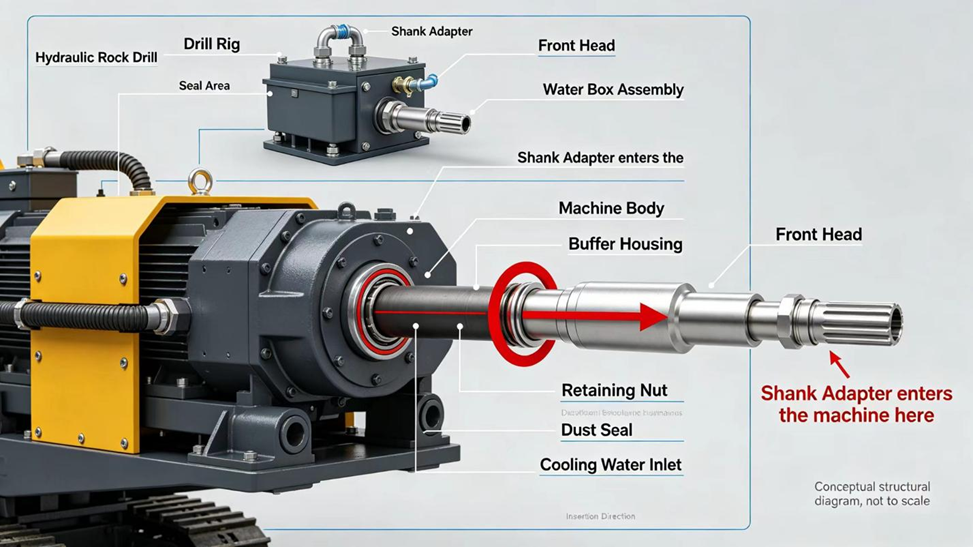
Every hydraulic rock drill that flushes its hole with water depends on a small ring of elastomer to keep that water where it belongs. The cup seal sits at the point where a rotating, hammering shank adapter passes through the drill's front head, and it has one job: keep the flushing water in its own chamber instead of letting it into the drill's lubricated mechanism, or letting drilling debris work its way back the other way. This article explains where the cup seal sits, how it manages to seal a component that is both rotating and being struck thousands of times a minute, what failure looks like, and what to check before ordering a replacement.
What Is a Cup seal in a Hydraulic Rock Drill?
A cup seal, also called a flushing seal, is the sealing element fitted inside a rock drill's front head or “water box” — the housing that surrounds the shank adapter where flushing fluid is introduced into the drill string. Most rock drilling uses water, air, or a water-air mixture to carry broken rock away from the bit and to cool it, and that flushing fluid has to be injected into the shank adapter's internal bore from a stationary supply line even though the adapter itself is both rotating and hammering. The cup seal is what keeps that connection sealed.
Depending on the manufacturer and the drill model, you may also see this component listed as a flushing seal, front head seal, or water box seal. All of these names refer to the same functional role: sealing a pressurized flushing chamber against a shank adapter that never stops moving while the drill is running.
Where Is the Cup seal Located, and What Does It Actually Seal?
The shank adapter has a radial hole (or two, on some designs) connecting its outer surface to its internal flushing bore. That hole sits inside an annular chamber formed by the front head's water box, so that flushing fluid fed into the box can enter the bore through the hole no matter what rotational position the adapter is in at that instant. Sealing that chamber typically takes at least two sets of seals: one set sealing the water box against the stationary front head structure, and another sealing it against the shank adapter itself, which is the seal doing the harder job, since it has to hold a seal against a surface that is simultaneously rotating and moving axially.
In practice this means a rock drill's cup seal arrangement is rarely a single ring. It is usually a small stack of sealing and bearing elements — seals, wear bushings, and sometimes a separate dust or wiper element — built into a water box that can be opened for service without removing the entire front head.
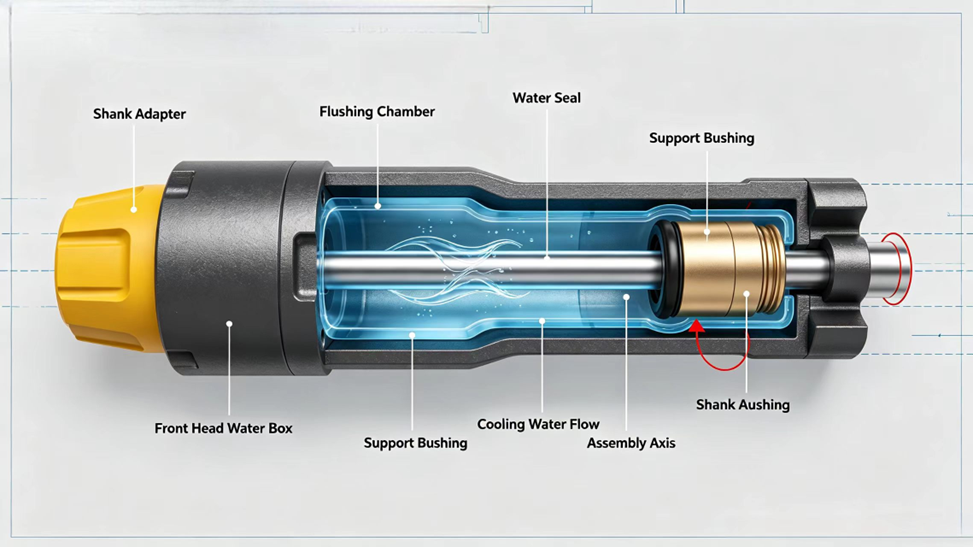
Photo1:Front Head Water Box Cross-Section
How Does the Cup seal Work While the Shank Adapter Is Rotating and Hammering?
This is the part of the job that makes a cup seal different from an ordinary static seal. While the drill is operating, the shank adapter is turning continuously (to index the bit for the next blow) and also moving through a small amount of axial travel as it absorbs and transmits each impact from the piston. The cup seal has to maintain continuous contact with that moving surface, in both directions of motion, while holding back flushing fluid that may be pressurized well above atmospheric pressure.
That combination — rotation, axial vibration, and pressure, all at once — is a harder duty than most dynamic seals see. It is also why the sealing surface on the shank adapter matters as much as the seal itself: any pitting, corrosion, or scoring on that surface gives the seal lip an uneven surface to ride on, and wear tends to accelerate from that point on.
Why Does External Flushing Put Extra Demand on the Cup seal?
Shank adapters are flushed in one of two ways. Internal flushing runs a water tube through the center of the drill and seals it against the adapter with a single O-ring at the tip, a comparatively simple, low-demand seal. External (front head) flushing feeds the flushing fluid into the water box around the outside of the adapter instead, which is generally considered the better design because it can deliver a larger flushing volume with less risk of leakage or water-hammer damage — but that capability is exactly why its seals see more continuous pressure and flow.
Most modern hydraulic rock drills use external, front-head flushing for this reason. The trade-off is that the cup seal in that front head design is doing full-time, pressurized, dynamic sealing work rather than the comparatively easy job of a static tip seal, which is part of why flushing seals are treated as a routine wear item rather than a fit-and-forget part.
The flow entering that chamber behaves like flow through a restrictor orifice, a relationship well established in flushing-circuit design for dynamic seals generally:
Q = 0.0019159 · C · d2 · (Δp / ρ)1/2 (1)
where Q is the flushing flow rate, C is a flow coefficient, d is the flow path’s effective diameter, Δp is the pressure drop across it, and ρ is the flushing fluid’s density. The practical takeaway is that flushing flow is controlled by the pressure differential across the water box, not by pressure alone: published guidance on flushing dynamic seals in industrial rotating equipment recommends keeping the flushing side only marginally above the sealed chamber’s pressure, on the order of 0.05–0.2 MPa higher, and keeping fluid velocity through any restriction low enough to avoid impingement erosion, generally under 3–5 m/s where the fluid carries solids. Rock drill flushing water is rarely perfectly clean, so both an overly aggressive pressure differential and an undersized flow path can accelerate wear at exactly the point the cup seal is trying to protect.
What Happens When a Rock Drill's Cup seal Fails?
Once a cup seal loses its sealing lip or starts leaking past a worn contact surface, flushing fluid can migrate from the water box into the drill's rotation and percussion mechanism, where it mixes with or displaces the lubricating oil. Water contamination in hydraulic or lubricating oil accelerates corrosion of internal components, degrades the oil's lubricating properties, and can lead to accelerated wear well beyond the front head itself.
The failure can also run the other way: a seal that has lost its grip on the shank adapter can let drilling fluid escape outward around the adapter instead of down the bore, which shows up as visible leakage at the front of the machine and a drop in the flushing flow that actually reaches the bit — reducing how effectively cuttings are cleared from the hole.
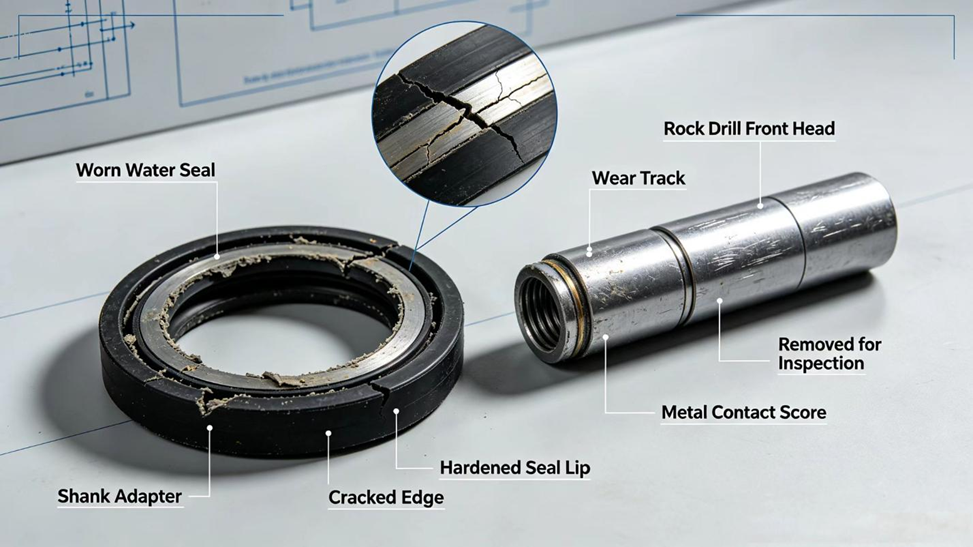
Photo2:Worn Cup seal and Shank Adapter
How Can You Tell If Your Rock Drill's Cup seal Has Failed?
A failing cup seal usually shows up as some combination of the following:
- Visible water or flushing fluid leaking from the front head area during operation.
- A milky or discolored appearance in the drill's hydraulic or lubricating oil, indicating water contamination.
- Reduced flushing flow or pressure reaching the bit, even though the pump and flushing line check out normally.
- Faster-than-normal corrosion or pitting visible on the shank adapter where it passes through the front head.
- Increased wear or scoring on the water box bushings at the next teardown.
The table below connects these symptoms to likely causes and a sensible first check.
Symptom |
Likely Cause |
Next Check |
Visible leakage at the front head |
Cup seal lip worn or damaged, or seal seated incorrectly |
Open the water box and inspect the seal and its seat |
Milky or discolored lubricating/hydraulic oil |
Water has migrated past the seal into the mechanism |
Drain and inspect the oil, then inspect the seal |
Reduced flushing flow at the bit |
Fluid escaping around the adapter instead of down the bore |
Check for leakage at the front head before assuming a pump or line problem |
Corrosion or pitting on the shank adapter surface |
Prolonged exposure to flushing water, often saline or mineralized |
Inspect the adapter's sealing surface for roughness |
Water box bushings show uneven wear |
Radial movement of the adapter from bushing wear is overloading the seal |
Check bushing clearance, not just the seal |
Because water contamination and mechanical wear can produce overlapping symptoms, opening the front head and inspecting the seal, its seat, and the adapter's sealing surface together gives a more reliable answer than judging from any one symptom alone.
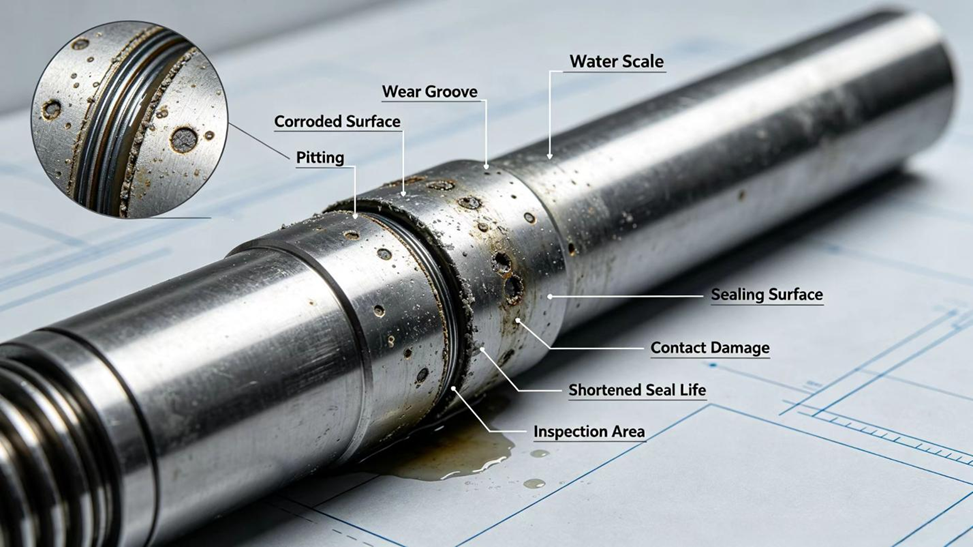
Photo3:Shank Adapter Sealing Surface Wear
What Causes Premature Cup seal Wear?
Several factors independently shorten a cup seal's service life, and they often compound each other:
- Abrasive fines in the flushing water or returning cuttings, which act like a lapping compound against the seal lip and the adapter surface.
- Corrosive or mineralized (including saline) flushing water, common on many mine and coastal sites, which pits and roughens the adapter's sealing surface over time.
- Running the drill dry or with inadequate flushing pressure, which can let the seal run hot against the adapter instead of riding on a thin fluid film.
- Radial play in the shank adapter from worn support bushings, which forces the seal to work against a surface that is wobbling rather than running true.
- A seal material mismatched to the site's water chemistry or temperature, discussed in more detail in a dedicated material comparison.
The shank adapter's own surface condition deserves particular attention here, since general wear engineering ties material loss directly to surface hardness through a relationship of the general form:
W = K / Hn (2)
where W is wear volume, H is the surface hardness of the harder-wearing component, K is a constant tied to the material pairing and contact conditions, and n is a wear index typically between 1 and 2. Research on the heat treatment of rock-drill shank tail material confirms the practical side of this relationship: quenching parameters that raise surface hardness measurably improve wear resistance, while under-tempered or over-tempered parameters leave residual stress or coarsened grain structure that undermines it. The relevance for a cup seal is direct — corrosion pitting on the adapter's sealing surface is functionally a local loss of that hardened layer, so a corroded adapter can accelerate seal wear even if the seal itself is in good condition and correctly installed.
How Does Shank Adapter and Bushing Wear Affect Cup seal Life?
The cup seal does not work in isolation from the rest of the front head assembly. The shank adapter is normally supported by wear bushings that keep it running true inside the water box; as those bushings wear, the adapter is allowed to move more in the radial direction as it rotates and hammers. That extra radial movement is transferred directly to the cup seal, which now has to flex and re-seat against a surface following a wobbling path instead of a clean, concentric one.
This is a common reason a “new” cup seal fails again quickly after replacement: if the bushings and the adapter's sealing surface are not inspected and, where needed, replaced or refinished at the same time, the new seal is immediately subjected to the same abnormal loading that wore out the old one.
How Do You Choose the Right Replacement Cup seal?
With a confirmed failure and the front head open for inspection, three things determine the right replacement:
- Exact dimensional and profile match to the OEM part. Water box seal geometry, lip design, and groove dimensions are specific to the rock drill model and are not generally interchangeable across brands.
- A material suited to the site's flushing water and temperature. Cup seals are most commonly specified in polyurethane or FKM depending on abrasion, water chemistry, and temperature — a distinction covered in detail in a companion article on cup seal materials.
- Confirmation that the shank adapter's sealing surface and the water box bushings are within tolerance, since a correctly chosen seal installed against a worn or scored adapter will not reach its expected service life.
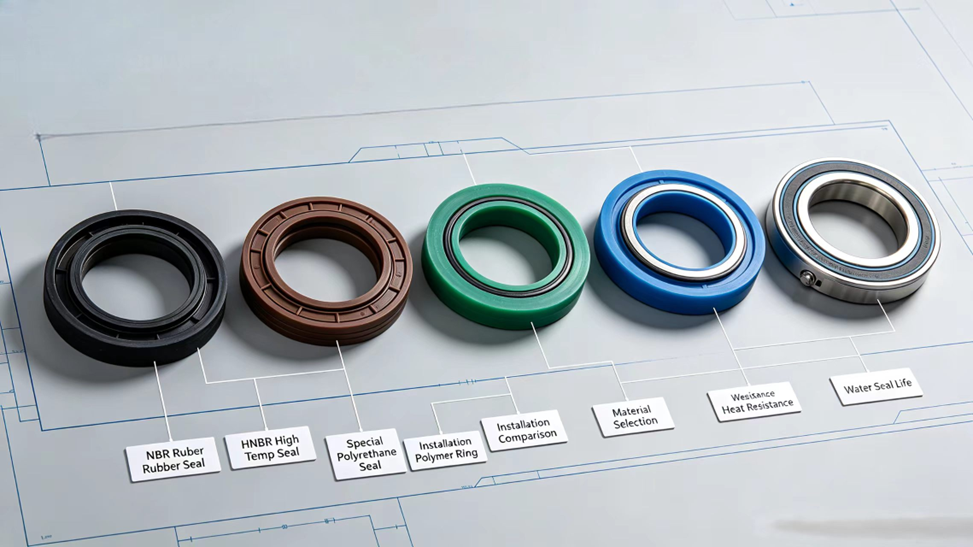
Photo4:Replacement Cup seal Material Comparison
Where Can You Source a Reliable Replacement Cup seal?
Because cup seal dimensions and lip profiles are specific to each rock drill model, sourcing comes down to finding a supplier who can match your machine's exact part number rather than a generic “cup seal” description.
Nanjing Hovoo Machinery Technology Co., Ltd, a Chinese seal manufacturer founded in 2013, produces PU, rubber, and PTFE sealing components for hydraulic rock drills and hydraulic breakers, cross-referenced to major brands such as Atlas Copco/Epiroc, Furukawa, Montabert, Sandvik, and Tamrock, among others, and states that it provides free technical support to confirm the correct part number, dimensions, and material grade for a given rock drill model before an order is placed.
If you are unsure which cup seal your machine needs, providing the rock drill's model, the front head or water box part number, and a note on your site's flushing water quality (fresh, saline, or abrasive) to a supplier that can cross-reference against OEM specifications is the most reliable way to get a seal that actually fits and lasts.
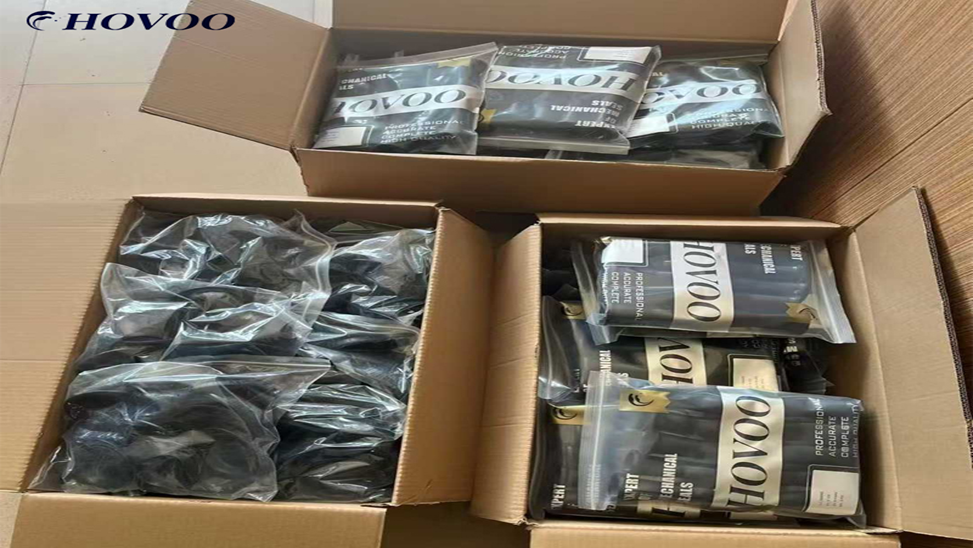
Photo5:Packaged Rock Drill Cup seal Kit
Selected technical references consulted for this article:
- Zhou B., Zhao Y., Zhang H., Liu F., Zhu W. “Analysis of the Effect of Flushing on Mechanical Seal Performance.” Mechanical & Electrical Engineering Technology, 2023, 52(05): 269–272.
- Han Z. “Analysis of the Effect of Different Heat Treatment Parameters on the Hardness and Wear Resistance of Rock Drill Shank Tails.” Zhejiang Pulanka Drilling Tools Co., Ltd., technical paper, 2026.
- Zhang H., Liu X., Wang J., Sun M. “Structural Design and Motion Simulation Research on a New Type Composite Rotary Percussion Drilling Tool.” Journal of Mechanical Strength, 2017, 39(2): 392–396.
Table of Contents
- What Is a Cup seal in a Hydraulic Rock Drill?
- Where Is the Cup seal Located, and What Does It Actually Seal?
- How Does the Cup seal Work While the Shank Adapter Is Rotating and Hammering?
- Why Does External Flushing Put Extra Demand on the Cup seal?
- What Happens When a Rock Drill's Cup seal Fails?
- How Can You Tell If Your Rock Drill's Cup seal Has Failed?
- What Causes Premature Cup seal Wear?
- How Does Shank Adapter and Bushing Wear Affect Cup seal Life?
- How Do You Choose the Right Replacement Cup seal?
- Where Can You Source a Reliable Replacement Cup seal?


