

 EN
 AR
 CS
 DA
 NL
 FI
 FR
 DE
 EL
 IT
 JA
 KO
 NO
 PL
 PT
 RO
 RU
 ES
 SV
 TL
 IW
 ID
 LV
 SR
 SK
 VI
 HU
 MT
 TH
 TR
 FA
 MS
 GA
 CY
 IS
 KA
 UR
 LA
 TA
 MY

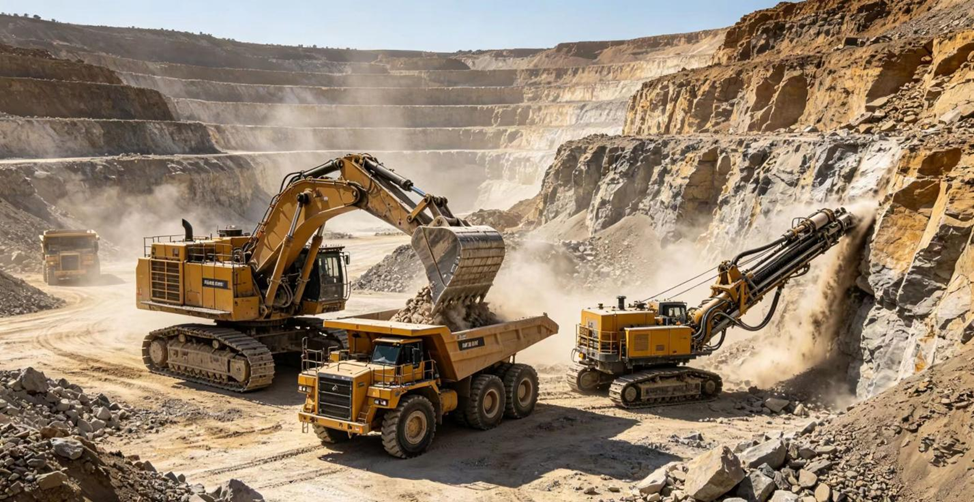
Bauma China 2026 takes place at the Shanghai New International Exhibition Centre (SNIEC) from 24 to 27 November. The show encompasses construction, mining, and building-materials machinery, making it a key venue for mining sector procurement and maintenance teams seeking sealing components for underground and surface mining equipment. The range of machinery represented — from tunnel boring machines and roadheaders to hydraulic shovels and drill rigs — illustrates the breadth and severity of sealing challenges in the mining environment.
Mining machinery operates under conditions that represent the extreme end of the hydraulic sealing spectrum. Underground machines work in continuous exposure to water, fine mineral dust, and abrasive ore particles. Surface machines face temperature extremes, high-cycle hydraulic loading, and contamination from blasted rock material. A seal failure on a production machine in an underground mine or at a surface pit can stop equipment that is often the bottleneck for the entire production circuit. Selecting seals with the technical capability to survive these conditions — and sourcing from suppliers with the technical depth to support specification work — is a priority maintenance decision.
What Makes Mining Applications More Demanding Than Standard Construction Use?
Mining machinery sealing requirements differ from construction machinery in several significant ways. First, production pressure: a mining operation runs on a continuous schedule, and unplanned downtime on a critical machine has an immediate impact on output. The cost tolerance for seal failure and unplanned repair is lower in mining than in most construction applications, which makes component selection and preventive maintenance more rigorous.
Second, contamination severity: mining environments generate finer and harder particles than most construction environments. Fine ore dust and drilling slurry reach seal surfaces through routes that coarser grit would not. Rock dust from blasting has a particle hardness that can abrade seal lips rapidly once the initial protective oil film is displaced. Underground water ingress combines with dust to form slurries with high abrasive and corrosive potential.
Third, pressure and load intensity: many mining hydraulic circuits operate at higher pressure than standard construction equipment, particularly in rock drilling, tunnel boring, and large hydraulic shovel applications. Higher working pressure increases extrusion risk for seals in cylinder and actuator positions, requires harder or more precisely engineered backup ring configurations, and places greater demands on shaft seal containment in pump and motor units. These factors together justify using higher-specification seal materials and profiles in mining applications compared to equivalent positions in lighter-duty construction equipment.
What Are the Key Sealing Applications in Underground Mining Equipment?
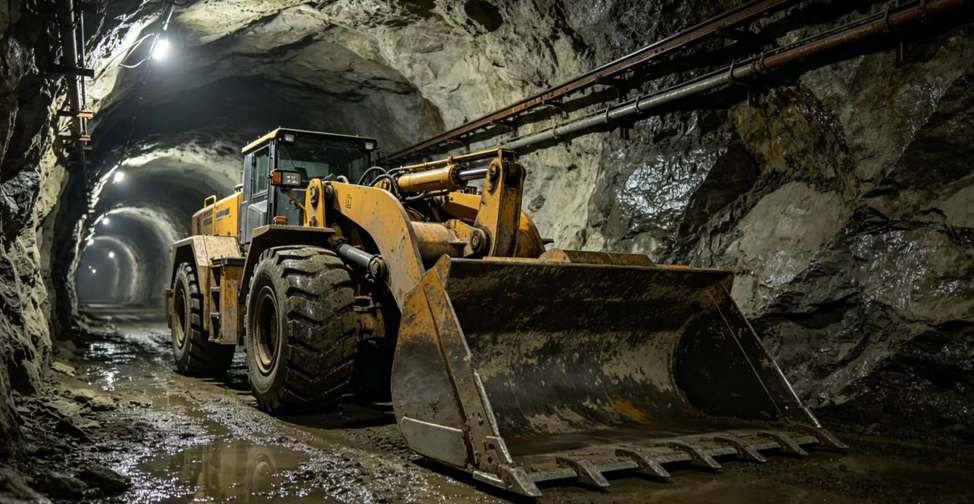
Underground mining uses a range of specialized machines that differ from surface construction equipment in their configuration, operating environment, and sealing requirements. Continuous miners and roadheaders use cutting drums with large rotating seals that must exclude rock dust and water while retaining lubricant under load. Bolting machines and roof support jacks use long-stroke cylinders operating in water-saturated environments where rust on the cylinder rod is a constant risk.
Longwall hydraulic roof supports — also called powered supports or shields — are among the most hydraulic seal-intensive equipment in underground mining. Each support unit contains multiple advance and stability cylinders that must maintain position under the full weight of the rock above. The hydraulic fluid in longwall systems is typically a water-based HFA or HFAE emulsion for fire safety reasons, which requires different seal compounds than mineral oil circuits.
Load-haul-dump (LHD) vehicles operating underground have articulated steering cylinders, dump cylinders, and hydraulic transmission components that must function in combined exposure to rock dust, mine water, and the mechanical shock of moving over rough underground roadways. The wiper seals and rod seals on LHD cylinders are among the highest-replacement items in underground mobile equipment maintenance.
What Sealing Challenges Do Tunnel Boring Machines Present?
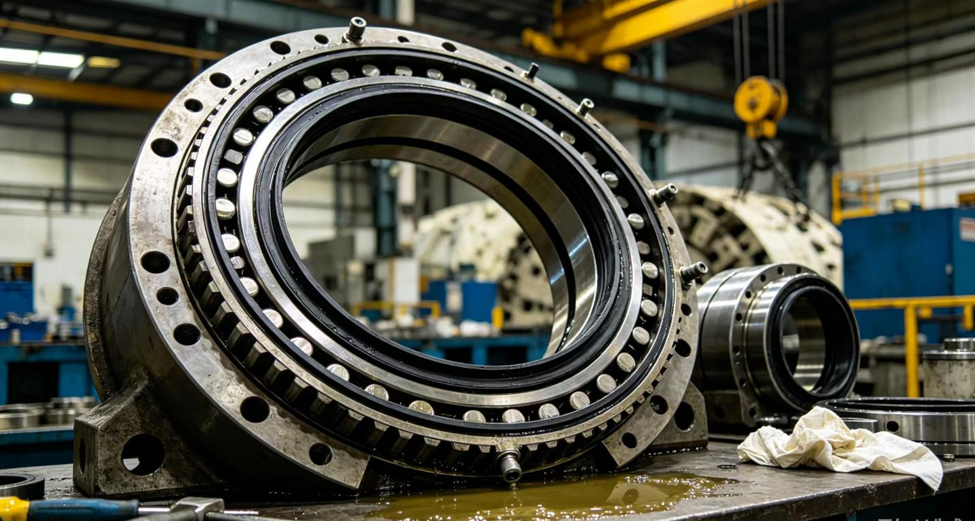
Tunnel boring machines (TBMs) represent the most technically demanding sealing environment in the mining and tunneling sector. The main bearing seal on a TBM is a large-diameter rotary seal that separates the pressurized ground face from the machine interior. It operates continuously under substantial differential pressure — often several bars in compressed air or slurry pressure applications — while the main bearing rotates at low speed under the full thrust load of the cutter head.
TBM main bearing seals are typically multi-lip configurations with grease-lubricated lips, using specialized elastomeric compounds and precision metal backing rings. The grease injection system that maintains the lubrication between the lips is as critical as the seal material itself — insufficient grease injection allows the lip-to-housing contact surface to run dry, generating heat and accelerating wear. A TBM that loses its main bearing seal in a critical tunnel drive faces one of the most complex and costly repairs in underground construction.
In addition to the main bearing seal, TBMs contain dozens of thrust cylinder seals, screw conveyor shaft seals, erector arm cylinder seals, and slurry circuit seals. The erector arm cylinders, which position and install tunnel lining segments, operate in a heavily contaminated environment with wet concrete and bentonite slurry exposure. Seals in this zone must resist both abrasive wear and chemical attack from cement and concrete pore water.
A 2021 condition-monitoring paper from a tunnelling contractor shows how seal condition is judged in practice. It lists the common main bearing damage modes as indentation (metal flakes or grit rolled into the contact surfaces through a poor internal seal), scuffing from dry running when lubricant or water is short, scoring, abrasive wear when sand enters through the seal, and corrosion from standing idle or water in the lubricant [1]. For the lubricant, it names contamination, viscosity, cleanliness and water content as the four parameters to watch, and for seal leakage in particular it recommends regular spectrometric oil analysis, with silicon and aluminium content as indicators of ingress, at roughly 15-day intervals [1]. Ferrography separates wear into running-in, normal and severe stages, with normal, warning and danger lines set from the machine's own baseline [1]. On clearance, the paper states that the bearing is serviced once the gap reaches 1.7 mm [1]. That threshold belongs to the machines in that paper, and any real limit should come from the TBM manufacturer. The logic is nonetheless transferable: a seal that fails lets grit in, the oil shows it before the bearing does, and trending the oil is cheaper than a bearing replacement.
What Materials Are Specified for Extreme-Duty Mining Seals?
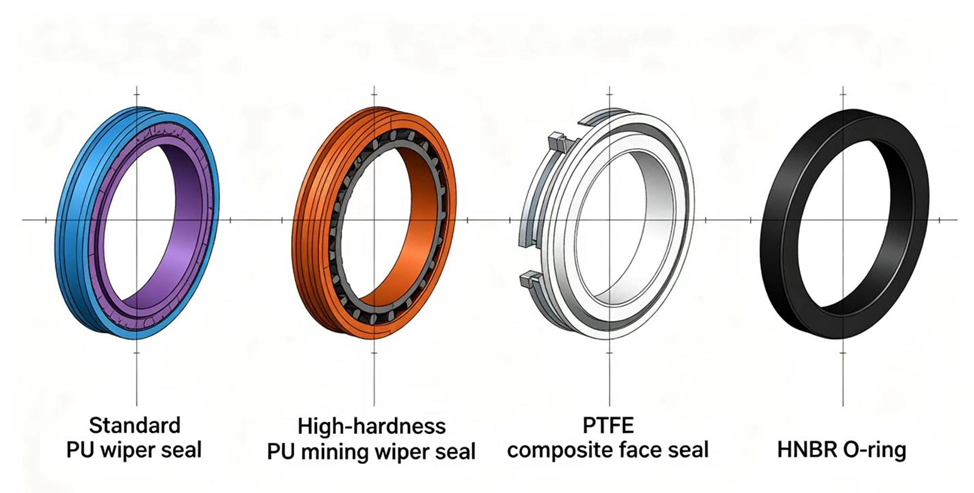
The material requirements for mining seals are more demanding than for construction seals in two key respects: chemical exposure and abrasive particle hardness. In underground mining with water-based hydraulic fluids, standard PU and NBR compounds may swell or degrade more quickly than in mineral oil circuits. HNBR and FKM compounds offer broader chemical resistance for water-based fluid circuits and are commonly specified for dynamic seals in longwall and other water-emulsion hydraulic systems.
For applications with high abrasive particle exposure — TBM cutter head vicinity, continuous miner cutting head seals, drill rod guide seals — filled PTFE composite materials offer better abrasion resistance than unfilled PTFE in face seal configurations, and high-hardness PU compounds with Shore D ratings are used in wiper seals where soft compounds would be cut quickly. The selection of filler material in PTFE composites (glass fiber, carbon fiber, or bronze) affects both the abrasion resistance and the thermal conductivity of the running face, and the optimum selection depends on the specific duty cycle.
Specialty compounds including carboxylated nitrile (XNBR) and hydrogenated carboxylated nitrile (XHNBR) are used in some extreme-duty mining seal applications for their combination of high tensile strength, abrasion resistance, and chemical resistance. At Bauma China, mining-focused seal suppliers who stock these specialty compounds alongside standard grades are better positioned to address the full range of sealing positions in a mining fleet.
What Are the Highest-Priority Seal Positions in Surface Mining Equipment?
Surface mining equipment — hydraulic shovels, large wheel loaders, blasthole drill rigs, and haul trucks — has distinct sealing priorities from underground equipment due to the different environmental profile and the larger scale of the machines.
Hydraulic shovels and large excavators used in surface pit mining have very large bore cylinder seals in the dipper arm, crowd cylinder, and hoist cylinder positions. The scale of these cylinders means that a seal failure results in a large oil loss rate, a rapid loss of dipper force, and a costly repair involving major disassembly. The rod seals and wiper seals on these cylinders are exposed to blasted rock dust and the fine material generated by the digging cycle. High-abrasion wiper seal compounds and double-wiper configurations are used on the largest machines to extend the period between rod seal replacements.
Blasthole drill rigs use rotary head seals that must contain hydraulic oil and air flushing media while allowing high-speed rotation of the drill string. The contamination environment at the drill collar — fine rock dust, drilling cuttings, and compressed air — is particularly hostile to conventional lip seals. Multi-lip seal configurations with grease injection between the lips are standard on production drill rigs.
How Should Mining Maintenance Teams Evaluate Seal Suppliers at Bauma China?
Mining maintenance teams evaluating seal suppliers at Bauma China should apply more stringent technical criteria than for standard construction equipment, reflecting the higher consequences of seal failure and the more demanding operating environment. The table below identifies the key areas and the evidence required from a credible supplier.
Evaluation area |
Specific requirement |
Evidence to request |
Compound range for mining |
HNBR, FKM, and filled PTFE options in addition to standard NBR and PU |
Material datasheet per compound; temperature and fluid resistance limits stated |
Water-based fluid compatibility |
Tested compatibility with HFA, HFAE, or HFAS hydraulic fluids if applicable to your system |
Immersion test data with the specific fluid type; not a generic 'water-resistant' claim |
Abrasion resistance data |
Quantitative abrasion resistance data for wiper seal compounds under defined test conditions |
Test method, test conditions, and result in standardized wear units |
Large-diameter seal capability |
Ability to supply or manufacture seals for large bore cylinders (200mm bore) and TBM main bearings |
Catalog range or custom manufacturing capability statement; sample drawings |
Mining equipment references |
Experience supplying seals for named mining equipment types or OEMs |
Specific machine references; maintenance team contacts if available |
Technical support depth |
Ability to support specification work for non-standard or extreme-duty applications |
Application engineer contact; documented case studies if available |
How Do Water-Based Hydraulic Fluids Affect Seal Selection in Mining?
Water-based hydraulic fluids are the standard in many underground mining applications where fire safety is required. The two main types are high water-content fluids (HFA, typically 95–97% water with an additive concentrate) and water glycol fluids (HFC). These fluids have very different properties from mineral oil, and standard mineral oil seal compounds are often incompatible.
NBR, which is the standard O-ring material for mineral oil circuits, swells and degrades in HFA fluids. HNBR offers better resistance to water-based fluids but must be tested against the specific fluid and concentration. FKM is the preferred compound for most water-glycol circuits. EPDM is compatible with water and some water-based fluids but is incompatible with mineral oil — mixing EPDM seals into a mixed-fluid fleet requires careful tracking to prevent installation in mineral oil circuits.
Low viscosity is the underlying difficulty with water-based fluid: it gives a thin lubricating film, so leakage and wear are higher than in oil, and the dynamic seal is what decides whether water hydraulics is practical [2]. A 2026 study of the rotary seal in a low-speed, high-torque, high-water-based hydraulic motor from a mining-university team (seal outer diameter 275 mm, 21 MPa, 10 r/min) used a modified PTFE retainer ring with bronze particles, loaded by a nitrile O-ring [2]. The friction torque of such a seal can be estimated by integrating the contact stress f(x) over the seal width a [2]:
Tf = π μf (dm2 / 2) ∫0a f(x) dx (1)
where μf is the friction coefficient and dm the seal outer diameter [2]. In the finite element results, grooves in the ring raised peak contact stress (about 36.9 MPa for a plain ring against 45.8 to 53.8 MPa for grooved rings at 21 MPa), while a larger extrusion gap reduced the friction torque; the authors selected a 0.4 mm gap. Measured friction torque at 21 MPa reached 1,371.3 N·m [2]. After running, the ring surface was smoother; the PTFE region had a profile fluctuation of about 0.7 μm and the bronze particles about 2 μm, and the exposed bronze particles bore against the housing and improved wear resistance [2]. These values are for one very large, slow motor, but they show how filled PTFE and design geometry are combined to deal with water-based fluid.
At Bauma China, if your underground operation uses water-based hydraulic fluid, bring the fluid type designation and concentration to seal suppliers and ask for compound-specific immersion test data. A supplier who can provide volume swell percentages and mechanical property retention data after immersion in your specific fluid type is offering verifiable technical evidence rather than a generic compatibility claim.
What Is the Role of Grease-Lubricated Seals in Mining Equipment?
Grease-lubricated multi-lip seals are used in several critical mining applications where oil-lubricated or hydraulically pressurized seals would not survive the contamination environment. These include TBM main bearing seals, large rotary drilling head seals, continuous miner and roadheader cutting head seals, and slew ring seals on large shovels and cranes.
The operating principle is that grease packed between the lips provides both lubrication of the lip-to-housing contact and a physical barrier against abrasive particles. The grease must be replenished continuously or at regular intervals through a grease injection system. When grease injection is interrupted or the interval is too long, the grease between the lips becomes contaminated with abrasive particles, the lip-to-housing contact runs partially dry, and wear accelerates.
Seal compound selection for grease-lubricated mining seals must consider grease compatibility as well as the chemical environment. NBR is generally compatible with most lithium and calcium-complex greases. HNBR and FKM extend the temperature and chemical compatibility range. At Bauma China, ask suppliers about the specific grease types their multi-lip seal compounds are compatible with, and confirm that the grease specified in the equipment manual is compatible with the seal compound before changing greases.
How Can Hovoo Seal Support Mining Machinery Sealing at Bauma China 2026?
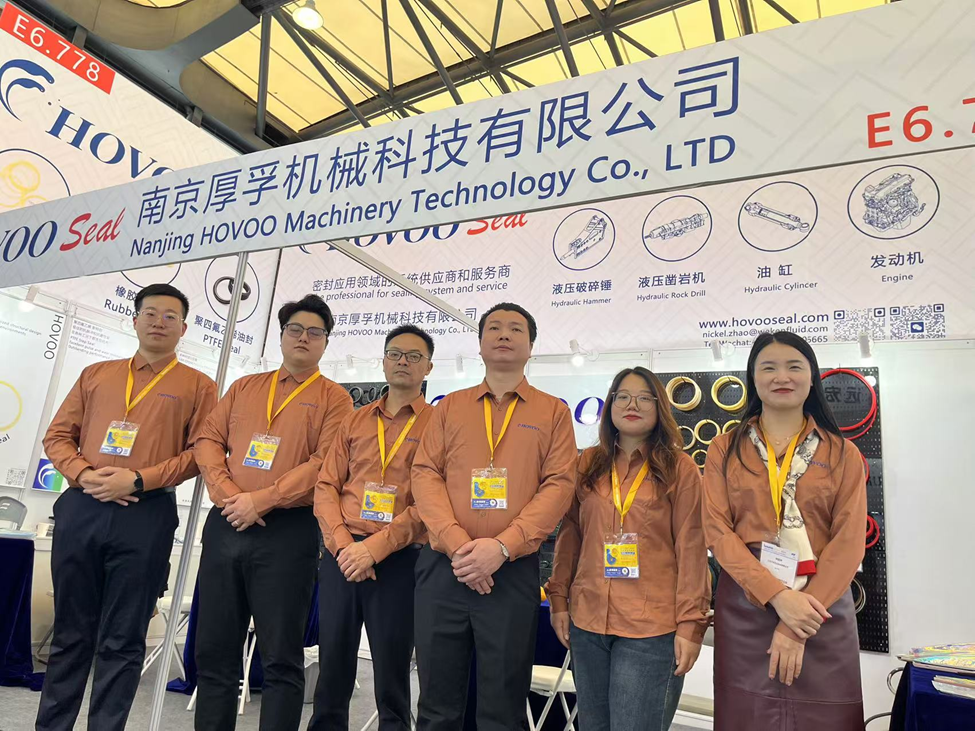
Hovoo Seal (Nanjing Hovoo Machinery Technology Co., Ltd) supplies hydraulic sealing components for the mining sector, including extreme-duty wiper seals, high-pressure piston seals, shaft seals, multi-lip rotary seals, and O-rings in standard and specialty compounds. The product range addresses both surface and underground mining applications, with compound options including standard NBR and PU for mineral oil circuits and HNBR and FKM for water-based fluid applications.
Technical support covers compound selection for non-standard hydraulic fluids, dimensional specification for large-bore cylinders, and review of seal configurations for demanding applications including drill rig rotary heads, longwall support cylinders, and large hydraulic shovel cylinders. Custom seal profiles produced to customer drawings are available for legacy equipment and non-standard housing geometries.
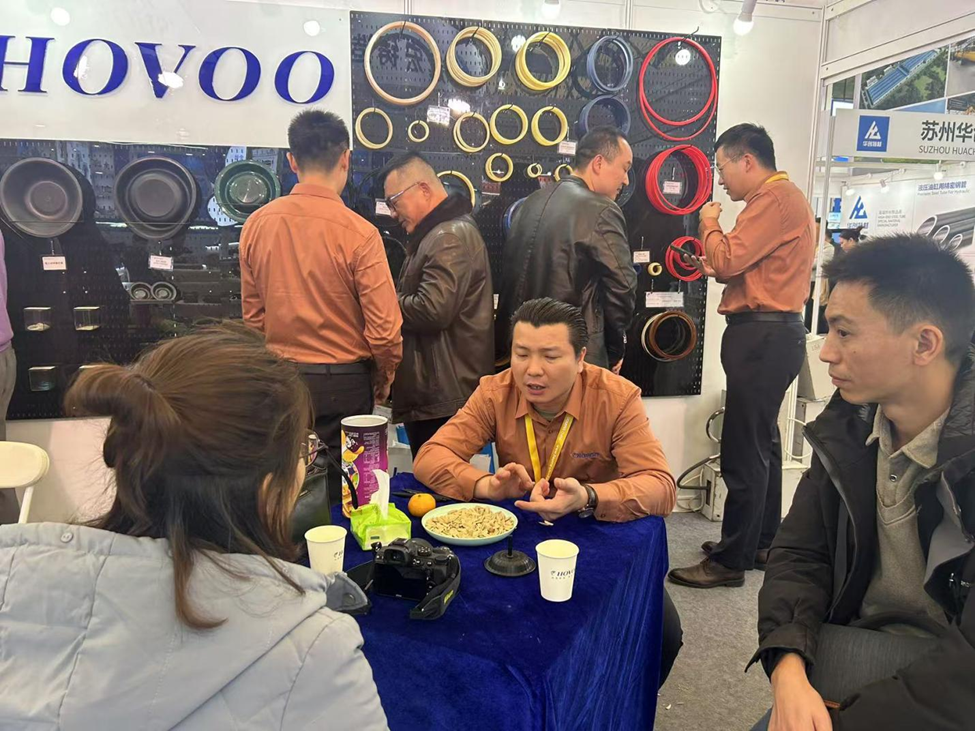
Hovoo Seal will exhibit at Booth W2-579, Shanghai New International Exhibition Centre (SNIEC), Bauma China 2026, from 24 to 27 November 2026. Mining maintenance managers, procurement engineers, and distributors are invited to visit the booth to discuss specific equipment models and sealing requirements. Bring equipment model references, OEM part numbers, or samples of existing seals for on-site technical review.
To prepare an inquiry before the show, provide the mining equipment manufacturer and model, the hydraulic fluid type and operating pressure range, the cylinder bore and rod diameter or motor model, and a description of the operating environment (surface or underground, dust type, water presence). This information allows the team to prepare a material and profile recommendation in advance.
Conclusion: Mining machinery sealing requirements represent the most technically demanding applications in the hydraulic seal product category. The combination of high pressure, abrasive contamination, water-based fluids, and production-critical uptime requirements demands seal products specified to the full severity of the application and supported by suppliers with genuine technical depth. Bauma China 2026 provides an opportunity to evaluate suppliers against these criteria, to verify material specifications, and to establish relationships with companies capable of supporting the technical requirements of underground and surface mining equipment. Visit Hovoo Seal at Booth W2-579 to discuss your specific mining application sealing needs from 24 to 27 November 2026.
Frequently Asked Questions
How do I specify seals for a machine that has been converted from mineral oil to HFA fluid?
A fluid type conversion requires replacement of all elastomeric seals with compounds compatible with the new fluid before the machine is put into service with the new fluid. For HFA water-based fluids, replace NBR and standard PU seals with HNBR or FKM equivalents across all dynamic and static sealing positions. Consult the seal supplier with the HFA fluid type and concentration to confirm compound selection for each position. Do not assume that seals that were working in mineral oil will tolerate the conversion without replacement.
What is a reasonable service interval for wiper seals on underground LHD cylinders?
There is no universal interval applicable across all LHD models, rock types, and operating conditions. In wet, abrasive underground environments, wiper seal wear rates are substantially higher than in surface construction applications. Many underground operations inspect and replace wiper seals on a shorter interval than the full cylinder overhaul cycle. Track replacement frequency by cylinder position on each machine type to establish the consumption rate for your specific conditions, and set inventory levels accordingly.
Are there standard seal profiles for TBM main bearing seals?
TBM main bearing seals are not standardized in the same way as hydraulic cylinder seals under ISO 7425. They are generally produced to the specific drawings of the TBM manufacturer or the bearing manufacturer, and dimensional standards vary significantly between machine brands and bore sizes. Sourcing replacement main bearing seals requires the original drawing or the OEM part number, and a supplier capable of manufacturing to the specified profile and dimensional tolerances. Allow adequate lead time for procurement of non-standard TBM seals.
How should seal kits for mining equipment be stored on site?
Seal kits should be stored in original sealed packaging, away from direct sunlight, ozone-generating equipment (electric motors, welding equipment, UV lighting), and elevated temperature. Underground mine storage is generally favourable for temperature stability but may present humidity challenges. Maintain a first-in-first-out rotation policy and perform a visual inspection of seals before installation — reject any seal that shows surface cracking, hardening, or visible contamination. Keep shelf life records and rotate stock before the manufacturer's recommended maximum storage age is reached.

References (Chinese-language sources; titles translated)
- Chen Na. Condition monitoring technology for the main bearing system of a tunnel boring machine (TBM). Equipment Management and Maintenance, 2021, No. 1 (second half), DOI: 10.16621/j.cnki.issn1001-0599.2021.01D.85.
- Man Jiaxiang, Huang Chuanhui, Yu Mingquan, Zhao Jiyun, Wang Yunfei, Cao Chao. Characteristics of rotary dynamic seals in a high water-based hydraulic motor. Tribology, online first, 20 May 2026.
Table of Contents
- What Makes Mining Applications More Demanding Than Standard Construction Use?
- What Are the Key Sealing Applications in Underground Mining Equipment?
- What Sealing Challenges Do Tunnel Boring Machines Present?
- What Materials Are Specified for Extreme-Duty Mining Seals?
- What Are the Highest-Priority Seal Positions in Surface Mining Equipment?
- How Should Mining Maintenance Teams Evaluate Seal Suppliers at Bauma China?
- How Do Water-Based Hydraulic Fluids Affect Seal Selection in Mining?
- What Is the Role of Grease-Lubricated Seals in Mining Equipment?
- How Can Hovoo Seal Support Mining Machinery Sealing at Bauma China 2026?
- Frequently Asked Questions


