33-99No. Mufu E Rd. Gulou District, Nanjing, China [email protected] | [email protected]
33-99No. Mufu E Rd. Gulou District, Nanjing, China [email protected] | [email protected]

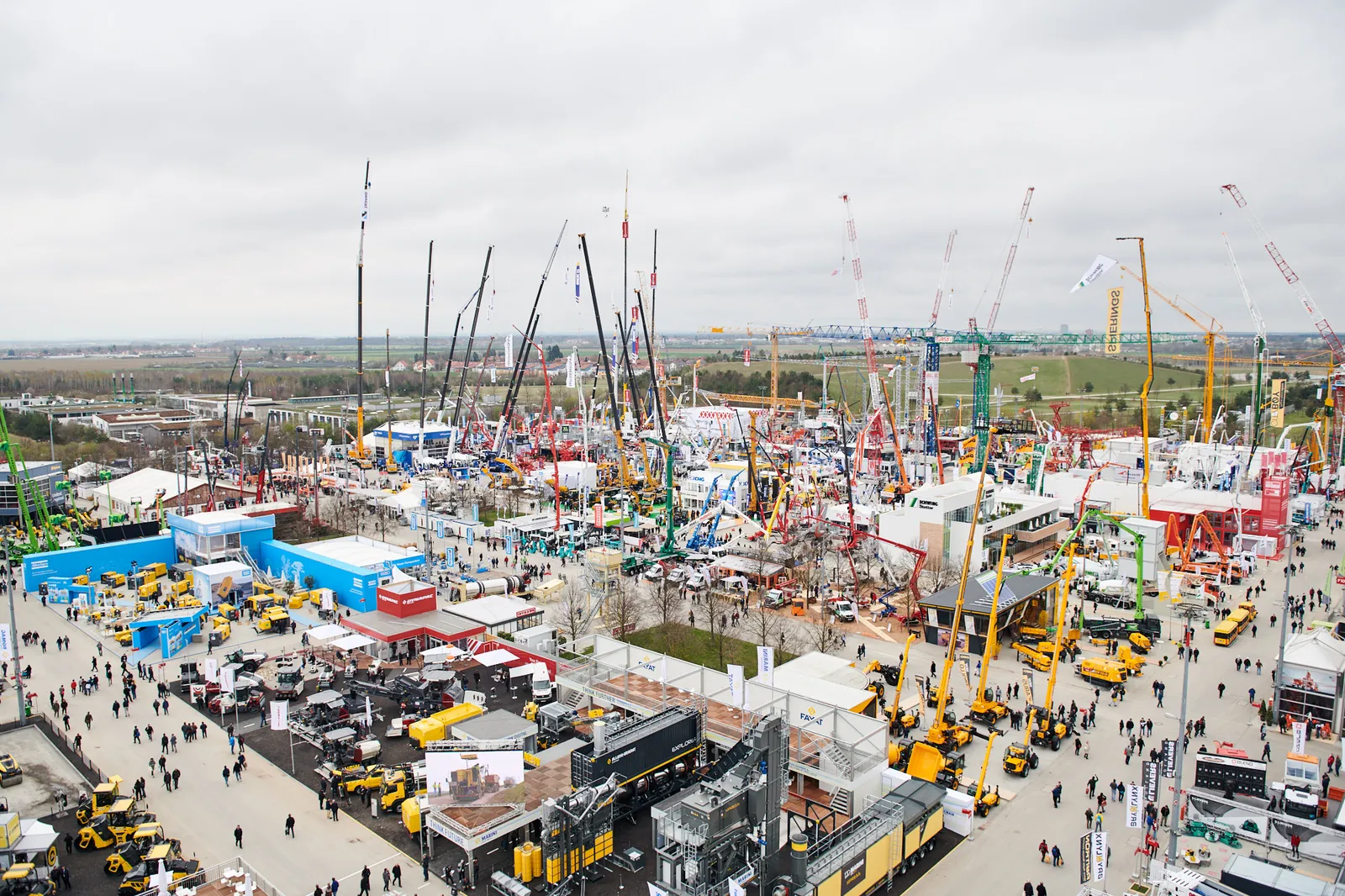
There's a particular moment that happens at bauma CHINA every two years, usually on the first morning. You're walking the outdoor exhibition lots at the Shanghai New International Expo Centre, and somewhere between the 50-tonne excavator on one side and a fully electric wheel loader demonstration on the other, it hits you: this is not a regional show. The 2024 edition pulled in exhibitors from 32 countries and visitors from 188 nations. That is a wider geographic spread than most shows anywhere in the world manage.
The 2026 edition runs November 24 to 27 at SNIEC in Pudong. Organisers — Messe München Shanghai, a subsidiary of the Munich-based group that runs the original bauma — had confirmed participants from 30 countries and regions before exhibitor recruitment had even formally concluded. The show covers over 300,000 square metres of combined indoor and outdoor space. It is, by any reasonable measure, Asia's largest and most consequential trade fair for construction and mining machinery.
bauma CHINA launched in 2002, at a moment when China's infrastructure ambitions were just beginning to accelerate. The timing was either very fortunate or very calculated — probably both. Over the two decades since, the Chinese construction machinery industry went from assembling foreign-licensed designs to genuinely competing with global OEMs on technology. SANY, XCMG, Zoomlion, and Shantui are now household names in construction sectors across Africa, Southeast Asia, and Latin America. bauma CHINA grew alongside that transformation, moving from a showcase of imported technology to a platform where Chinese manufacturers announce global product launches.
The Munich brand carried real weight in that process. The bauma name signalled professional seriousness — it told international exhibitors that the visitor quality would be worth the investment, and it told Chinese buyers that the event had genuine international standing. That mutual credibility is harder to build than floor space, and it explains why bauma CHINA held its position through multiple cycles of competing Chinese trade fair launches.
The show organises exhibitors across five broad zones. Ground-engaging and earthmoving machinery — excavators, graders, bulldozers, compact equipment — holds the largest share of floor. Building material machines covers cement production plant, concrete batching, asphalt technology, and prefabricated component systems. A dedicated mining machinery section displays extraction, crushing, screening, and underground equipment. Construction vehicles occupy a separate zone. Components and enabling technologies — hydraulics, drivetrain systems, telematics, control platforms, tyres, filtration — fill the fifth.
The 2024 edition signalled where the momentum is heading. New energy machinery — battery-electric excavators, hydrogen fuel cell concepts, hybrid concrete pumps, electric tower cranes — moved from novelty to mainstream. SANY, XCMG, LGMG, and DINGLI all brought production-specification electric models, not prototypes. For 2026, that category is expected to be larger still, driven by Chinese government incentive programmes that are actively pushing construction fleet electrification and by export market requirements in Europe and North America where emissions standards are tightening.
Category |
Details |
Event Name |
bauma CHINA 2026 (bauma Shanghai) |
Dates |
November 24–27, 2026 |
Venue |
Shanghai New International Expo Centre (SNIEC), Pudong, Shanghai |
Frequency |
Biennial; organised by Messe München Shanghai Co., Ltd. |
The 2026 show opens against a complicated global backdrop. Supply chain restructuring, tariff friction between China and major Western markets, and shifting investment patterns in Southeast Asia are all reshaping how Chinese OEMs approach international expansion. The old model — export finished machines directly — is giving way to local assembly, technology licensing, and regional manufacturing partnerships. bauma CHINA 2026 is where those conversations happen. International buyers attend to evaluate the latest Chinese product generations. Chinese manufacturers attend partly to recruit the international distribution and local partner relationships that their overseas strategies now depend on.
For hydraulic breaker and attachment suppliers, bauma CHINA presents a dual opportunity that no other single show replicates. On one side: Chinese OEMs are the world's most active buyers of attachments for bundled machine-and-tool packages targeting export markets. A relationship established at bauma CHINA can generate orders across Africa, Southeast Asia, and the Middle East within a single commercial year. On the other: the show is where Chinese hydraulic breaker manufacturers reveal their latest products — machines that are increasingly competing with European and Japanese brands on specification, not just price. Watching that competitive landscape directly, in Shanghai in November, beats reading the trade press summaries by about six months.

Welcome to HOVOO, a Chinese seal factory. Production of PU, Rubber and PTFE seals. The seals include O-ring, piston seal, rod seal, Gray ring and gas seal.


 EN
EN
 AR
AR CS
CS DA
DA NL
NL FI
FI FR
FR DE
DE EL
EL IT
IT JA
JA KO
KO NO
NO PL
PL PT
PT RO
RO RU
RU ES
ES SV
SV TL
TL IW
IW ID
ID LV
LV SR
SR SK
SK VI
VI HU
HU MT
MT TH
TH TR
TR FA
FA MS
MS GA
GA CY
CY IS
IS KA
KA UR
UR LA
LA TA
TA MY
MY
