

 EN
EN
 AR
AR CS
CS DA
DA NL
NL FI
FI FR
FR DE
DE EL
EL IT
IT JA
JA KO
KO NO
NO PL
PL PT
PT RO
RO RU
RU ES
ES SV
SV TL
TL IW
IW ID
ID LV
LV SR
SR SK
SK VI
VI HU
HU MT
MT TH
TH TR
TR FA
FA MS
MS GA
GA CY
CY IS
IS KA
KA UR
UR LA
LA TA
TA MY
MY
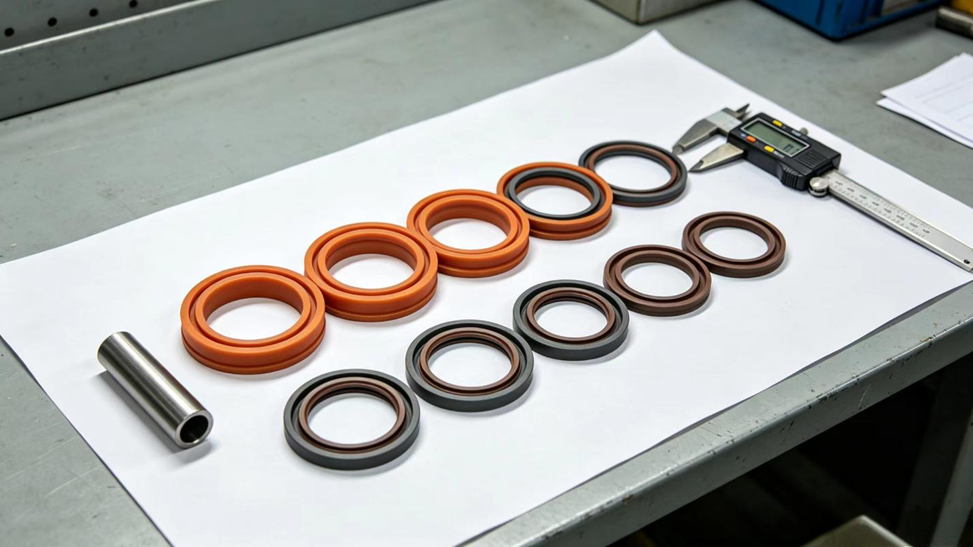
A backup ring is a small, hard ring that sits beside a seal and does one job: it keeps the seal from being pushed into the clearance gap when pressure rises. It is easy to overlook in a seal kit because it does not seal anything itself. But when it is missing, worn, or fitted on the wrong side, the seal it was protecting is usually the part that fails. This article explains what a backup ring does, why extrusion is such a risk in a rock drill, how to recognize a problem, and what to check before ordering a replacement. Numbers quoted below come from published engineering studies, which are listed at the end.
What Is a Backup Ring in a Rock Drill Seal Set?
A backup ring, also called an anti-extrusion ring, is a ring made of a harder material than the seal it supports. It is installed in the same groove as a seal, on the side away from the pressure, so that it fills the gap between the metal parts that the seal would otherwise be pushed into. In catalogs it may also appear as a back-up ring, backing ring, or support ring. The last name is sometimes used for other parts, such as guide or wear rings, so check the function of the part and not only the name.
On a rock drill, backup rings are used alongside O-rings and piston or rod seals in the percussion unit and in the hydraulic cylinders of the drill and rig. Whether and where a particular drill uses them depends on the model, so the parts diagram for your machine is the reference.
What Is Seal Extrusion, and How Does It Happen?
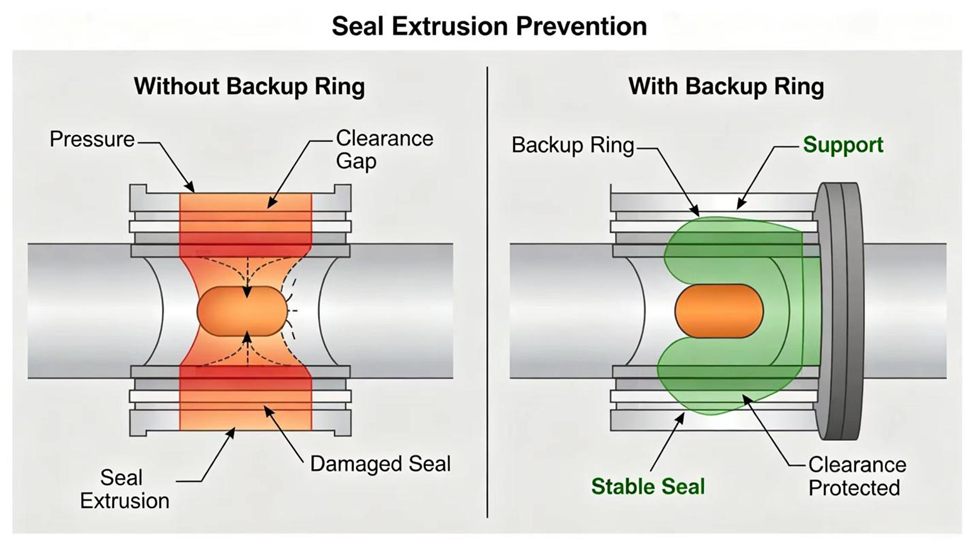
Every dynamic seal has to work across a small clearance between two metal parts, for example between a piston and its bore. When the fluid pressure is high, the seal material is pushed toward the low-pressure side. A soft material will flow into the clearance gap. This is extrusion. Once a part of the seal is in the gap, the moving surfaces pinch and tear it, and the damage that results is often described as nibbling: small pieces are removed from the edge of the seal on each pressure cycle.
Three factors make extrusion more likely: higher pressure, a larger clearance, and a softer seal material. Higher temperature also contributes, because most seal materials become softer as they warm. Finite-element studies put numbers on the first three. In one study of a rubber O-ring without a backup ring [1], a base case of an 80 × 3.55 mm O-ring of 75 IRHD hardness at 16 MPa, with a 0.2 mm gap and 20% initial compression, was extruded into the gap by 0.166 mm. Changing one factor at a time gave the following results:
- Hardness from 65 to 85 IRHD: the extruded length fell from 0.291 mm to 0.086 mm.
- Pressure from 8 to 24 MPa: it rose, almost in a straight line, from 0.048 mm to 0.271 mm.
- Gap from 0.10 to 0.30 mm: it rose from 0.102 mm to 0.258 mm.
- Cross-section diameter from 1.8 to 7 mm: it fell from 0.220 mm to 0.126 mm.
- Initial compression from 12% to 28%: it hardly changed, between 0.166 and 0.168 mm.
Fitting all the simulation results together, the authors obtained an empirical relation for the extruded length L [1]:
L = 0.709 − 0.0115 Hr + 0.0159 p + 1.00 t − 0.057 d + 0.0055 d2 (1)
Here L is in mm, Hr is the hardness in IRHD, p is the pressure in MPa, t is the groove gap in mm, and d is the O-ring cross-section diameter in mm. The fit has a correlation coefficient R² of 0.9786, and a negative L means that no extrusion occurs. Read as sensitivities, each additional MPa adds about 0.016 mm of extrusion, each additional 0.1 mm of gap adds about 0.1 mm, and each additional hardness point removes about 0.012 mm. The gap is by far the strongest lever. The relation comes from simulations of an O-ring in the range of 65 to 85 IRHD, 8 to 24 MPa, and 0.1 to 0.3 mm gap, so it shows the trend and is not a design rule for a rock drill seal.
How Does a Backup Ring Stop Extrusion?
Supplier guidance on seal design lists three ways to deal with extrusion. The first is to reduce the clearance, which usually means tighter manufacturing tolerances and higher cost. The second is to use a harder seal material, which is often limited by what is available and may seal less well at low pressure. The third is to add a backup ring, which is commonly presented as the most practical option.
A backup ring works because it is harder than the seal and so resists being pushed into the gap. It fills the space between the seal and the clearance, which reduces the effective gap that the softer seal can reach. The seal itself stays soft and flexible enough to seal at low pressure, and the ring takes over the job of resisting the pressure at the edge.
The simulation results above show why each of the three options works. The gap term in the relation has a coefficient of 1.00 mm of extrusion per mm of gap, while hardness has a coefficient of only 0.0115 mm per point, so closing the gap by 0.1 mm does as much as raising the rubber hardness by about nine points. A backup ring effectively closes the gap, because the soft seal now has to flow into a space bounded by a much stiffer ring. The stiffness of rubber itself rises only moderately with hardness. For the same group of compounds, the elastic modulus E in MPa follows the hardness Hr in IRHD as [1]:
lg E = 0.0198 Hr − 0.5432 (2)
This gives about 5.5 MPa at 65 IRHD, 7.0 MPa at 70, 8.7 MPa at 75, 11.0 MPa at 80, and 13.8 MPa at 85 IRHD. Engineering plastics used for backup rings are stiffer than any of these rubber compounds by a large factor, which is why a thin ring can do what a much harder rubber cannot.
Why Do Pressure Pulses Make Extrusion Risk Higher in a Rock Drill?
In a percussion unit the pressure is not steady. It rises and falls with each blow, and sharp peaks can occur when the piston reverses. Each peak briefly pushes the seal toward the clearance gap with more force than the average working pressure suggests. A seal that would be safe at the average pressure can be damaged by repeated peaks, because every peak adds a little more material to the gap and every cycle damages it a little further.
Studies of working drills show how large the peaks are. In a model of a drill supplied at 15 MPa, chamber pressure peaked at about 25 MPa, roughly 1.7 times the supply pressure, when the piston struck and when the control spool reversed [2]. In a prototype supplied at 18 MPa, the pressure in the primary buffer chamber carried short peaks of the order of 40 MPa on top of a working level of 18 to 20 MPa [3]. A ring chosen for the average pressure would be undersized for these peaks.
Rubber responds to such pulses with a delay. A transient simulation of an O-ring under fast pressure switching [4] describes the rubber with a hyperelastic strain-energy function and a viscoelastic relaxation law:
W = C10 (I1 − 3) + (J − 1)2 / D1 (3)
g(t) = 1 − Σ gi ( 1 − e−t/τi ) (4)
In the first expression W is the strain energy density, I₁ the first strain invariant, J the volume ratio, and C₁₀ and D₁ are material constants. In the second, g(t) is the relaxation modulus as a fraction of its initial value, and the gi and τi are the Prony coefficients and relaxation times. The simulation found that, at high pressure, the stress concentrated at the contact with the cylinder wall on the low-pressure side, where the ring was extruded and torn at its root. During fast pressure rises, the interface slipped and a secondary contact-pressure peak formed on the low-pressure side, and both effects grew as the pressure amplitude and the rate of change increased. Stress also kept changing after the pressure had stopped changing, because of viscoelastic lag [4].
Frequency adds to this. At a percussion rate of 95 blows per second [5], a seal and its backup ring go through roughly 340,000 pressure cycles in one hour of drilling.
This is also why extrusion problems should not be looked at in isolation from the rest of the circuit. A weak accumulator charge or a restricted return line raises the pressure peaks, and a backup ring cannot fully compensate for a circuit that is producing abnormal peaks.
Where Is a Backup Ring Fitted, and Which Side Does It Go On?
The general rule in published guidance is that the backup ring is installed on the low-pressure side of the primary seal, which is the side toward the clearance gap that the seal would be pushed into. If the pressure acts in one direction only, one ring is enough. If the pressure acts in both directions, as it does on a double-acting piston, a ring is needed on each side. One supplier's guide recommends two rings if the pressure direction is uncertain.
Adding a ring needs space. The groove must be wide enough to hold the seal and the ring or rings, so a backup ring cannot normally be added to a groove that was designed without one. The correct number and position of rings for your drill is model-specific, and the seal kit and the parts diagram should be followed.
The clearance that a ring has to bridge is limited by pressure. A published rock drill Step seal source [6] lists a maximum diametral clearance that becomes tighter as pressure rises. For rod diameters of 30 to 36 mm it is 0.6 to 0.3 mm up to 20 MPa and 0.3 to 0.2 mm from 20 to 40 MPa, and for 38 to 50 mm it is 0.8 to 0.4 mm and 0.4 to 0.2 mm. In that design the stepped PTFE ring is itself a rigid element and the O-ring behind it never touches the moving surface. These are example values for one seal type, and the limit for your drill is the manufacturer's.
What Are the Main Types of Backup Ring?
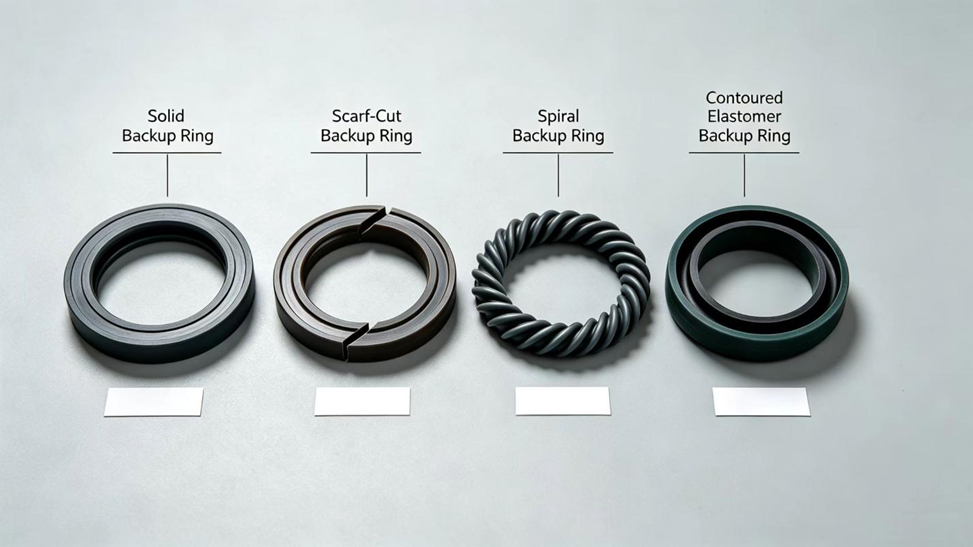
Backup rings are made in several forms, and the form affects how easily they can be installed:
- Solid (uncut) rings: a continuous ring with no gap, which gives full support but must be stretched or compressed to fit and is easiest in larger grooves.
- Scarf-cut or split rings: cut at an angle along the circumference, so they can be fitted without stretching and are widely used where the ring must be installed over a flange or into a closed groove.
- Spiral rings: a continuous strip wound into a helix, which can be installed in small diameters and in closed grooves.
- Contoured elastomer rings: molded rubber rings, commonly in high-hardness nitrile or fluoroelastomer, shaped to fit the O-ring and normally used where pressure is lower.
How Can You Tell That a Seal or Backup Ring Has Extruded?
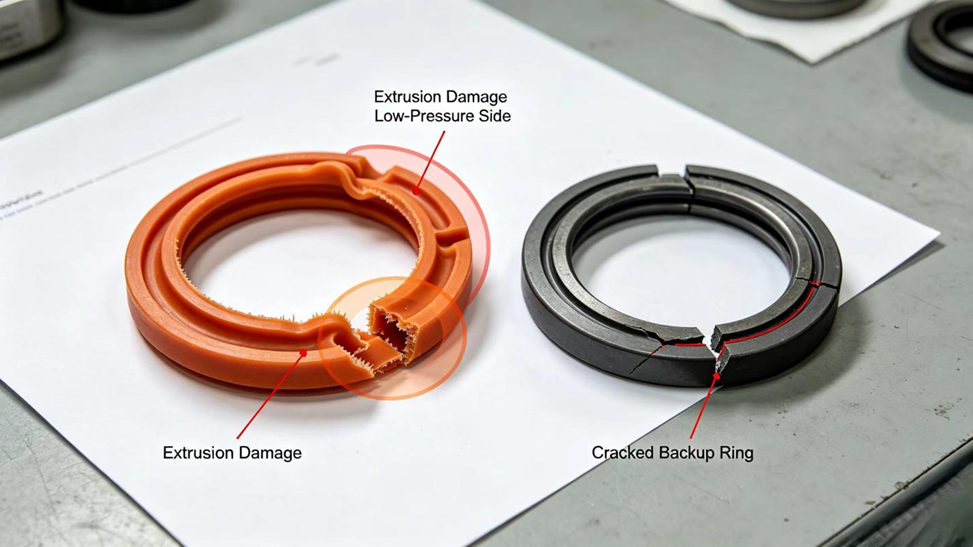
Extrusion damage is often visible when the seal is removed. The observations below point toward extrusion, but they should be confirmed against the other possible causes.
Observation |
What It May Indicate |
Next Check |
Small chips or a ragged edge on the low-pressure side of the seal |
Seal material pushed into the clearance gap |
Check whether a backup ring was fitted and where |
Backup ring cracked, chipped, or worn through |
Pressure peaks or clearance beyond what the ring can support |
Check clearance and circuit pressure peaks |
Seal and ring show wear on the high-pressure side |
Ring fitted on the wrong side, or one ring where two are needed |
Compare against the parts diagram for the pressure direction |
New seal fails again in a short time |
Extrusion cause not removed, such as a worn bore or missing ring |
Inspect bore and piston, and the full seal set |
Flattened or deformed ring |
Overload, high temperature, or wrong material |
Check oil temperature and ring material |
A seal that has been extruded often has the backup ring as the missing or damaged component, so the ring should be inspected whenever the seal is replaced.
What Causes a Backup Ring to Fail Early?
A backup ring can be the cause or the victim of a failure. The conditions below are known to shorten its life:
- Pressure peaks above what the ring's material and design are rated to support.
- A clearance gap that has grown through wear of the bore, the piston, or a guide bush, which asks more of the ring than it was designed to take.
- A ring material that is not suited to the oil temperature, so that it softens or hardens over time.
- Installation damage, such as a ring that was nicked, twisted, or pinched in the groove.
- Fitting the ring on the wrong side of the seal, or leaving it out when the seal kit was reassembled.
Installation deserves particular attention. A rock drill fault analysis [7] attributes seal failures largely to poor seal quality, damage during fitting, and unsatisfactory groove machining, and advises that seals and bushings are fitted with special tools. A failure analysis of a 65Mn spring-steel sealing retaining ring [8] shows how an assembly step alone can break a ring. That ring is a metal retainer in a piston assembly and not a polymer anti-extrusion ring, but the lesson applies. Circlip pliers without a stop squeezed the ring to an outer diameter of 10.0 to 10.5 mm, beyond its elastic limit, whereas a hand-tight pinch corresponded to about 10.31 to 10.35 mm. The fracture also began at a brittle recast layer left by wire cutting, and a tempering temperature near 360 °C had left the steel in a hard but brittle condition. The remedy was to change the process order, raise the tempering temperature, and use a dedicated assembly fixture.
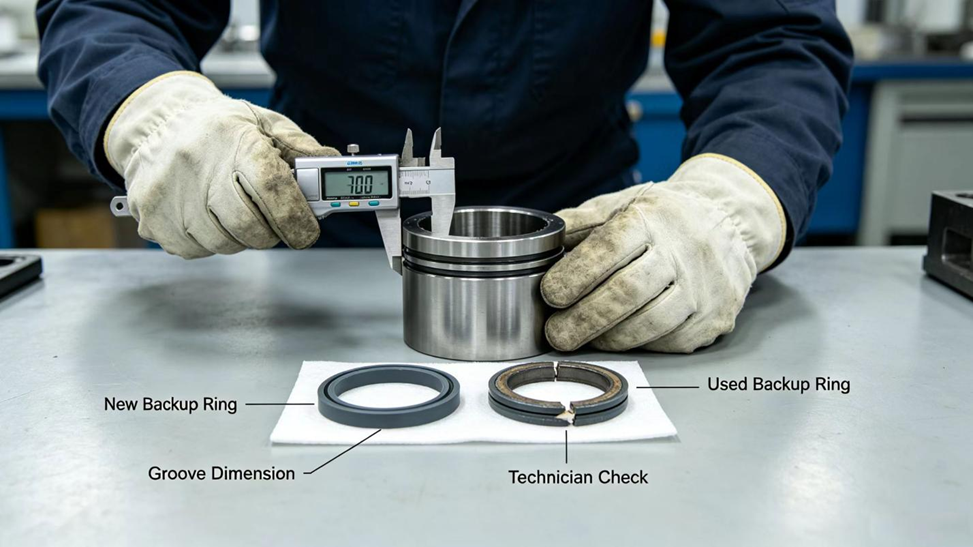
What Should You Check Before Replacing a Backup Ring, and How Do You Choose the Right One?
Before ordering, check these points in order:
- Identify the drill model and the exact position of the seal and ring on the parts diagram, and note how many rings are fitted and on which sides.
- Inspect the old ring and seal for the damage patterns in the table above, and keep them for comparison.
- Check the groove, the bore, and the piston for wear that has increased the clearance, and compare the measured clearance with the manufacturer's limit for the working pressure.
- Check the pressure side of the circuit, including accumulator pre-charge, because high peaks defeat even a correct ring.
- Follow the manufacturer's procedure for opening the unit; this is model-specific and the circuit must be depressurized first.
When choosing the replacement, three points matter:
- Dimensions and profile: the ring must fit the groove and the gap exactly. A ring that is slightly thin leaves the gap open.
- Material: the ring must be hard enough for the pressure and suitable for the oil temperature. The materials are compared in the companion article on backup ring materials.
- Set completeness: the ring should be matched to the seal it supports, so replace the seal and ring as a set unless the seal is confirmed to be undamaged.
Where Can You Source a Reliable Replacement Backup Ring?
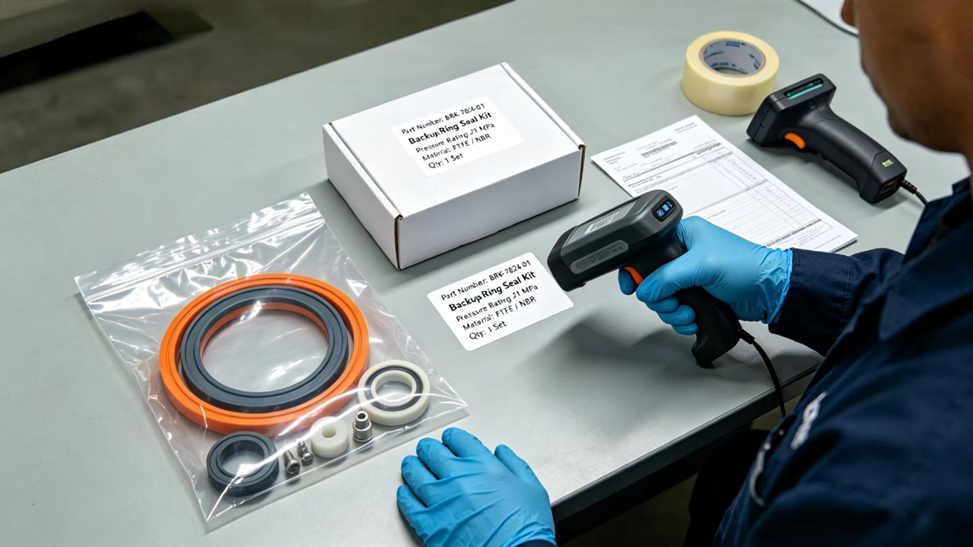
Backup rings are small and look simple, but the correct one depends on the groove, the gap, the pressure, and the material. Matching normally starts from the OEM part number, a drawing, or the worn part, not from a general description.
Nanjing Hovoo Machinery Technology Co., Ltd, a Chinese sealing manufacturer founded in 2013, produces PU, rubber, and PTFE sealing components, including piston seals, rod seals, and seal kits, and has a product range for hydraulic rock drills. The company states that it offers free technical support. If you need to confirm the right ring for a seal set, you can send the rock drill model, the OEM part number, the groove and ring dimensions or a drawing, photographs of the old ring and seal, and the working pressure and oil temperature, and ask the supplier to review the ring type and material before an order is placed.
Selected technical references consulted for this article:
- Lu Yunjiang, Huang Le, Dai Changhao. Extrusion resistance analysis of O-ring based on Marc. Chinese Hydraulics & Pneumatics, 2020, (3): 84–89. (In Chinese)
- Wang Jiansen, Yan Hongliang, Zhang Xin, Wang Yanjun, Liu Bin, Wei Liejiang. Optimal clearance design between impact piston and cylinder of a dual-chamber-controlled hydraulic rock drill. Chinese Hydraulics & Pneumatics, 2025, 49(4): 79–91. (In Chinese)
- Wang Jiansen, Yang Guangsheng, Liu Shaojun, Feng Huai, Wen Yongqiang. Analysis of the overpressure phenomenon in the primary buffer chamber of a dual-chamber-controlled hydraulic rock drill. Chinese Hydraulics & Pneumatics, 2026, 50(7): 57–67. (In Chinese)
- Yuan Xiaoming, Zheng Ze, Chen Haimin, Li Yongqi, Wang Weiwei, He Shixing. Simulation study on an O-type static sealing ring under pulse pressure. Hydraulics Pneumatics & Seals, 2026, online first. (In Chinese)
- Yang Mingming. Experimental study on the impact performance of a hydraulic rock drill. Equipment Management and Maintenance, 2025, (10). (In Chinese)
- Li Chuan, Yan Tianjun, Li Tiehui. Impact piston sealing and the Step seal of hydraulic rock drills. Rock Drilling Machinery & Pneumatic Tools, 2003, (3): 8–12. (In Chinese)
- Liu Jiankui, Fu Yuehua, Zhou Shijie. Analysis and countermeasures for common faults of hydraulic rock drills. Rock Drilling Machinery & Pneumatic Tools, 2020, (4): 59–61. (In Chinese)
- Han Honggang, Ma Mingming, Yu Kexuan, Xu Huanrui. Fracture causes and control measures of 65Mn spring steel sealing retaining rings. Heat Treatment Technology and Equipment, 2026, 47(3): 74–77. (In Chinese)
Table of Contents
- What Is a Backup Ring in a Rock Drill Seal Set?
- What Is Seal Extrusion, and How Does It Happen?
- How Does a Backup Ring Stop Extrusion?
- Why Do Pressure Pulses Make Extrusion Risk Higher in a Rock Drill?
- Where Is a Backup Ring Fitted, and Which Side Does It Go On?
- What Are the Main Types of Backup Ring?
- How Can You Tell That a Seal or Backup Ring Has Extruded?
- What Causes a Backup Ring to Fail Early?
- What Should You Check Before Replacing a Backup Ring, and How Do You Choose the Right One?
- Where Can You Source a Reliable Replacement Backup Ring?


