

 EN
 AR
 CS
 DA
 NL
 FI
 FR
 DE
 EL
 IT
 JA
 KO
 NO
 PL
 PT
 RO
 RU
 ES
 SV
 TL
 IW
 ID
 LV
 SR
 SK
 VI
 HU
 MT
 TH
 TR
 FA
 MS
 GA
 CY
 IS
 KA
 UR
 LA
 TA
 MY

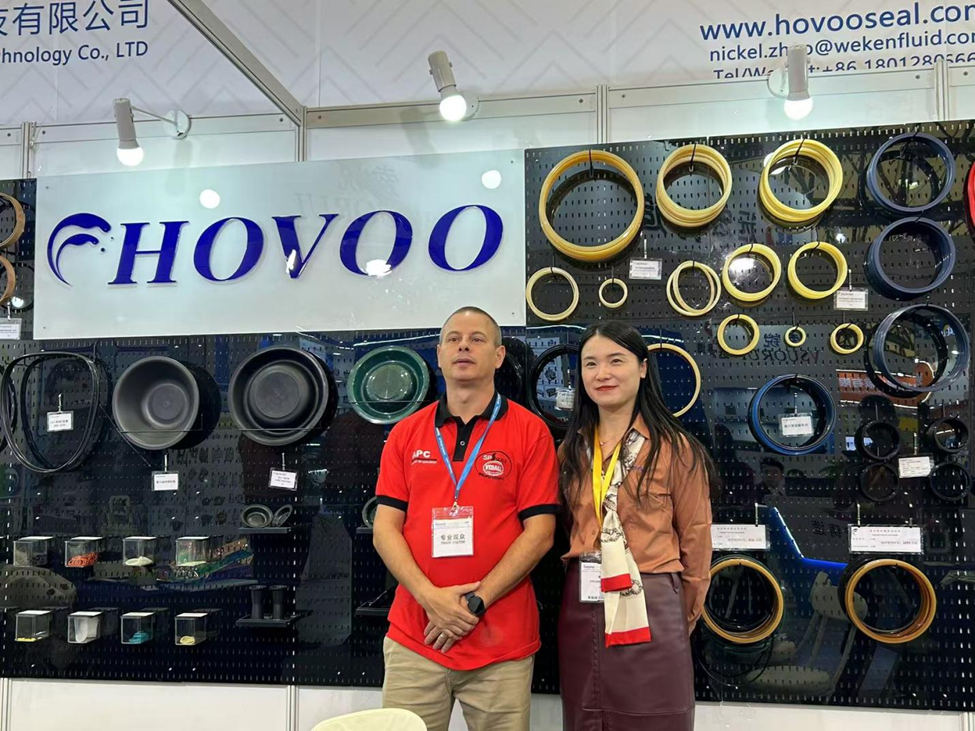
Bauma China 2026 opens at the Shanghai New International Exhibition Centre (SNIEC) from 24 to 27 November. The show serves as Asia's primary gathering for the construction, mining, and industrial machinery supply chain, where hydraulic component manufacturers, seal producers, and equipment distributors meet procurement and maintenance teams from around the world. For engineers responsible for hydraulic pump and motor maintenance, the event provides direct access to seal suppliers and an opportunity to evaluate technical claims against physical samples and quality documentation.
Seals in hydraulic pumps and motors are not interchangeable with standard cylinder seals. The combination of rotary shaft motion, high case pressure, and finely machined running surfaces creates a set of sealing demands that requires specific profiles, materials, and dimensional precision. Understanding these requirements before arriving at Bauma China allows more targeted supplier evaluation and better purchasing decisions.
Why Are Seals Critical to Hydraulic Pump and Motor Performance?
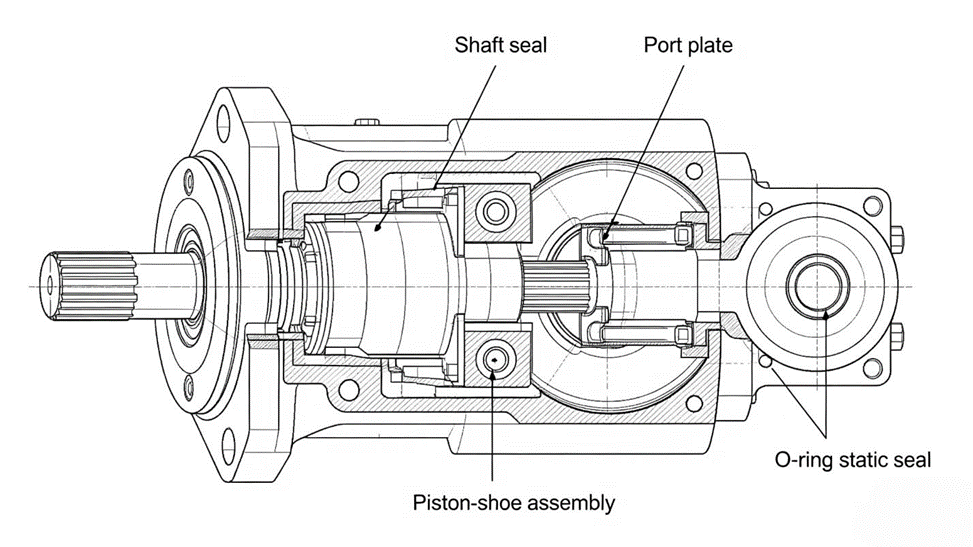
A hydraulic pump converts mechanical input energy into fluid flow. A hydraulic motor performs the reverse conversion. In both cases, the pump or motor contains pressurized hydraulic oil separated from the external environment by a set of seals at the shaft, the port connections, and the housing joints. Any leakage path through these seals diverts oil that should be doing work — reducing efficiency, contaminating the external machine surfaces, and creating a maintenance burden.
The shaft seal is the most performance-critical seal in a pump or motor. It must prevent oil from leaking along the rotating shaft where it exits the housing, while introducing as little friction and heat as possible to avoid reducing input efficiency. At the same time, it must maintain this sealing function across a range of shaft speeds, operating pressures, and temperatures throughout the service life of the unit.
Static seals at port connections and housing splits maintain pressure containment at stationary interfaces. Their failure mode is generally more gradual — progressive compression set or chemical degradation leads to slow leakage rather than sudden failure — but they contribute to overall case pressure and efficiency just as the dynamic seals do. A pump or motor that leaks at multiple static seals may be losing enough oil volume to affect system response even if no single leak is individually significant.
What Types of Seals Are Found in Hydraulic Pumps and Motors?
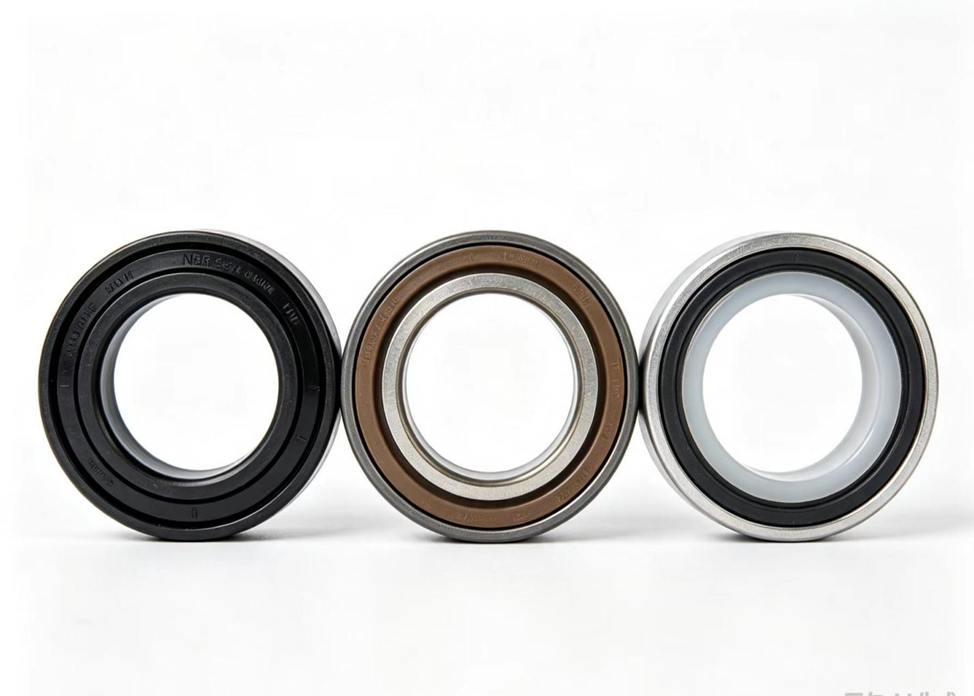
The shaft seal or rotary shaft lip seal is the primary dynamic seal in a hydraulic pump or motor. It consists of a lip, typically of NBR or FKM compound, spring-loaded against the rotating shaft to maintain contact force as the lip wears. The lip is designed to allow a minimal oil film between the lip and the shaft to provide lubrication and prevent dry contact, while preventing bulk oil flow past the seal.
Some pump and motor designs use mechanical face seals or radial lip seals with a PTFE running face to achieve longer service life or to handle higher shaft speeds. PTFE lip seals operate with lower friction than elastomeric lip seals, reducing heat generation at high speed, but require a very smooth and hard shaft surface to function correctly.
- rings and bonded seals at port connections and housing flanges provide static sealing. Piston shoe seals and slipper pad retainer seals are used inside axial piston units to retain the piston-to-swashplate contact film. Barrel seal plates in gear pump designs are lapped flat surfaces that provide both sealing and bearing function simultaneously — these are precision machined components rather than elastomeric seals, but they are part of the sealing system and are replaced at major overhaul.
What Materials Are Specified for Pump and Motor Shaft Seals?
Material selection for hydraulic pump and motor shaft seals is determined by the hydraulic fluid type, the operating temperature range, and the shaft speed. NBR (nitrile rubber) is the standard material for mineral-oil circuits operating at normal industrial temperatures. NBR shaft seals in standard acrylic-bonded metal housings are the most widely stocked option and are compatible with most mineral-based and zinc-free hydraulic oils.
FKM (fluoroelastomer, commonly known as Viton) is specified for applications with synthetic fluids, phosphate-ester fire-resistant fluids, biodegradable ester-based oils, or for operating temperatures above the NBR service range. FKM has broader chemical resistance than NBR, but it is stiffer at low temperature and must be verified for compatibility with the specific fluid before use. An FKM shaft seal installed in a system running a standard mineral oil is likely to perform correctly, but the reverse — an NBR seal in a system running a fluid outside the NBR compatibility range — will fail chemically.
PTFE-lipped shaft seals are used in applications where shaft speed is high enough that elastomeric lip seals would generate excessive heat or where the lip wear rate must be minimized. The PTFE face requires a smooth, hard shaft surface — surface roughness must be within tight limits for the thin PTFE lip to function correctly. At Bauma China, ask shaft seal suppliers for the rated shaft speed limit and shaft surface requirement for each seal type they offer.
How Does Shaft Speed and Pressure Affect Shaft Seal Selection?
The shaft seal in a hydraulic pump or motor operates at the shaft surface speed, which is the product of shaft diameter and rotational speed. As shaft surface speed increases, the hydrodynamic oil film under the seal lip becomes thinner and generates more heat through viscous shear. Above a threshold speed that depends on the seal material and design, the lip generates sufficient heat to accelerate compound degradation and reduce contact force, which leads to early leakage.
Case pressure also affects shaft seal performance. In a pump, the case is normally near tank pressure, and the shaft seal sees a modest differential pressure. In a motor under high back-pressure conditions, or in a pump where internal leakage has raised case pressure above the back-pressure line capacity, the shaft seal must contain a higher differential, which increases contact force, friction, and heat generation. A shaft seal that performs reliably at normal case pressure may leak when case pressure is elevated by a blocked case drain or an undersized return line.
A published failure analysis makes this concrete. A load-sensing axial piston pump (displacement 45 mL/r, 1,500 r/min) leaked at the shaft seal during a −40 °C test, but not at normal or high temperature, and stopped leaking about 6 hours after returning to room temperature [1]. The investigators built a fault tree and eliminated the obvious causes one by one: the HNBR seal (rated −55 to 130 °C) showed no scratches or cracks, the shaft met drawing requirements, and the pump's volumetric efficiency was about 96% at 210 bar, so internal wear was not raising case flow [1]. The remaining cause was the case-drain line: a 12 mm bore pipe and hose leading to a 7 mm bore tube inside the tank, which created a flow restriction. The pump's manual limits case drain pressure to 0.5 bar [1].
For a long, thin line (length more than four times the diameter) the laminar pressure drop follows the Hagen–Poiseuille relation [1]:
Δp = 128 μ l Q / (π d4) (1)
where Q is the flow, μ the dynamic viscosity (kinematic viscosity times density), l the line length, and d the bore. Two features matter. Pressure drop is proportional to viscosity, and it falls with the fourth power of diameter [1]. At −40 °C the case flow of 2.5 L/min met oil with a kinematic viscosity of 451 mm²/s (compared with about 100 mm²/s at −20 °C), and the authors calculated a drain pressure of 1.92 bar, nearly four times the 0.5 bar limit; at −20 °C the same line gave 0.43 bar, within the limit [1]. A bench test at −40 °C then found that the seal began to leak at roughly 0.7 bar and stopped at roughly 0.6 bar on the way down, so this seal tolerated about 0.6 bar [1]. The fix was to enlarge the drain line to a 16 mm bore throughout, which gave a calculated 0.23 bar and a measured drain pressure of 0.21 bar or less, with no leakage [1]. Because the diameter enters as d⁴, the step from 7 mm to 16 mm cuts the diameter-dependent term by a factor of about 27, which is far more effective than any change of seal material. The lesson for maintenance teams is that a pump shaft seal that leaks only in cold weather is a prompt to check the case-drain line, not to replace the seal.
Temperature affects both seal compound elasticity and the viscosity of the oil film under the lip. At low temperature, NBR becomes stiffer and may allow the lip to lose contact on the down side of the shaft during rotation. At high temperature, the compound softens, which can cause the lip to deform and lose its designed contact geometry. Specifying a seal that is rated for the full operating temperature range of the application — including cold start and peak duty temperature — is important for achieving the expected service life.
Rotary seals in motors also carry a friction cost that reduces output. A 2026 study of rotary seals in a low-speed, high-torque water-based hydraulic motor (seal outer diameter 275 mm, up to 21 MPa, 10 r/min) used a PTFE-bronze retainer ring energized by a nitrile O-ring [2]. The friction torque follows from integrating the contact stress f(x) over the seal width a [2]:
Tf = π μf (dm2 / 2) ∫0a f(x) dx (2)
where μf is the friction coefficient and dm the seal outer diameter [2]. The paper's finite element results show that grooves in the ring raise peak contact stress (about 36.9 MPa for a plain ring against 45.8 MPa to 53.8 MPa for grooved designs at 21 MPa), that a larger extrusion gap lowers friction torque, and that torque rises with pressure; measured friction torque at 21 MPa reached 1,371.3 N·m for the selected design, against 1,199.2 N·m predicted [2]. In the motors they tested, measured torque was higher than simulated, and the authors conclude that the simulation captures the trend rather than the absolute value. The dimensions are specific to a very large, slow water-hydraulic motor, so they are not representative of a typical mineral-oil pump seal. They do show why seal friction, not only leakage, belongs in a motor sealing evaluation.
For static seals, such as O-rings in end caps and pressure housings, the contact pressure on the sealing face is the sum of the initial squeeze pressure and the fluid pressure transmitted through the rubber, pm = p0 + pH [3]. A finite element study of an O-ring in an underwater pressure housing confirmed the sealing criterion that the maximum contact stress must exceed the external pressure [3].
What Failure Modes Are Specific to Pump and Motor Seals?
Shaft seal leakage is the most common field complaint. The external appearance is oil at the shaft exit point of the pump or motor housing. The root cause may be lip wear from abrasive contamination or extended service, chemical degradation from an incompatible fluid, thermal hardening from excessive case temperature or shaft speed, or installation damage during replacement.
Lip inversion occurs when the shaft seal lip folds outward during assembly, typically because it was installed dry or forced over a sharp shaft feature without a proper installation tool. An inverted lip seals initially but fails quickly as the inverted geometry concentrates stress and allows oil past the contact band. This failure mode is avoidable with correct installation technique and the use of installation guides.
O-ring extrusion at high-pressure port connections occurs when the O-ring is specified for an incorrect groove depth or is used without a backup ring in a groove where the gap between mating surfaces exceeds the O-ring tolerance. The extruded material forms a fin that may initially seal but will be progressively trimmed by the mating surfaces, leading to leakage. Backup rings specified for the port connection groove geometry eliminate this failure mode.
Case drain seal failure in a hydraulic motor can be catastrophic. If the seal that separates the case drain from the shaft or a port fails internally, high pressure can enter the case and exceed the case rating, potentially destroying the motor shaft seal and pressurizing the drain line. Regular drain line pressure monitoring is a practical diagnostic for early detection of internal seal deterioration.
Shaft seal leakage can have a cause outside the seal altogether. The case-drain restriction described above is one; another is wear inside the pump that raises case flow beyond what the drain line can carry [1]. Before replacing a shaft seal that leaks repeatedly, measure the case-drain pressure at operating temperature and compare it with the pump manual's limit.
How Should Buyers Evaluate Pump and Motor Seal Suppliers at Bauma China?
The table below outlines the evaluation criteria and the evidence to request when comparing seal suppliers at the show.
Evaluation criterion |
Verification question |
Expected supplier evidence |
Shaft seal range |
What shaft diameter and housing bore combinations are stocked, and in which materials? |
Stock catalog with dimensions and material designations |
Speed and pressure ratings |
What is the maximum rated shaft surface speed and case pressure for each seal design? |
Technical datasheet with speed limit table; not just a general statement |
Fluid compatibility |
Which fluids has each compound been tested against? |
Immersion test data or compatibility table with fluid types |
Dimensional interchangeability |
Can you cross-reference to major pump and motor OEM housing dimensions? |
OEM cross-reference list or part number mapping service |
Quality and certification |
What material certification and dimensional inspection records accompany product? |
ISO 9001 certificate; material certificates; inspection reports on request |
Stock depth |
How many units of common shaft seal sizes are held in finished goods stock? |
Stock quantity confirmation; lead time for non-stocked items |
What Installation Practices Extend Pump and Motor Seal Life?
Shaft seal service life is significantly affected by installation quality. The lip seal must be installed squarely in its bore, seated to the correct depth, and lubricated before the shaft is inserted. Dry installation generates high friction on the initial rotation and can score the shaft surface before the oil film is established.
The shaft surface at the seal contact zone must be free from burrs, scores, spiral machining marks, and corrosion. A shaft with a spiral machining finish will act as a small pump and move oil in one direction along the lip contact path — the direction depends on the helix angle and rotation direction. Polished shaft surfaces perpendicular to the rotational direction give the best results. If the shaft has a worn groove from the previous seal, either replace the shaft or reposition the new seal on a fresh contact zone if the housing geometry allows.
For pumps and motors being returned to service after extended storage, verify that the shaft seal has not hardened or taken a set during storage. A seal that has been stored for an extended period in a position where the lip is permanently compressed may not spring back to its designed contact geometry. Replace seals that have been in storage beyond the recommended shelf life rather than returning them to service on high-value pump units.
What Hydraulic Fluid Compatibility Issues Arise at Bauma China 2026?
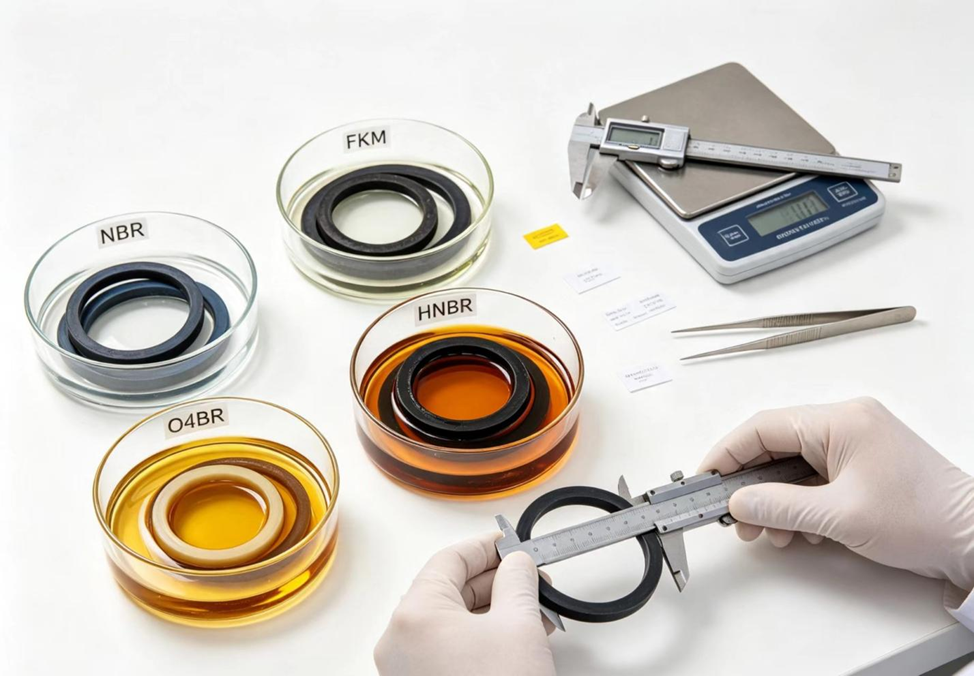
The construction equipment market is seeing wider adoption of biodegradable hydraulic fluids, particularly HEES (synthetic ester) fluids specified on equipment operating near water sources, in forestry, or under environmental permits. Standard NBR shaft seals and O-rings may not be fully compatible with ester-based fluids; HNBR or FKM compounds are required for reliable service.
Water-glycol fire-resistant fluids, used on equipment operating near furnaces or in underground mining where fire suppression is critical, require FKM or EPDM seals for all fluid-contact positions. Standard NBR will swell and lose mechanical properties in water-glycol fluids. If your fleet includes equipment transitioned to fire-resistant fluid, verify that the replacement seal kits used in maintenance are specified for the current fluid type.
Mixing hydraulic fluids — using a mineral oil additive or topping up with a different fluid grade — can also affect seal performance when the resulting blend is outside the compatibility range for the installed seal material. At Bauma China, suppliers who can provide compound-level immersion test data across the range of fluids encountered in the field are better positioned to support maintenance decisions than those who provide only generic compatibility statements.
What Should Procurement Teams Know About Hydraulic Motor Seal Kits?
Hydraulic motor overhaul kits typically include all dynamic and static seals required for one major service: the shaft seal, internal O-rings, backup rings at high-pressure ports, and where applicable, barrel seal plates or port plate seals. For gear motors, the kit covers gear housing O-rings and the shaft seal. For piston motors, the kit covers shaft seal, end cover O-rings, servo control seals, and internal dynamic seals.
When sourcing motor seal kits, provide the motor manufacturer, model designation, and hydraulic fluid type. If the motor has been modified or repaired with components from a different supplier, verify that the housing dimensions for each seal position match the original before ordering replacement kits. Non-standard modifications can result in groove dimensions that do not match the standard kit profiles.
For high-usage motors in continuous-production environments, holding a minimum stock level of seal kits for each motor model provides insurance against unplanned downtime. At Bauma China, confirm stock depth and emergency delivery capability with suppliers before adding them to an approved vendor list.
How Can Hovoo Seal Support Hydraulic Pump and Motor Sealing at Bauma China 2026?
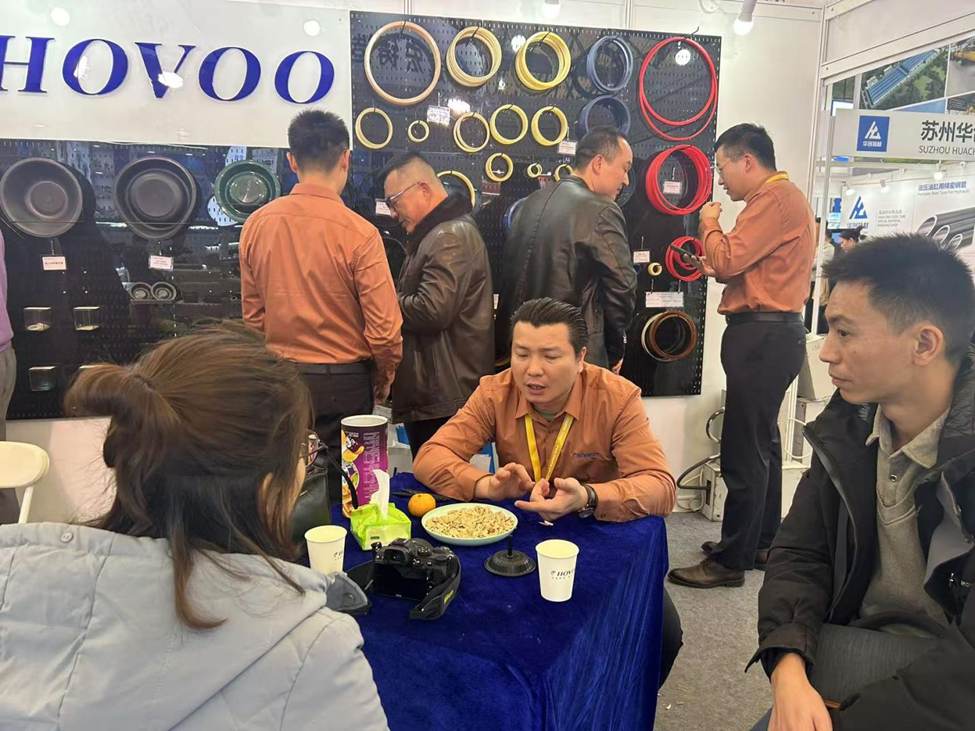
Hovoo Seal (Nanjing Hovoo Machinery Technology Co., Ltd) supplies shaft seals, O-rings, backup rings, and seal kits for hydraulic pumps and motors across the construction, mining, and industrial machinery sectors. The shaft seal range covers standard and non-standard housing dimensions in NBR, FKM, and PTFE-faced designs. Technical support includes cross-referencing by pump or motor model and OEM part number, compound selection for non-standard hydraulic fluids, and review of shaft surface condition requirements for PTFE-faced seal applications.
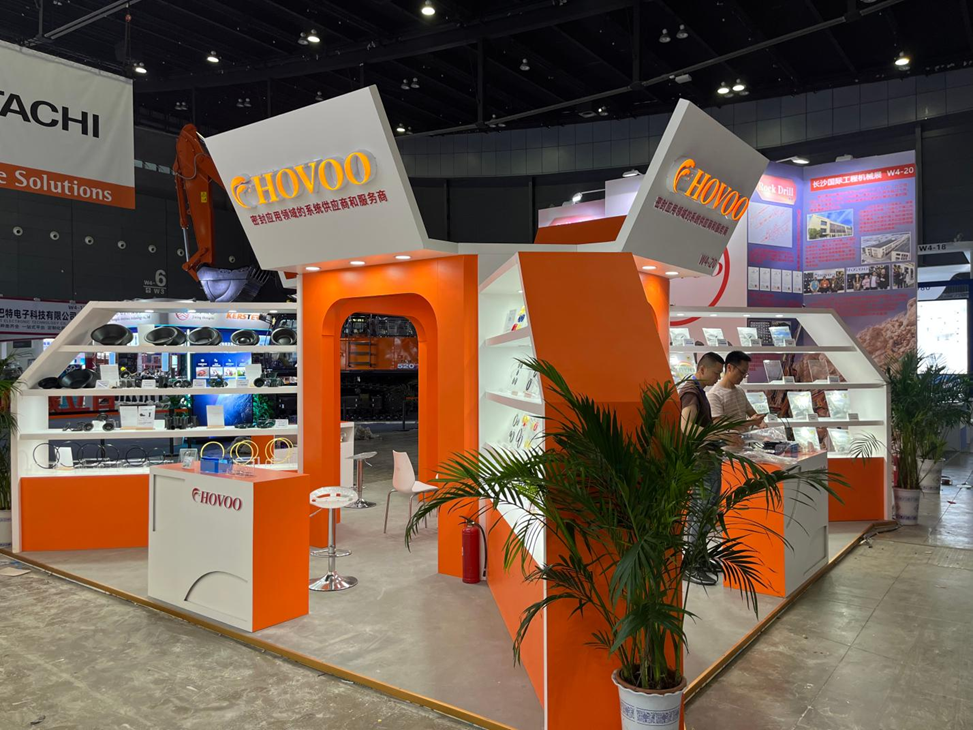
Hovoo Seal will be at Booth W2-579, Shanghai New International Exhibition Centre (SNIEC), Bauma China 2026, from 24 to 27 November 2026. Visitors are welcome to bring motor or pump shaft dimensions, OEM part numbers, or photographs of worn shaft seals and housing bores for on-site technical consultation. The team can confirm dimensional compatibility and recommend compound selection based on the specific hydraulic fluid and operating conditions.
To prepare an inquiry before the show, provide the pump or motor manufacturer, model designation, shaft diameter, housing bore diameter, hydraulic fluid type and brand, and operating case pressure range. This allows the team to identify the correct shaft seal and O-ring specifications in advance.
Conclusion: Hydraulic pump and motor seals require more specific technical knowledge than standard cylinder seals to specify correctly. Shaft speed, case pressure, and fluid compatibility all determine whether a given seal design and material will deliver reliable service life. Bauma China 2026 provides an opportunity to evaluate qualified suppliers, compare shaft seal designs across manufacturers, and establish technical support relationships for pump and motor maintenance programs. Visit Hovoo Seal at Booth W2-579 to discuss your specific hydraulic pump and motor sealing requirements.
Frequently Asked Questions
Why does my hydraulic pump shaft seal leak only in cold weather?
Cold oil is far more viscous, and the pressure drop along the case-drain line rises in proportion to viscosity. If the drain line is too narrow, case pressure can exceed what the shaft seal tolerates. One published case traced a −40 °C shaft seal leak to a restricted drain line and cured it by enlarging the bore, with no change to the seal [1]. Check drain line size and pressure before replacing the seal.
How do I know when a hydraulic pump shaft seal needs replacement?
The primary sign is oil at the shaft exit point of the pump housing. Early-stage leakage may appear as a slight wet sheen on the shaft before oil drips are visible. Other indicators include unexplained hydraulic fluid level drops in the tank and oily deposits on the pump housing or adjacent structure. Regular visual inspection of the pump shaft area at each planned service is the simplest and most reliable detection method.
Can I replace only the shaft seal without dismantling the full pump?
In most pump and motor designs, the shaft seal can be replaced by removing the shaft end cover or front bearing plate without fully dismantling the pump internals. Consult the service manual for your specific pump model to confirm the procedure. Partial replacement is practical if the pump internals are in good condition and only the shaft seal has failed. If the pump has had extended operation with a leaking seal, check whether abrasive contamination has reached the internal sealing surfaces before reassembling.
What shaft surface roughness is required for a PTFE-face shaft seal?
PTFE-face shaft seals require a finer shaft surface finish than elastomeric lip seals. The required roughness depends on the seal design and supplier, so take the figure from the seal manufacturer's datasheet rather than from a general rule. If the shaft surface has a spiral machining finish, the helix must be checked against the pump rotation direction to ensure it does not pump oil outward past the seal.
Is it safe to mix NBR and FKM O-rings within the same pump overhaul kit?
It is technically possible if both compounds are compatible with the hydraulic fluid in use. However, the practical recommendation is to use all seals from the same kit and the same compound specification for each overhaul. Mixing compounds makes troubleshooting future failures more complex, and a standard overhaul kit is designed to provide a matched set for the complete service interval.

References (Chinese-language sources; titles translated)
- Fu Shuguang, Liu Xiangyang, Zhang Shengzhuo, Yu Liang. Analysis on the low-temperature oil leakage of the hydraulic pump shaft seal of a certain type. Hydraulics Pneumatics & Seals, 2021, No. 2, pp. 91–93. DOI: 10.3969/j.issn.1008-0813.2021.02.023.
- Man Jiaxiang, Huang Chuanhui, Yu Mingquan, Zhao Jiyun, Wang Yunfei, Cao Chao. Characteristics of rotary dynamic seals in a high water-based hydraulic motor. Tribology, online first, 20 May 2026.
- Zhao Wende, Xu Dechun. Finite element analysis of the sealing performance of an O-ring in the pressure shell of an AUV. Manufacturing Informatization (CAD/CAM/CAE/CAPP), 2009, No. 7, pp. 66–68.
Table of Contents
- Why Are Seals Critical to Hydraulic Pump and Motor Performance?
- What Types of Seals Are Found in Hydraulic Pumps and Motors?
- What Materials Are Specified for Pump and Motor Shaft Seals?
- How Does Shaft Speed and Pressure Affect Shaft Seal Selection?
- What Failure Modes Are Specific to Pump and Motor Seals?
- How Should Buyers Evaluate Pump and Motor Seal Suppliers at Bauma China?
- What Installation Practices Extend Pump and Motor Seal Life?
- What Hydraulic Fluid Compatibility Issues Arise at Bauma China 2026?
- What Should Procurement Teams Know About Hydraulic Motor Seal Kits?
- How Can Hovoo Seal Support Hydraulic Pump and Motor Sealing at Bauma China 2026?


