

 EN
 AR
 CS
 DA
 NL
 FI
 FR
 DE
 EL
 IT
 JA
 KO
 NO
 PL
 PT
 RO
 RU
 ES
 SV
 TL
 IW
 ID
 LV
 SR
 SK
 VI
 HU
 MT
 TH
 TR
 FA
 MS
 GA
 CY
 IS
 KA
 UR
 LA
 TA
 MY

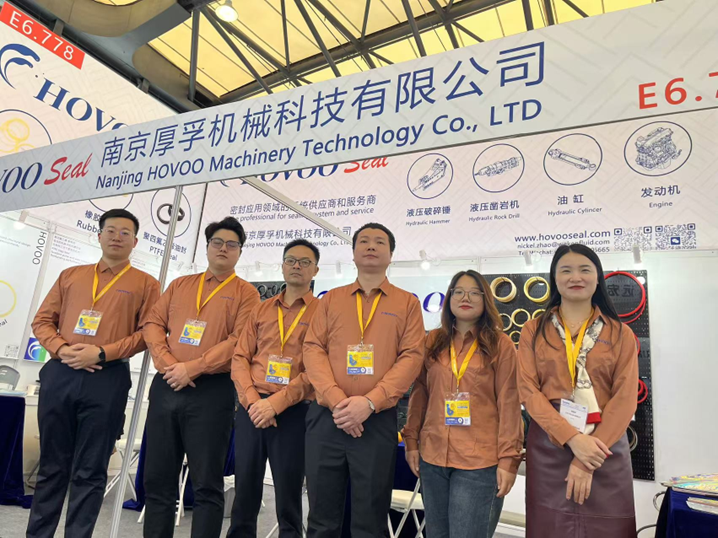
Bauma China returns to the Shanghai New International Exhibition Centre (SNIEC) from 24 to 27 November 2026. The biennial show is the largest construction, mining, and building-materials machinery trade fair in Asia, drawing more than 3,500 exhibitors and hundreds of thousands of trade visitors from across the world. For procurement engineers, maintenance managers, and distributors sourcing sealing components for hydraulic rock drills, the event offers a concentrated opportunity to evaluate products, meet technical teams, and verify quality claims face to face.
Rock drill seals operate under conditions that few other industrial seals must endure: repeated high-pressure impacts at frequencies that Chinese design work was already putting at 3,000 blows per minute or more (50 Hz and above) in the early 1980s [2], abrasive dust and water-borne contamination from drilling, and continuous hydraulic cycling in confined spaces. Selecting the wrong seal or sourcing from a supplier without the technical depth to support specification work can lead to premature leakage, piston damage, and unplanned downtime. This article explains what rock drill seals do, what distinguishes a reliable product, and how to use your time at Bauma China effectively when evaluating suppliers.
What Role Do Seals Play in a Hydraulic Rock Drill?
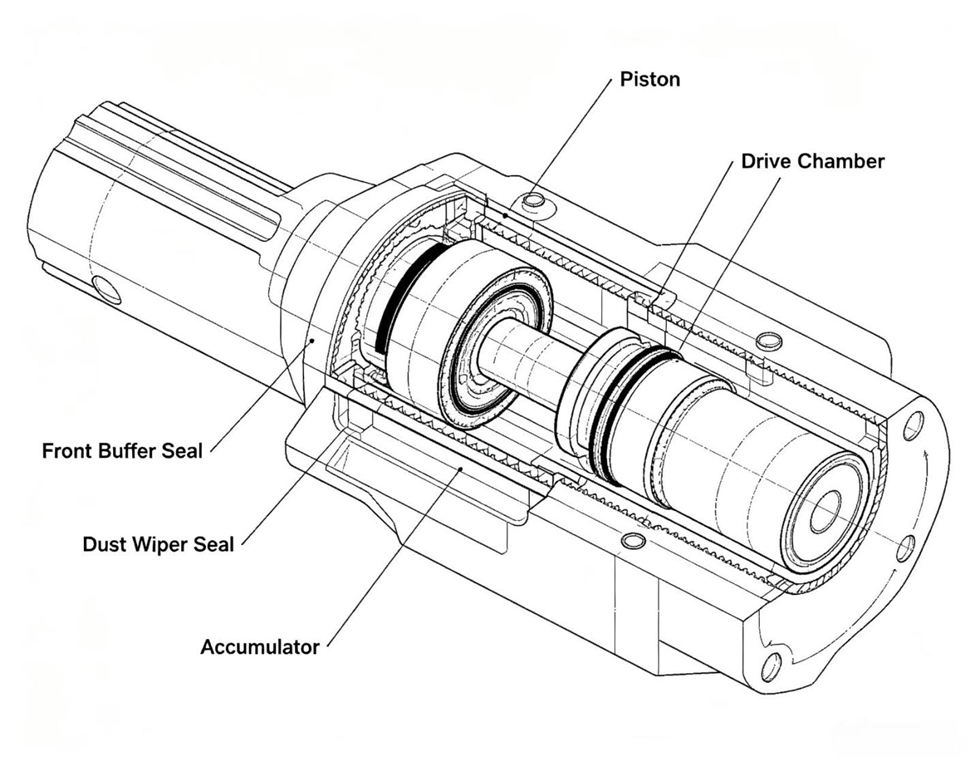
A hydraulic rock drill converts pressurized hydraulic fluid into percussive energy. Oil enters a drive chamber, accelerates a piston, and the piston strikes the drill rod shank at high velocity. The piston then resets for the next cycle. Seals serve three interdependent roles throughout this process.
First, they contain the pressurized oil on the power stroke so that hydraulic energy is directed into piston movement rather than lost as leakage. Second, they isolate the clean hydraulic circuit from the dusty exterior environment, preventing abrasive particles from entering through the rod opening and damaging the piston surface or the cylinder bore. Third, on the return stroke, they allow precise pressure control in the back chamber to regulate strike frequency and energy.
When a seal begins to fail, oil bypasses the piston rather than driving it. The immediate effect is a reduction in impact energy. Over time, contamination from the drill environment reaches the cylinder bore, scores the piston surface, and accelerates wear on both the piston and the housing. The result is a repair that involves far more than replacing the seals.
Two problems dominate the early Chinese literature on hydraulic rock drills: oil leakage and cylinder scuffing, meaning seizure of the piston in its bore [2]. The trade-off is easy to state. A large piston-to-bore clearance makes scuffing less likely but leaks heavily, and in severe cases the oil escapes through the gap and the machine stops working. A small clearance limits leakage but invites scuffing and, at worst, jamming. The same source traces scuffing to two causes: solid impurities in the oil that adhere to the sliding pair, and eccentricity from low machining accuracy that makes the piston run out radially [2].
One workaround of that period was to seal the piston directly against the moving surfaces with O-rings. It worked as a seal, but the O-rings were in direct sliding contact and wore quickly: the author reports that nitrile rubber survived only about one thousand impacts, and that a machine striking at more than 3,000 blows per minute reached only 40 to 50 hours of life in that arrangement [2]. The proposed remedy was a floating guide (sealing) sleeve. The sleeve sits between piston and cylinder with a small radial gap to the piston (δ1) and a larger gap to the cylinder (δ2 = 1.5 to 2.5 times δ1), is sealed to the cylinder by four O-rings, and can move radially, so the annular gap around the piston stays uniform even when the piston runs eccentric [2]. The design principle still applies: seal life depends on how well the structure keeps the sliding gap concentric, not only on the seal compound.
Which Seal Positions Are Critical in a Rock Drill System?
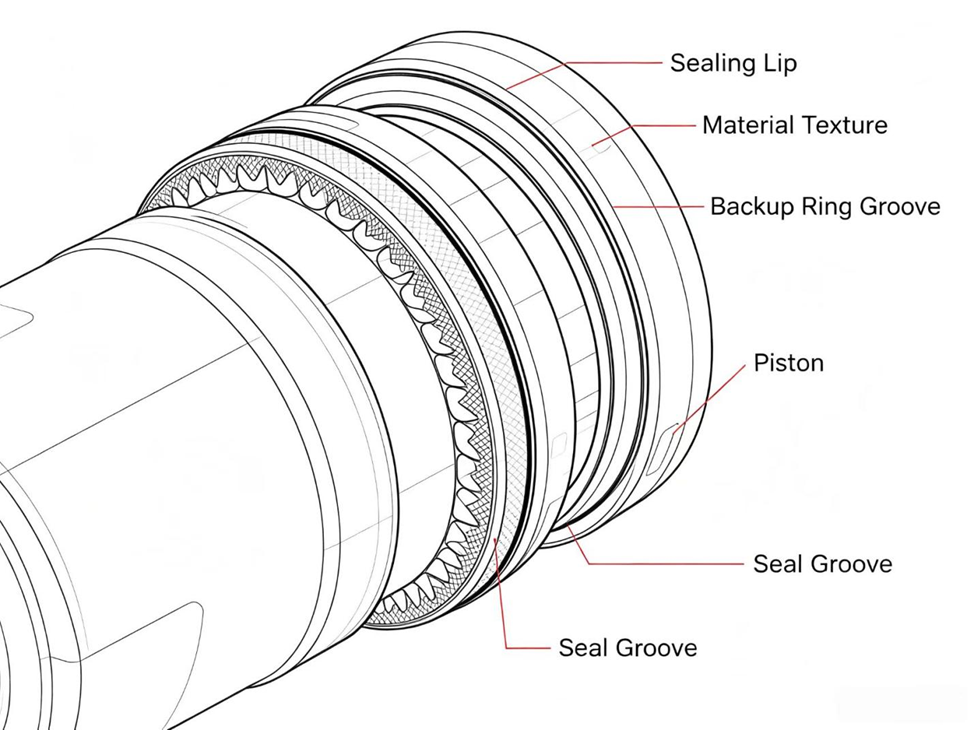
A hydraulic rock drill typically contains several distinct sealing positions, each with different requirements. The piston seal or impact seal sits in the main drive bore and is exposed to the full percussion force on each cycle. It must withstand rapid pressure reversals without extruding into the clearance gap or developing a set that reduces sealing contact pressure over time.
The front buffer seal or cup seal sits near the rod opening and provides a secondary barrier between the hydraulic circuit and the drill environment. Dust wiper seals sit at the exterior face and physically scrape drilling debris from the rod surface as the piston retracts. The accumulator diaphragm, though not a sliding seal, separates the nitrogen gas charge from the hydraulic oil and damps pressure spikes caused by each impact.
A rotary-percussive rock drill also has a water-flushing path, and it adds one more critical position. The Y-ring seal between the drill shank and the flushing head is exposed at the same time to rotation, high-frequency axial impact, and a water medium with poor lubricity; leakage and early failure are frequent there, and because the seal is difficult to replace, each failure costs drilling time [1].
Backup rings often support O-rings or lip seals in the higher-pressure positions, preventing extrusion into the clearance gap at peak impact loads. Step seals (also called Glyd rings) combine a PTFE sliding element with an energizing O-ring and are used in positions where both low friction and reliable sealing at pressure are needed.
What Materials Are Used in Rock Drill Seals and Why Does It Matter?
Material selection directly determines whether a seal survives the percussion and thermal conditions inside a rock drill. Polyurethane (PU) is the most common material for piston seals and buffer seals because it combines high tensile strength, abrasion resistance, and the elasticity needed to maintain a sealing lip under cyclic loading. PU seals resist extrusion better than rubber alternatives at the pressures typical of rock drill circuits.
Nitrile rubber (NBR) is used in O-rings and static seals where temperature and petroleum-based hydraulic fluids are the primary concerns. For applications with fire-resistant or phosphate-ester fluids, or in environments above the NBR service range, hydrogenated nitrile (HNBR) or fluoroelastomer (FKM/Viton) alternatives are used. FKM offers broader chemical resistance but is less tolerant of dynamic impact loads in a sliding seal role.
PTFE composite materials are used in Step seals and Glyd rings. PTFE reduces friction in the sliding contact zone, but pure PTFE deforms under load; compounding it with glass fiber, carbon fiber, or graphite filler significantly improves creep resistance and wear life. At Bauma China, ask suppliers to identify the filler system in their PTFE compounds and to provide wear data under conditions relevant to your application.
How Do Impact Conditions Affect Seal Selection?
The percussion frequency and working pressure of the rock drill are the two most important variables in seal selection. A light rock drill used for anchor bolting operates at lower working pressure and lower strike frequency than a heavy drill deployed for open-face quarry blasting. A seal designed for one duty cycle may extrude, fatigue, or overheat in another.
Published modelling of the drill-shank water seal shows how the physics works. Treating the sealing interface as a thin lubricating film, the film thickness at the lip is set by the shank speed and the pressure gradient across the contact. For a shank moving sinusoidally, the one-dimensional Reynolds equation gives the instantaneous film thickness h(t), and integrating the fluid carried past the lip gives the net leakage over one cycle [1]:
h(t) = 2ηu(t) / [ 9 · (dp/dx)(t) ] (1)
Vnet = π d [ ∫out u(t) h(t) dt − ∫in u(t) h(t) dt ] (2)
Here η is the dynamic viscosity of the medium, u(t) the instantaneous shank speed, dp/dx the maximum pressure gradient in the contact, and d the shank diameter [1]. Two practical points follow. Film thickness scales with viscosity, so a water seal runs on a far thinner film than an oil-lubricated seal. And net leakage is the difference between the fluid carried out on the outward stroke and the fluid pumped back on the inward stroke, which is why lip geometry that favors return pumping lowers leakage.
The same study combined this model with a three-dimensional finite element model of a polyurethane Y-ring and reports the following trends [1]. The highest von Mises stress occurs at the inner lip that contacts the shank, with a second stress concentration where the inner side meets the bottom of the groove; these are the places to inspect on a failed seal. Contact pressure on both the primary and secondary sealing faces exceeded the medium pressure, which is the basic condition for sealing:
pc pmedium (3)
Contact stress on the outward stroke was higher than on the inward stroke. A larger impact-velocity amplitude raised leakage, while rotation reduced net leakage over a cycle. Leakage fell as medium pressure rose, but net leakage was lowest at an intermediate pressure, so a seal that performs well at one pressure setting should not be assumed to perform equally well at another [1]. These results come from simulation of a water seal; they identify the variables that matter rather than predicting the performance of any specific product.
Circuit architecture changes the pressure history the seals see. A data study of 11 dual-control and 4 rear-control Epiroc rock drills compared the ratio of piston stressed areas in the return and power strokes and found that the ranges for the two architectures do not overlap, leading the authors to conclude that design variables built on a single area ratio are not universal [3]. The study also treats impact energy and impact frequency as performance parameters, with impact energy defined by the piston mass m and impact velocity v:
E = ½ m v2 (4)
For seal buyers the practical consequence is that a specification should be tied to the drill model and its pressure cycle, not to a generic rock drill category.
Extrusion risk increases with higher working pressure and wider clearance between the piston and the bore. If the radial gap is tighter, a harder seal compound (higher Shore A or Shore D hardness) is less critical. If the gap is wider — for example, due to bore wear — or if pressure peaks are high, a backup ring is necessary to prevent the primary seal from being forced into the gap on the power stroke.
Thermal load from friction adds another constraint. At high percussion frequency, the seal lip generates heat through repeated compression and release. If the hydraulic oil temperature rises significantly during operation, the seal must retain its mechanical properties at that elevated temperature. Seals that are borderline at room temperature may fail rapidly once the circuit reaches operating temperature after extended drilling.
What Are the Most Common Failure Modes for Rock Drill Seals?
Understanding failure modes before visiting a supplier at Bauma China helps you ask questions that reveal whether their product addresses the underlying mechanism rather than just the symptom.
Extrusion damage appears as a nibbled or rolled edge at the sealing lip, caused when the seal material is pushed into the clearance gap during the pressure stroke. This can result from excessive working pressure, insufficient seal hardness for the radial clearance, missing or incorrectly specified backup rings, or a gap that has widened due to bore wear.
Abrasive wear on the sealing lip indicates that fine particles have reached the sliding surface, either because the dust wiper has failed, because the wiper is incompatible with the particle size generated at the drill face, or because the flushing medium used at the rock face is carrying particles back into the seal zone.
Fatigue cracking at the lip root, rather than at the lip face, suggests that the seal is cycling through a range of deformation that exceeds the material's fatigue limit. This can occur when the seal is incorrectly sized, when the housing groove dimensions do not match the seal profile, or when pressure spikes from a malfunctioning accumulator are amplifying the cyclic stress.
Wear can be estimated with the Archard model. In the water-seal study, the wear volume over one cycle is the wear coefficient K multiplied by the contact load N and the sliding distance L, summed over the outward and inward strokes, and the load is obtained by integrating the simulated contact pressure p(x) over the contact length [1]:
V = K · N · L , N = ∫ π D · p(x) dx (5)
In that study the computed water film, about 0.009 μm at its thickest, was far thinner than the 0.8 μm roughness of the shank, so the film was assumed to give no protection and a wear coefficient of 1.7 × 10⁻⁶ (non-metal against metal) was used [1]. Simulated average contact loads rose from about 684 N (inward) and 766 N (outward) at an impact-velocity amplitude of 157 mm/s to about 1,167 N and 1,393 N at 314 mm/s. Predicted life decreased as impact amplitude and rotation speed increased, and increased with medium pressure within the range studied [1]. These are simulation results for a pure-water seal and are not service-life figures; their value is in showing which variables a supplier should be able to discuss.
Impact transients matter for other seal types as well. Fluid–solid coupling simulations of a gas honeycomb seal struck by a rotor show leakage rising steeply at the instant of impact and then decaying, with the leakage increment growing when impacts follow one another [4]. The seal type is different, but the message is the same: transient impact, not only steady pressure, sets the leakage a seal must withstand.
How Should You Evaluate Rock Drill Seal Quality at a Trade Show?
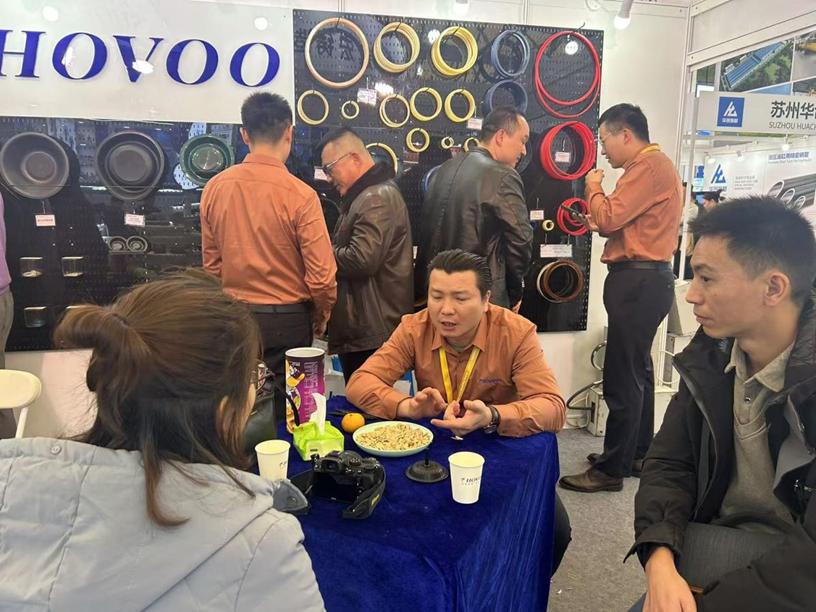
A trade fair booth provides limited time to assess a supplier, so prepare a focused set of questions and bring your own reference information. The table below lists the key verification areas, what to look for, and what a credible supplier should be able to provide.
Verification area |
What to ask or observe |
Expected supplier response |
Material specification |
Ask for the compound designation, base polymer, and filler system for each seal position |
Datasheet with polymer grade, hardness range, and temperature limits; not just a trade name |
Dimensional standard |
Ask whether seals are produced to ISO, DIN, or a customer drawing |
Drawing number or standard reference; ability to cross-check against your part number |
Quality documentation |
Ask about incoming material testing and final inspection |
Material certificates, hardness test records, or dimensional inspection reports |
Application experience |
Ask which rock drill models or OEMs they currently supply |
Specific model references or OEM part numbers; credible answers are specific, not generic |
Technical support |
Ask how they handle specification questions or failure analysis |
Named contact, response process, and evidence of previous support cases |
Note that a supplier's ability to show samples and describe their products fluently is not itself evidence of quality. Request documentation rather than accepting verbal assurances.
What Should Procurement Teams Know About Seal Kits for Rock Drills?
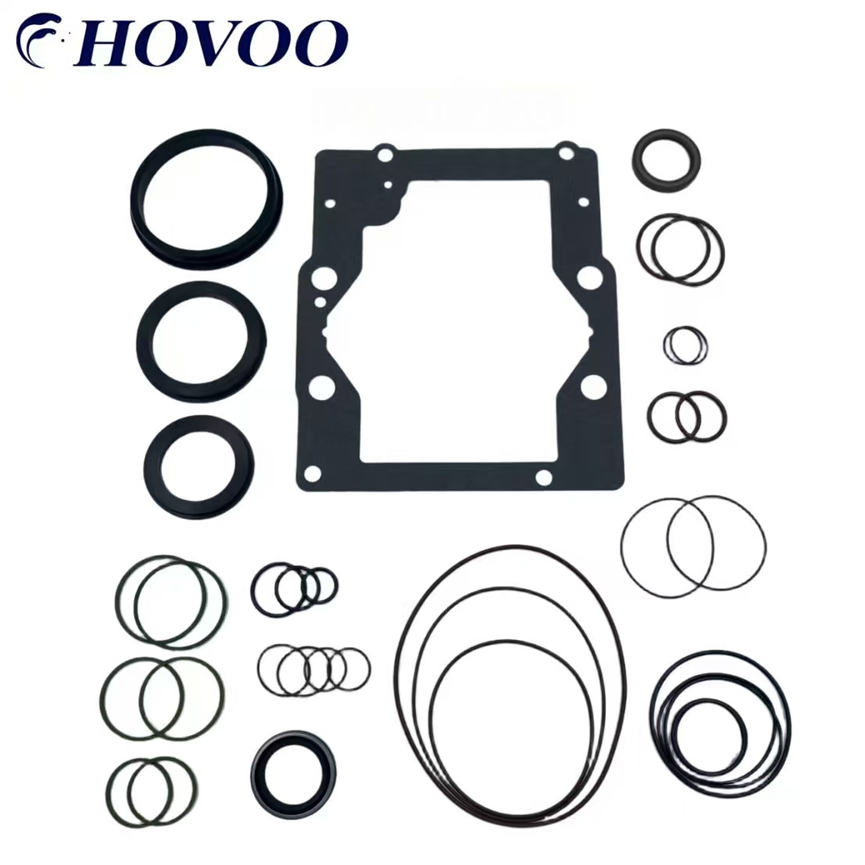
Most rock drill manufacturers and distributors supply seals as a complete kit covering all seal positions in one service interval, rather than as individual items. A kit approach reduces the risk of missing a seal position during overhaul and ensures that all components are replaced at the same time, which is important when one aging seal can accelerate wear on a neighbor.
When sourcing a replacement kit, verify that every position in your drill model is included. Kits from different suppliers may cover different positions or may include items that do not match your housing groove dimensions. The safest verification approach is to provide the supplier with the OEM part number for the kit or the drill model and serial number range, and to ask for a position-by-position cross-reference.
At Bauma China, suppliers who hold finished stock of common kits offer faster delivery than those who build to order. Ask about lead times for both standard and urgent orders, and confirm that packaging protects the seals from UV exposure and ozone during storage, as both degrade rubber compounds even before the seal is installed.
How Does the Accumulator Diaphragm Fit Into the Seal System?
The nitrogen accumulator in a hydraulic rock drill absorbs the pressure spikes that occur each time the piston impacts the drill rod shank. Without adequate damping, these spikes propagate through the hydraulic circuit and accelerate fatigue in every other seal in the system. The diaphragm separates the gas charge from the oil and flexes with each pressure event.
Diaphragm materials are typically NBR or HNBR for standard hydraulic oils, with compound adjustments for mineral oil versus synthetic fluid compatibility. A diaphragm that has hardened, cracked, or lost its nitrogen pre-charge will allow the full unattenuated spike to reach the piston seals on every strike. The result is a dramatic shortening of piston seal life, sometimes without any external sign that the accumulator is the root cause.
When evaluating suppliers at Bauma China, ask specifically about accumulator diaphragms as part of the seal kit offering. A supplier who treats the diaphragm as an optional add-on rather than an integral system component may not have the application understanding needed for rock drill seal specifications.
What Standards and Certifications Are Relevant for Rock Drill Seals?
Rock drill seals do not fall under a single governing standard in the way that, for example, hydraulic cylinder seals are addressed by ISO 7425. However, several standards govern the materials and test methods that credible suppliers should reference.
Material properties for polyurethane and rubber seal compounds are tested according to methods in the ISO 37, ISO 1817, ISO 815, and ASTM D standards families, covering tensile strength, elongation, compression set, and fluid compatibility. Dimensional tolerances for common groove profiles follow ISO 3601 for O-rings and ISO 7425 for hydraulic cylinder seals; suppliers who produce seals for rock drill positions outside these standard groove geometries should be able to provide customer-drawing manufacturing capability.
At Bauma China, be cautious about suppliers who cite certifications without being able to identify the specific test method, standard version, or accredited laboratory. A meaningful certification is traceable — it identifies the standard, the test batch, and the issuing body.
How Can Hovoo Seal Support Your Rock Drill Sealing Needs at Bauma China 2026?
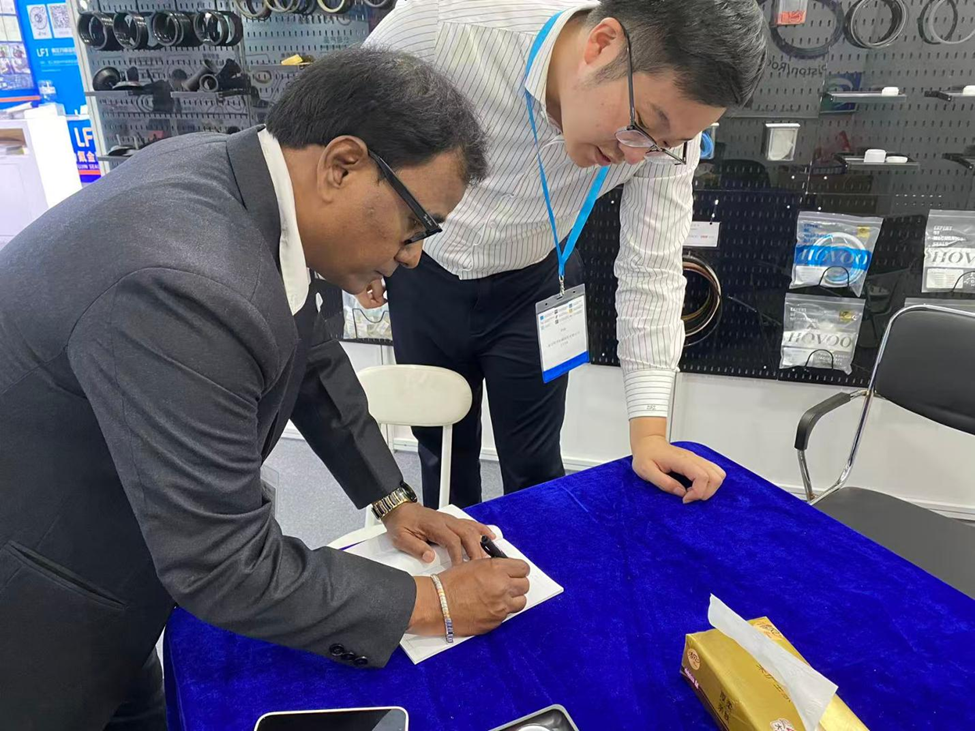
Hovoo Seal (Nanjing Hovoo Machinery Technology Co., Ltd) has specialized in hydraulic sealing components since 2013, with a product range covering piston seals, rod seals, O-rings, wiper seals, rotary seals, pneumatic seals, and seal kits for hydraulic rock drills and hydraulic breakers. The engineering team provides free technical support for specification questions, including cross-referencing OEM part numbers, reviewing application conditions, and confirming material compatibility for non-standard hydraulic fluids.
At Bauma China 2026, Hovoo Seal will exhibit at Booth W2-579, Shanghai New International Exhibition Centre (SNIEC), from 24 to 27 November 2026. Visitors are welcome to bring sample seals, OEM part numbers, or drawings for on-site technical review.
To prepare a technical inquiry before the show, provide the rock drill model, the OEM part number or seal kit reference, the operating pressure range, the hydraulic fluid type, and photographs of any worn or failed seals. This information allows the team to identify the correct compound, profile, and backup ring specification for your application.
Conclusion: Rock drill seals are a small component with a disproportionate effect on overall drill reliability. Extrusion resistance, material durability under percussion loading, and correct groove geometry all affect how long a seal set survives in service. Bauma China 2026 provides an efficient opportunity to evaluate multiple suppliers in a short time and to ask the technical questions that distinguish a qualified supplier from a catalogue trader. Visit Hovoo Seal at Booth W2-579 to discuss your specific application and to review the product range for hydraulic rock drills and breakers.
Frequently Asked Questions
Can I use standard hydraulic cylinder seals in a rock drill?
Not reliably. Standard hydraulic cylinder seals are designed for continuous sliding motion under steady pressure. Rock drill seals are exposed to repeated high-energy impacts that create very short, high-amplitude pressure spikes. A standard cylinder piston seal may extrude or fatigue rapidly in this dynamic environment. Seals specified for rock drill duty are formulated and profiled to resist the impact load cycle.
How often should rock drill seals be replaced?
Replacement intervals depend on the drill model, the rock type being drilled, the operating pressure, and the condition of the hydraulic oil. There is no universal interval. The correct practice is to inspect the seals during scheduled drill maintenance, watch for the first signs of leakage or reduced impact energy, and replace before the secondary damage stage where oil contamination reaches the bore. Consult the drill manufacturer's service manual for model-specific guidance.
What information do I need to order a replacement seal kit?
Provide the drill manufacturer name, the drill model designation, and the OEM kit part number if available. If the OEM part number is not available, a photograph of the existing seals, the piston diameter, and the cylinder bore diameter allow most suppliers to identify the correct kit. Operating pressure range and hydraulic fluid type are needed to confirm material compatibility.
Is it acceptable to replace only the leaking seal rather than the full kit?
It is possible but not recommended. If one seal has reached the end of its service life, the others in the same drill have typically operated for the same number of cycles under the same conditions. Replacing a single item often results in another seal failing shortly afterward, with a second unplanned stoppage. Full kit replacement at each service interval is generally more cost-effective over the equipment lifecycle.

References (Chinese-language sources; titles translated)
- Xia Wenlong. Analysis of sealing performance and life prediction of the water seal of a rotary-percussive rock drill. Master's thesis, 2021.
- Guo Fengcen. Improvement of the sealing mechanism of hydraulic rock drills. Mining Machinery, 1981, No. 6.
- Zhou Zhihong, Ding Hejiang, Tian Xiang. Analysis of piston stressed area of Epiroc's hydraulic rock drills and assessment of the 3-section method. Rock Drilling Machinery & Pneumatic Tools, 2024, No. 3, pp. 10–. DOI: 10.19449/j.cnki.2095-6282.2024.03.011.
- Zhu Shengquan, Zhao Jing. Study on sealing characteristics of honeycomb seal under impact condition. Mechanical Engineer, 2024, No. 7, pp. 52–55.
Table of Contents
- What Role Do Seals Play in a Hydraulic Rock Drill?
- Which Seal Positions Are Critical in a Rock Drill System?
- What Materials Are Used in Rock Drill Seals and Why Does It Matter?
- How Do Impact Conditions Affect Seal Selection?
- What Are the Most Common Failure Modes for Rock Drill Seals?
- How Should You Evaluate Rock Drill Seal Quality at a Trade Show?
- What Should Procurement Teams Know About Seal Kits for Rock Drills?
- How Does the Accumulator Diaphragm Fit Into the Seal System?
- What Standards and Certifications Are Relevant for Rock Drill Seals?
- How Can Hovoo Seal Support Your Rock Drill Sealing Needs at Bauma China 2026?


