33-99No. Mufu E Rd. Gulou District, Nanjing, China [email protected] | [email protected]
33-99No. Mufu E Rd. Gulou District, Nanjing, China [email protected] | [email protected]

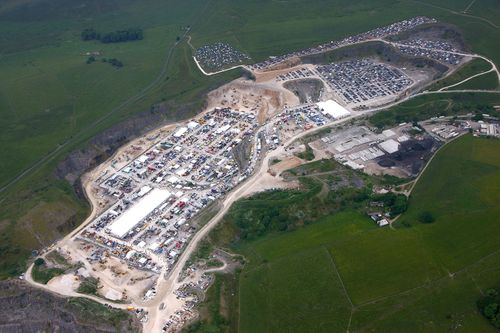
Most trade shows put machines on a polished floor under bright lighting and ask visitors to imagine what they look like working. Hillhead does something else entirely. The exhibition takes place in an active limestone quarry in Derbyshire, England, and the machines on display are running — drilling, crushing, screening, loading, compacting — in the actual material they were designed to process. That is not a marketing detail. It is the reason 19,577 unique visitors travelled to a quarry in the Peak District hills in 2024, and why the 2026 edition is already oversubscribed for exhibition space.
Hillhead 2026 runs June 23 to 25 at Hillhead Quarry, Buxton, in the limestone belt of the Derbyshire Peak District. Organised by the QMJ Group, it is the world's only major exhibition held entirely within a working quarry. The 2024 edition set an all-time attendance record with 26,626 visits over three days and the second-highest unique visitor count in the show's history. Exhibitors for 2026 are confirmed at over 600 companies from across Europe, North America, Australia, and Asia.
Hillhead started in 1981 as a relatively modest quarrying industry event, hosted in an actual quarry because the organiser couldn't afford a conventional exhibition hall. That necessity turned into the show's defining feature. By the late 1980s it was clear that the working environment was not a handicap but an asset — buyers could watch a crusher process real rock, evaluate a screen's actual separation performance on live material, see how a haul truck handled the gradient of a genuine quarry ramp. No indoor show could replicate that, regardless of how much money it spent on stand design.
The 2024 edition demonstrated the vitality of the format after a four-year gap caused by the pandemic. Visitors spent more time at the show than in any previous edition. The proportion of attendees who came back for more than one day reached a new record. Both metrics point to the same conclusion: people are finding things worth seeing and conversations worth having. That doesn't happen at shows where the content has grown stale.
The product range at Hillhead maps directly onto the quarrying and aggregate production value chain. Primary and secondary crushing equipment — jaw crushers, cone crushers, impact crushers, and the associated screens and conveyors — dominates the outdoor demonstration zones where rock is actually being processed. Drilling and blasting equipment appears in sections of the quarry where face work can be safely reproduced. Aggregate processing equipment — washing systems, attrition scrubbers, density separators, grading plants — runs in areas where material flow can be managed.
Construction and road-building machinery occupies significant space alongside the quarrying equipment. Compaction rollers, pavers, milling machines, and crushing and screening plant adapted for demolition recycling all appear in operating conditions. The demolition and recycling segment has grown noticeably in recent editions as the crossover between quarrying and construction waste processing has become commercially significant — aggregate produced from demolition concrete and brick rubble increasingly enters the same supply chains as natural stone.
Category |
Details |
Event Name |
Hillhead 2026 |
Dates |
June 23–25, 2026 |
Venue |
Hillhead Quarry, Buxton, Derbyshire SK17 0EL, United Kingdom |
Scale (2024 edition) |
600+ exhibitors; 26,626 visits over 3 days; 19,577 unique visitors |
Hillhead's attendance skews heavily toward operational decision-makers. Quarry managers, production engineers, fleet supervisors, plant buyers, and aggregate processing specialists form the core visitor base. These are people who manage rock every working day and who evaluate equipment in terms of tonnes per hour, wear cost per tonne, and downtime frequency. They are not easily impressed by brochure claims. The working demonstration format at Hillhead gives them something to evaluate with the same critical eye they apply to equipment already running on their own sites.
The geographic reach extends well beyond the UK. European quarrying groups, Australian hard-rock contractors, and North American aggregate producers attend consistently. The show runs a facilitated Hosted Buyer programme that brings senior procurement professionals from major aggregate companies specifically to meet exhibitors — a structure that converts floor traffic into commercial conversations with qualified intent rather than casual browsing.
Hydraulic breakers, pulveriser attachments, crusher buckets, and demolition shears all appear at Hillhead alongside the fixed crushing and screening plant. The quarrying application for hydraulic breakers is specific: primary reduction of oversized blasted material that will not pass through the crusher feed, face scaling after blasting, and secondary breaking of material that jams in the primary crusher cavity. These applications generate significant wear and require equipment that can sustain high-impact loads on the hardest commercial rock types — limestone, granite, basalt, dolerite. The buyers at Hillhead who are looking at hydraulic breaking equipment are not evaluating it theoretically. They have a specific problem on a specific site, and they want to see whether the machine in front of them can solve it.

Welcome to HOVOO, a Chinese seal factory. Production of PU, Rubber and PTFE seals. The seals include O-ring, piston seal, rod seal, Gray ring and gas seal.


 EN
EN
 AR
AR CS
CS DA
DA NL
NL FI
FI FR
FR DE
DE EL
EL IT
IT JA
JA KO
KO NO
NO PL
PL PT
PT RO
RO RU
RU ES
ES SV
SV TL
TL IW
IW ID
ID LV
LV SR
SR SK
SK VI
VI HU
HU MT
MT TH
TH TR
TR FA
FA MS
MS GA
GA CY
CY IS
IS KA
KA UR
UR LA
LA TA
TA MY
MY
