

 EN
 AR
 CS
 DA
 NL
 FI
 FR
 DE
 EL
 IT
 JA
 KO
 NO
 PL
 PT
 RO
 RU
 ES
 SV
 TL
 IW
 ID
 LV
 SR
 SK
 VI
 HU
 MT
 TH
 TR
 FA
 MS
 GA
 CY
 IS
 KA
 UR
 LA
 TA
 MY

The basic function of a seal is to keep the medium in. But more and more additional functions have come to be tied to seals, from reducing friction and saving space to sharing the work of neighboring parts. As technology develops, the meaning of the word “seal” keeps expanding.
If we want one sealing company to stand as a miniature of the history of sealing, Freudenberg is a choice that cannot be bypassed. How did a 19th-century German company enter the sealing business, and how has it kept expanding its business as equipment has changed?
Where the Freudenberg Name Comes From
On 9 February 1849, Carl Johann Freudenberg and Heinrich Christian Heintze founded Heintze & Freudenberg in Weinheim, Germany. They took over an existing tannery with about 50 workers at the start, producing calf leather. In 1874, Carl Johann became sole owner and the company was renamed Carl Freudenberg.
Around 1929, the economic crisis hit the leather industry and Freudenberg began looking for new products. Developer Walther Simmer and his team, inspired by leather sealing samples from the United States, studied how to use the materials at hand in machinery. In 1929 the company began producing early seals; in 1932 the Simmerring became a clear milestone in the company’s history. The name comes from Simmer’s surname.
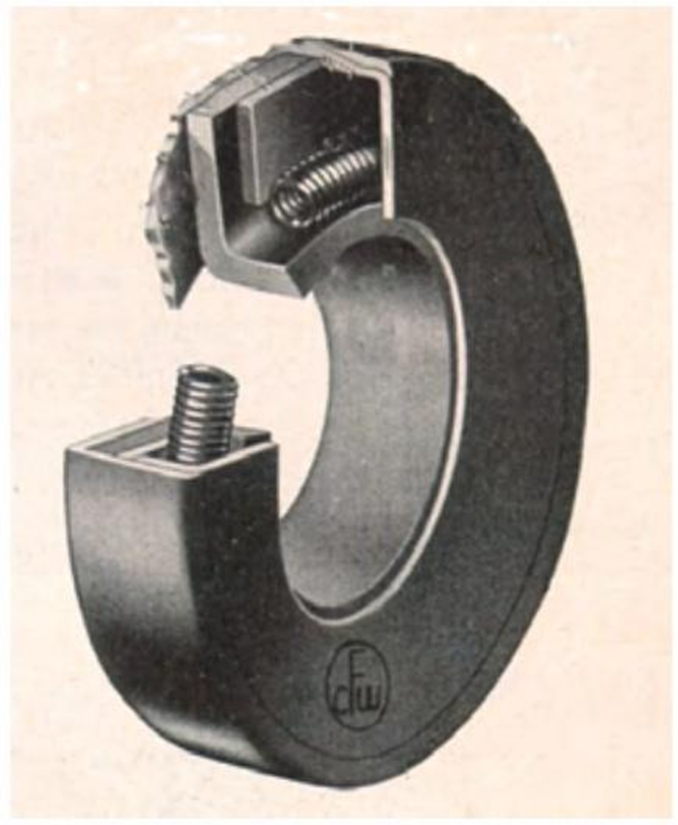
Figure 1 An early Simmerring with a garter spring, dated 1932 in the original image.
A metal case, a flexible sealing part and a garter spring: for anyone familiar with oil seals, this product, nearly 100 years old, contains all the main elements of today’s classic spring-loaded lip seal.
The material route then changed. In 1934 Freudenberg set up its main laboratory; in 1936 it began using nitrile rubber (NBR) for sealing rings. Around rubber formulation, tooling, vulcanization and lip machining, the company gradually built up a new set of manufacturing capabilities.
During the Second World War, under Nazi rule, Freudenberg went through Aryanization and the supply of products for the war effort. After the war, its products continued to develop along new material and structural lines.
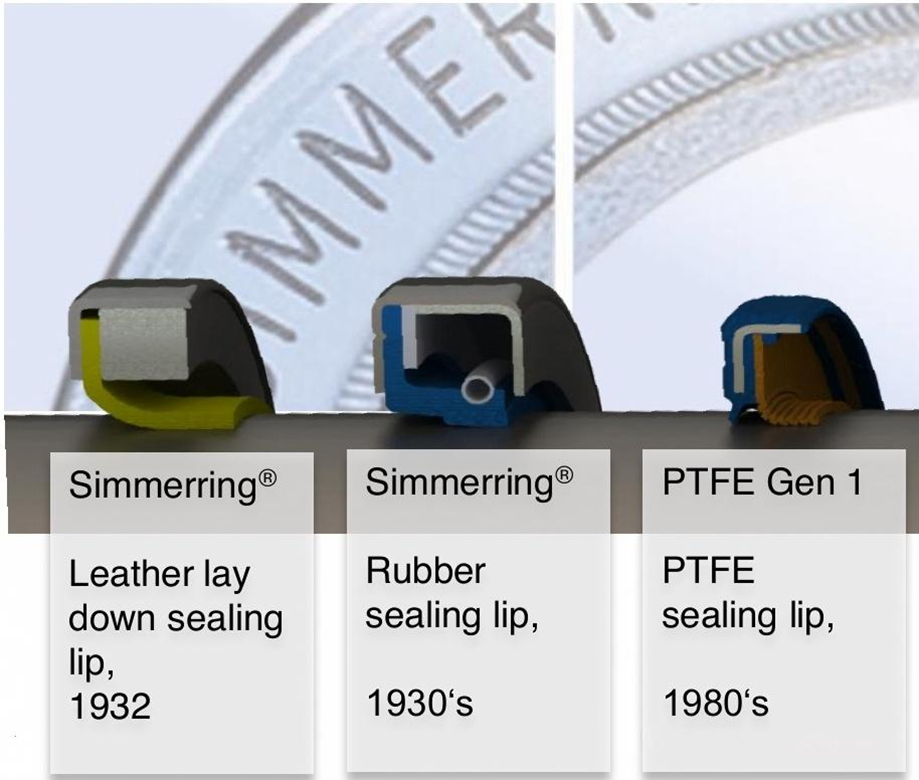
Figure 2a From left to right: leather, rubber and early PTFE lip designs.
Product Diversification as Technology Evolved
Keeping the oil in is the basic requirement of an oil seal. To meet machines’ demands for efficiency, life and installation space, seals have kept being given new missions.
The use of PTFE offered different friction and media-resistance characteristics, and lip shape, contact mode and return-pumping structures also became things to adjust. In 1997, Freudenberg began making a Simmerring with an integrated encoder, so that the sealing position began to carry the function of capturing information such as rotational speed.
Around friction reduction, the product line branched further. POP and ESS correspond to different designs of its PTFE and rubber lips respectively, while Levitex changed the arrangement of the main sealing pair.
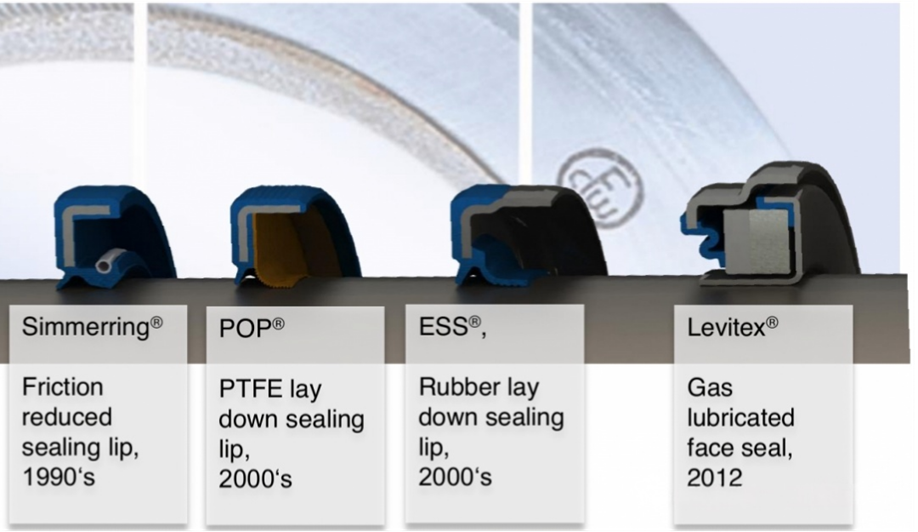
Figure 2b From left to right: the low-friction lip Simmerring, POP, ESS and Levitex. Each design has its own conditions of use, and the order in the figure does not imply that one fully replaces another.
A traditional radial lip shaft seal works through the fit between the lip and the shaft surface. Levitex, designed for crankshaft sealing, moves the main working position between two opposing end faces: one unit rotates with the shaft and the other is relatively stationary. In the working state where a gas film forms, aerodynamic features on the end faces keep the main sliding surfaces apart to reduce friction.
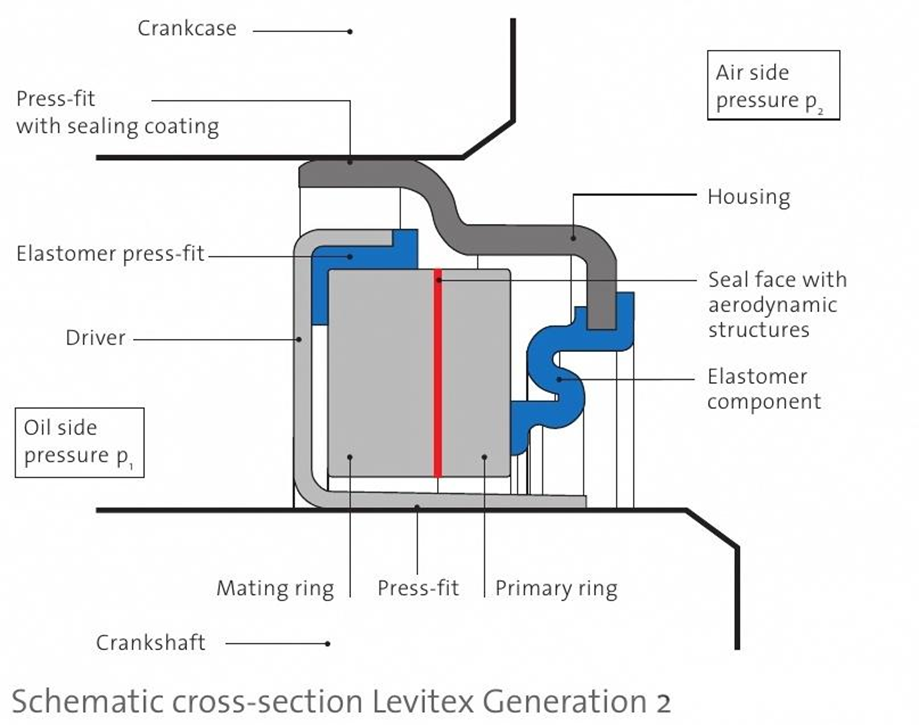
Figure 3 Second-generation Levitex structure. The crankshaft is below and the oil side is on the left; the red line marks the sealing end faces and the blue parts are elastomer components.
These products leave a clear technical thread: sealing companies began to consider materials, friction, structure and added functions at the same time, and how to make one component do more work in limited space.
Business Expansion through Cooperation and Acquisition
Shifting the view from parts to the company, Freudenberg’s internationalization has another thread: long-term cooperation.
In 1960, Freudenberg established a cooperation in sealing with NOK of Japan. In 1989, the two parties brought their U.S. sealing businesses into the Freudenberg-NOK General Partnership, known as FNGP.
For a sealing company that must serve automotive and industrial customers, going abroad also involves local production, application support and supply. Cooperative ventures let both sides jointly run business in some regions, and also make relationships in today’s sealing industry far more complex than competition among a few trademarks.
“Enfu,” well known in China’s sealing industry, is a product of this cooperation. Moving from supplying parts to taking part in local development, the company’s ties with customers deepened as well.
At the same time, Freudenberg kept expanding other specialist businesses through acquisitions. The 2004 acquisition of Burgmann Dichtungswerke was an important step into the wider mechanical seal business. By 2024, EagleBurgmann and the former Oil & Gas Technologies business group were integrated into Freudenberg Flow Technologies; the EagleBurgmann brand and the joint-venture relationship with EKK continue.
As a result, the Freudenberg Group today has two related business lines, FST and Flow Technologies: the former covers shaft seals, hydraulic seals and other products, and the latter includes EagleBurgmann’s mechanical seal business.
One Group, Different Trademarks for Different Fields
Freudenberg’s website uses Freudenberg as the corporate brand, but at the same time many well-known brands are brands under it for different fields.
Brand and logo |
Field and products |
Freudenberg / FST |
For automotive and general industry; provides standard and custom seals and carries out development of materials, structures and integrated components. |
Dichtomatik |
For routine applications in general industry, focused on standard seals, kits and supply; products are made by certified external suppliers. |
Corteco |
Serves the independent automotive aftermarket, mainly supplying seals, vibration-damping products and cabin air filtration products. |
The automotive aftermarket is in turn a highly segmented business. Overhauling a transmission requires seals, but also friction plates, steel plates and other parts. TransTec, TTK and Alto, which joined in recent years, let Corteco and the Freudenberg-NOK system offer a wider range of repair parts.
Aftermarket brand / business and logo |
Focus and relationship |
TransTec |
Repair kits, sealing components and tools for automatic transmissions, power steering and heavy-duty applications; part of the Freudenberg-NOK / Corteco system. |
Toledo Trans-Kits (TTK) |
Overhaul kits and related parts for automatic transmissions; joined the Corteco system in 2024 together with SAP. |
Seal Aftermarket Products (SAP) |
Transmission aftermarket business merged into Corteco in 2024, supplying kits, hard parts, electronics and tools. The image shows SAP and its product series together. |
Alto |
Clutch friction plates, steel plates and transmission repair kits, covering automotive, heavy equipment and marine applications; acquired by Freudenberg-NOK in 2025. |
Toledo Driveline has also been brought into the Corteco business, focusing on electronic control parts and some hard mechanical parts for driveline aftermarket.
Industry has another kind of need: equipment requires a custom seal, but the quantity is not enough to justify dedicated tooling, or the repair site cannot wait for a long stocking cycle. Freudenberg Xpress® serves prototyping, small batches, custom machining and repair replacement; DMH, which joined in 2025, links finished turned seals, materials, machines and software.
Industrial machining brand and logo |
Focus and relationship |
DMH |
Custom turned seals, semi-finished materials for seals, and matching CNC lathes and software. After the acquisition was completed in October 2025, it continues to operate as a product brand under FST. |
Beyond corporate brands, we also often see various product brands that correspond to different product categories and fields.
Product brand or logo |
Focus |
Simmerring® |
Radial shaft seals and the product series developed around sealing rotating shafts. |
Merkel® |
Hydraulic and fluid power seals, including rod seals, piston seals, guide and oscillating seals. Names such as Merkel Rotomatic and Merkel Omegat are still used for current products. |
Seventomatic® |
Seals for large main bearings of wind turbines, meeting requirements such as large size, shaft offset and grease retention. |
DIAvent® |
Pressure-equalization and venting products for battery housings; different models take on different functions. |
CFW® |
An abbreviation of Carl Freudenberg Weinheim, a brand mark owned by FST that can be seen on shaft seals and other products. |
Simmerring |
Seventomatic |
DIAvent |
|
|
|
Figure 4 Product image on the FST website showing three product brands.
Brands also change with organizational adjustments. Simrit was once the name of a sales channel for general industry; official material from 2012 also listed Merkel as a heavy-industry channel. Today, FST’s overall brand page organizes its market introduction around Freudenberg, Dichtomatik and Corteco, while Merkel continues to appear in product names.
Figure 5 Logo on the cover of the 2007 Simrit technical manual.
After Trygonal joined FST, the former group website switched to the Freudenberg Sealing Technologies heading, though in some regions the legal entity name still retains Trygonal.
Freudenberg’s Exploration in Electrification
The engine crankshaft was once an important application position and one of Freudenberg’s key businesses. As new-energy vehicles spread, electric drive systems bring another kind of problem: the potential difference between shaft and housing can cause current to discharge through the bearings, leading to electrical erosion damage. A seal sits exactly between the rotating shaft and the housing, and this position offers an opportunity for functional integration.
The eCON evo, introduced by FST in 2021, combines a conductive nonwoven material with a radial shaft seal to establish electrical contact between shaft and housing, aiming to reduce harmful discharge and electromagnetic interference. The seal therefore gains an electrical task.
By August 2026, FST’s announced Connector Seals solution turned attention to the inside of the battery: elastomer is overmolded onto metal cell connectors, combining electrical connection, insulation, sealing and mechanical positioning according to customer needs.
This means sealing suppliers have a chance to enter the customer’s design process earlier. How connectors are laid out, which functions can be merged and how assembly space is arranged all need to be discussed together. For this new solution, public information is not yet enough to judge its production scale and long-term performance; what can be seen is that Freudenberg is bringing its existing materials and manufacturing capabilities into new product positions.
The Next Stretch Still Requires Choices
Technical directions are multiplying, and the company must also decide where to put its resources.
Today Freudenberg is still owned by descendants of its founding family, and operates through the management system of the group and its business groups. By 2025 figures, group sales were about EUR 11.73 billion; of that, the business group sales disclosed by FST were about EUR 2.4 billion, with about 12,500 employees. Sales of both were lower than the previous year. The group’s results statement lists exchange-rate changes and weaker demand in key markets such as automotive as factors.
From 1 January 2026, the group dissolved the e-Power Systems business group and no longer continues the battery cell, module, system and fuel cell system businesses; the hydrogen component business was retained and folded into FST. The e-drive seals above and the 2026 battery connector solution show another development path at the component level. The contraction of system businesses and the development of component technology reflect business choices at different levels.
Judging from these moves, one path for Freudenberg’s future is to take part more deeply in customers’ component design: considering sealing together with electrical and mechanical functions, using materials and manufacturing experience to support integration, and then validating solutions through simulation and testing. The addition of DMH’s machined seal business also reminds us that, beyond new product development, small batches, repair and supply remain problems customers must solve every day.
Whether these investments can become a lasting business still depends on customer adoption, actual life, manufacturing cost and delivery performance.


