

 EN
 AR
 CS
 DA
 NL
 FI
 FR
 DE
 EL
 IT
 JA
 KO
 NO
 PL
 PT
 RO
 RU
 ES
 SV
 TL
 IW
 ID
 LV
 SR
 SK
 VI
 HU
 MT
 TH
 TR
 FA
 MS
 GA
 CY
 IS
 KA
 UR
 LA
 TA
 MY

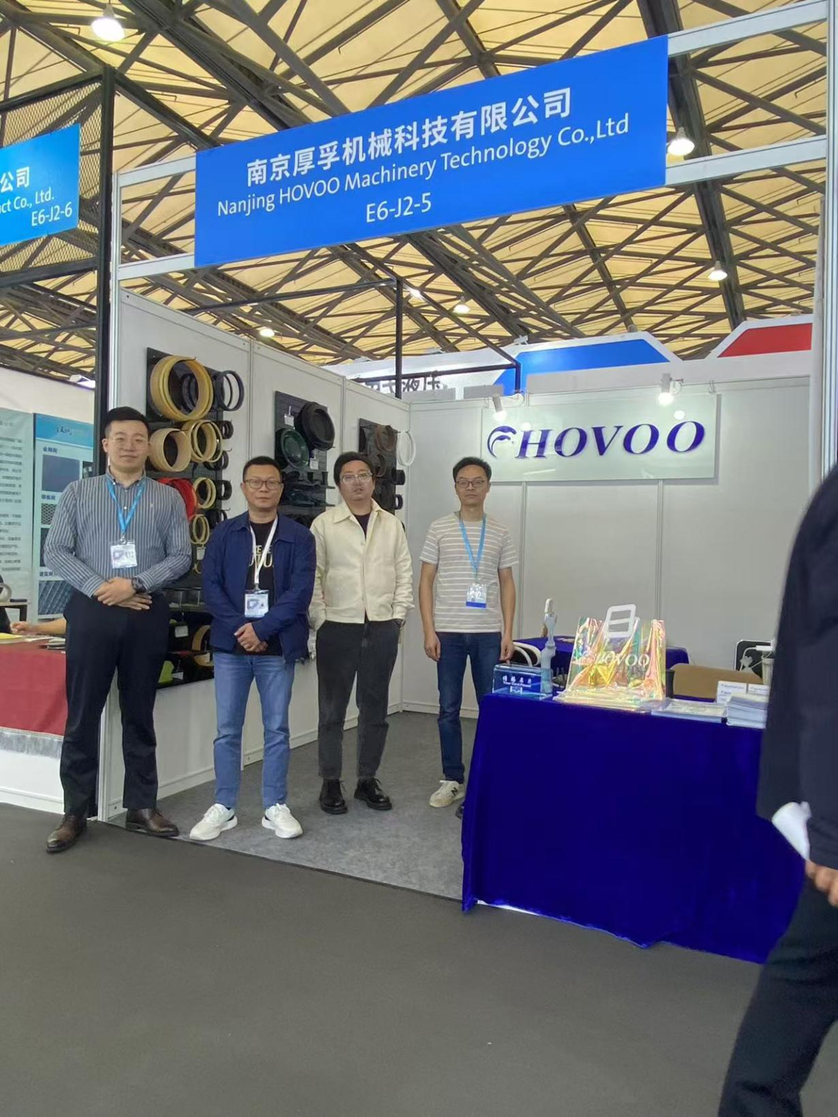
Bauma China 2026 takes place at the Shanghai New International Exhibition Centre (SNIEC) from 24 to 27 November. The show is the largest construction and mining machinery exhibition in Asia, attracting exhibitors and buyers from across the global supply chain. For maintenance engineers, fleet managers, and equipment distributors sourcing hydraulic cylinder seals, Bauma China concentrates dozens of seal manufacturers and distributors in one venue, enabling direct technical comparison and supplier qualification within a compressed timeframe.
Hydraulic cylinder seals are among the highest-volume spare parts in construction and industrial equipment maintenance. A cylinder with degraded seals leaks externally, loses holding force, and can drift under load — all conditions that affect both operator safety and machine productivity. Selecting the right seal profile and material for a specific cylinder application, and sourcing from a supplier who can back technical claims with documentation, are the decisions that determine real-world seal service life. This guide explains what hydraulic cylinder seals do, how to specify them correctly, and what to focus on when evaluating suppliers at Bauma China 2026.
What Functions Do Hydraulic Cylinder Seals Perform?
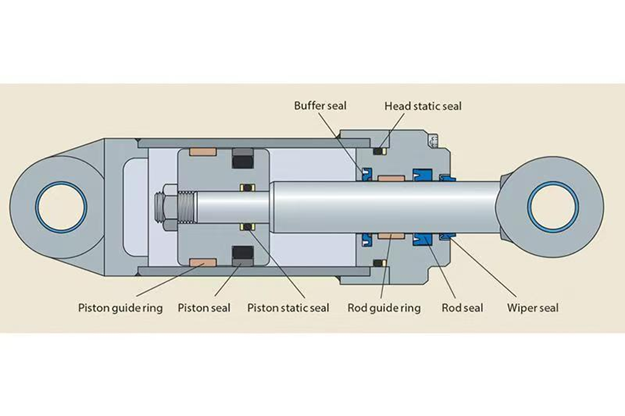
A hydraulic cylinder converts fluid pressure into linear mechanical force. Oil enters one chamber through a port, pressurizes the chamber, and pushes the piston along the bore. The rod attached to the piston extends or retracts, and the external load is applied through a clevis, flange, or rod-end fitting. Seals perform different functions at each position in this assembly.
The piston seal separates the two pressure chambers on either side of the piston. It contains the high-pressure oil in the active chamber and prevents it from bypassing the piston into the opposing chamber. A piston seal that loses its sealing force allows internal bypass: the cylinder can no longer hold a load statically, and extension or retraction speed drops because oil crosses the piston rather than driving it.
The rod seal sits in the cylinder head and seals the piston rod as it passes in and out of the cylinder. It prevents hydraulic oil from leaking along the rod surface to the outside of the machine. The wiper seal or rod wiper sits ahead of the rod seal and scrapes moisture, dirt, and abrasive particles from the rod surface on each retraction stroke, preventing them from being drawn past the rod seal into the oil. O-rings and static seals at port connections and end caps complete the sealing system.
What Seal Profiles Are Used in Hydraulic Cylinders?
Hydraulic cylinder seals are produced in several profiles, each matched to specific groove geometries and operating conditions. Understanding the standard profiles helps when specifying replacements and when comparing products across suppliers at Bauma China.
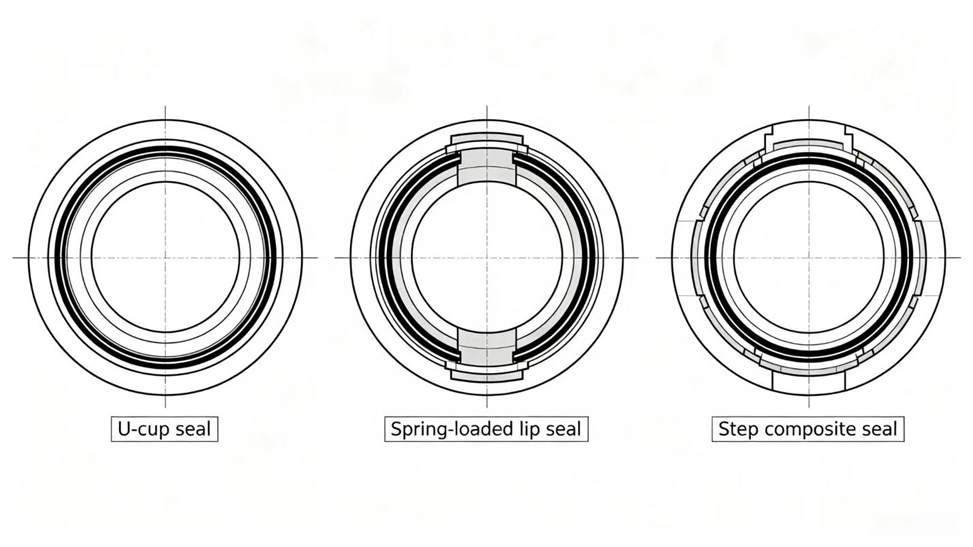
The U-cup or U-ring is the most widely used rod seal profile. Its lips contact the bore and the rod simultaneously, and hydraulic pressure pushes the lips outward, increasing contact force with increasing pressure. Single-acting U-cups are used in symmetric pressure applications; double-acting configurations use back-to-back U-cups or alternative profiles. The loaded lip seal adds an energizing spring or elastomeric insert behind the seal lips to maintain contact at low pressure, useful in applications where the cylinder must seal even when not under load.
Piston seals include composite designs such as the Glyd ring or Step seal, which combine a PTFE sliding face with a rubber energizer. These provide low friction and reliable sealing from zero pressure upward — critical in cylinders where breakout force must be minimized, such as in precision earthmoving attachments. Buffer seals sit ahead of the rod seal and absorb pressure spikes, protecting the primary rod seal from peak transient loads. Wear rings or guide rings are technically not seals but support the piston and rod laterally, reducing side-load contact between metal components and extending seal life by keeping the seal in alignment.
Composite piston seals of the Glyd-ring type address a specific hazard. Two single-acting seals arranged back to back can trap pressurized oil between them and be damaged by it; a double-acting composite seal, built from a PTFE sliding ring and an elastomer energizer, avoids that trap [3]. A PTFE-based sliding ring also avoids the creeping (stick-slip) that rubber seals are prone to, and an application report from a steel strip line credits the improved piston Glyd ring with low friction and reliable sealing in a hydraulic-cylinder-intensive plant [4]. A manufacturer's paper introducing a polyurethane version, launched at Bauma China 2014, quotes application limits of reciprocating motion up to 0.5 m/s (0.8 m/s short term), pressure up to 40 MPa (50 MPa short term), and −30 to +110 °C (120 °C short term) [3]. Those figures belong to one product family and are not general limits; they show the kind of operating envelope a data sheet should state.
The same paper explains why section geometry matters. Sealing performance depends on the compressive stress distribution on the sealing face: a profile whose stress rises steeply on the high-pressure side and falls gently on the low-pressure side seals more efficiently, and a beveled T-profile tolerates a larger extrusion gap than a rectangular profile under the same conditions, which relaxes the machining accuracy required of the cylinder hardware [3]. A recent finite element design study proposes a V-shaped composite for heavy, high-frequency duty, with a PTFE main ring (opening angle optimized at 60°) backed by an NBR support ring that supplies preload and a 45° groove to expel contaminants; the authors report stable sealing from −40 to 120 °C in simulation [5]. That is a design proposal, not a field-proven product, but it shows where seal design is heading.
What Are the Key Material Choices for Hydraulic Cylinder Seals?
Material selection is the most consequential technical decision in hydraulic cylinder seal specification. The correct material for a given application depends on the hydraulic fluid type, the operating temperature range, the pressure and speed of the cylinder, and the mechanical exposure of the rod to abrasive contamination.
Polyurethane (PU) is the dominant material for rod seals and wiper seals in construction equipment. Its high abrasion resistance and tensile strength make it well-suited to the mixed environment of dust, grit, and hydraulic pressure typical of excavator and crane cylinders. One manufacturer's published range for its standard polyurethane hydraulic grades is −30 to +110 °C, with a low-temperature grade rated to −45 °C and a high-temperature grade to +130 °C [3]; other suppliers' compounds differ, so the range must be read from the data sheet of the compound actually offered. For applications above the range of a given grade or with incompatible fluids, HNBR or FKM compounds are specified.
PTFE composite materials are used in Glyd rings, Step seals, and guide bands for the piston position. PTFE compounds filled with glass fiber, carbon fiber, or bronze provide the dimensional stability and low friction required at piston speeds and pressures typical of construction equipment cylinders. NBR and HNBR are used for O-rings and static seals, with HNBR offering improved compression set resistance at elevated temperature. FKM (Viton) is specified for phosphate-ester, fire-resistant, or high-temperature applications but costs significantly more than standard compounds.
Ageing is a real constraint on nitrile. A cylinder leakage study reports that nitrile seals held at 100 °C for 1,000 hours hardened by about 25% and recovered less than 40% of their elasticity, at which point they no longer seal [1]. The same study recommends fluoroelastomer seals above 100 °C and silicone below −20 °C, and treats these as case-specific choices rather than universal limits [1].
Filler choice in PTFE is also a variable worth asking about, not just the word PTFE. A 2026 tribology study of PTFE sealing materials filled with wollastonite fibre found that a fibre aspect ratio of 10:1 gave higher hardness, density, and tensile and compressive strength than 5:1, and lower friction coefficient and wear volume under both dry and oil-lubricated sliding; adding a stannous sulfide–phosphate solid lubricant reduced friction and wear substantially further [6].
How Does ISO 7425 Govern Hydraulic Cylinder Seal Grooves?
ISO 7425 defines the groove dimensions for hydraulic cylinder rod seals (Part 1) and piston seals (Part 2) in single-rod double-acting cylinders. The standard specifies groove width, depth, and corner radius tolerances for a range of rod and bore diameters, providing a common reference that allows seals from different manufacturers to be installed in the same grooves.
Compliance with ISO 7425 is important for interchangeability. A cylinder manufactured to the ISO groove profile should accept any seal specified to the same ISO profile, regardless of supplier. When sourcing replacement seals, verify that the profile designation (U-ring, quad-ring, composite piston seal, and so on) and the ISO groove dimensions match the original housing drawing rather than relying on the previous seal's visual appearance alone.
Not all cylinders are manufactured to ISO 7425. Equipment with non-standard groove profiles, cylinders from manufacturers who use proprietary specifications, and older equipment manufactured before the current standard version may require seals produced to a customer drawing or a legacy standard. At Bauma China, suppliers who offer drawing-to-sample manufacturing as part of their service are particularly valuable for maintenance programs covering diverse or older equipment fleets.
What Are the Common Failure Modes for Hydraulic Cylinder Seals?
Rod seal leakage is the most visible hydraulic cylinder seal failure: oil appears on the rod surface and drips from the cylinder head. It is caused by lip wear, extrusion of the seal material into the rod-head clearance, chemical degradation of the seal compound, or installation damage during overhaul. When oil appears on the rod, inspect the wiper seal first — a failed wiper that allows particles into the rod-seal zone can cause rapid seal lip abrasion even if the seal itself was recently replaced.
Internal bypass past the piston seal is less visible but detectable through cylinder drift under load or reduced extension and retraction speed. Bypass occurs when the piston seal lips lose contact pressure due to compression set, when extrusion damage has reduced the sealing contact area, or when bore wear has created a local clearance that the seal cannot bridge. Checking for bypass requires a pressure hold test with both cylinder ports blocked.
The clearance leakage can be estimated by treating the piston-to-cylinder gap as laminar flow between parallel plates, wrapped around the circumference. The flow has a pressure-driven part and a shear-driven part from piston motion [2]:
Q = π d h3 Δp / (12 μ L) + π d v h / 2 (1)
Here d is the piston diameter, h the radial clearance, Δp the pressure difference across the gap, μ the oil viscosity, L the gap length, and v the piston speed; the sign of the second term depends on the direction of motion [2]. The decisive feature is the cube on h: doubling the clearance multiplies the pressure-driven leakage by eight. If the gap is tapered, with heights h1 at the inlet and h2 at the outlet, the pressure-driven flow becomes [2]:
Q = π d Δp (h1 h2)2 / [ 6 μ L (h1 + h2) ] (2)
This is the basis of a variable-clearance piston design in a 2025 master's thesis: a deformable zone in the piston expands under pressure and closes the gap as pressure rises, with the clearance and pressure-equalizing grooves optimized by simulation to reduce internal leakage [2]. The design shows that internal leakage can be attacked in the hardware as well as in the seal.
Measured data show how the contributing factors rank. In an orthogonal test on a 100 mm bore, 500 mm stroke cylinder with a Glyd-ring main seal at 16 MPa and 50 °C, the authors varied seal wear (0.05 to 0.15 mm), fit clearance (0.03 to 0.09 mm), and oil contamination (NAS class 5 to 9). Measured internal leakage ranged from about 0.32 mL/min at the lowest level of all three factors to about 3.7 mL/min, and the factors ranked as seal wear (range R = 2.41), clearance (R = 1.85), and contamination (R = 0.92) [1]. The same study fits wear depth to a power law in the number of strokes with an exponent of about 0.65 (R² = 0.94), meaning wear grows fastest early in life, and states that leakage rises sharply once wear reaches about 0.15 mm [1]. Those values apply to the tested cylinder and should not be transferred to other designs.
A pressure-hold test can mislead if the oil temperature changes during the test, because oil expands when it warms and the pressure change is then partly thermal. The cited study separates the two. The thermal volume change is V·β·ΔT (β is the thermal expansion coefficient of the oil), the volume change implied by the pressure drop is −(V/K)·ΔP (K is the effective bulk modulus of oil and cylinder), and the leakage volume is the difference [1]:
ΔVleak = −(V/K) ΔP − V β ΔT (3)
For very small leaks below 0.5 mL/min, the study uses wavelet-packet analysis of pressure ripple; the energy entropy of the 125 to 250 Hz band correlated most strongly with leakage (R² = 0.96) [1]. The method is a laboratory result, but it illustrates a general point: external leakage is visible, whereas internal bypass needs a measurement. Pressure above about 20 MPa adds a further mechanism, since a recent design study notes that seals can deform plastically at that level and that stress concentration at the lip then accelerates fatigue [5].
Wiper seal failure allows abrasive particles and moisture to reach the rod seal zone. A worn wiper may leave a visible trail of debris at the cylinder head face or produce a gritty scraping feel during rod movement. Wiper seals in construction equipment operating in dusty environments may require replacement more frequently than the rod seal they protect, making them a worthwhile regular inspection point even outside of full overhaul intervals.
What Should Buyers Compare When Evaluating Cylinder Seal Suppliers at Bauma China?
Hydraulic cylinder seal sourcing decisions at a trade show are best structured around specific technical and commercial criteria. The table below lists the key areas and the expected responses from a technically competent supplier.
Comparison area |
What to ask |
What a credible supplier provides |
Seal profile range |
Which ISO 7425 profiles are stocked; can non-standard profiles be made to drawing? |
Profile catalog with cross-section drawings; sample manufacturing capability |
Material options per position |
Which compounds are available for each seal position and which fluid types are they rated for? |
Material datasheet per compound; fluid compatibility table |
Size range in stock |
What rod and bore diameter range is held in finished stock? |
Stock list or catalog with sizes; lead time for non-stocked sizes |
Quality documentation |
What certificates or test records accompany orders? |
ISO 9001 certificate; material certificates; dimensional inspection records on request |
OEM and aftermarket supply |
Which cylinder manufacturers or OEM brands do they supply? |
Specific OEM or model references; part number cross-reference service |
Technical support |
Can they help specify seals for a non-standard or legacy cylinder? |
Engagement offer; drawing service; application engineer contact |
Bring a sample of the worn or failed seal from your most common cylinder model when visiting the booth. Physical dimensions and visual failure evidence help suppliers confirm the correct replacement profile and identify whether the failure mode indicates a specification issue.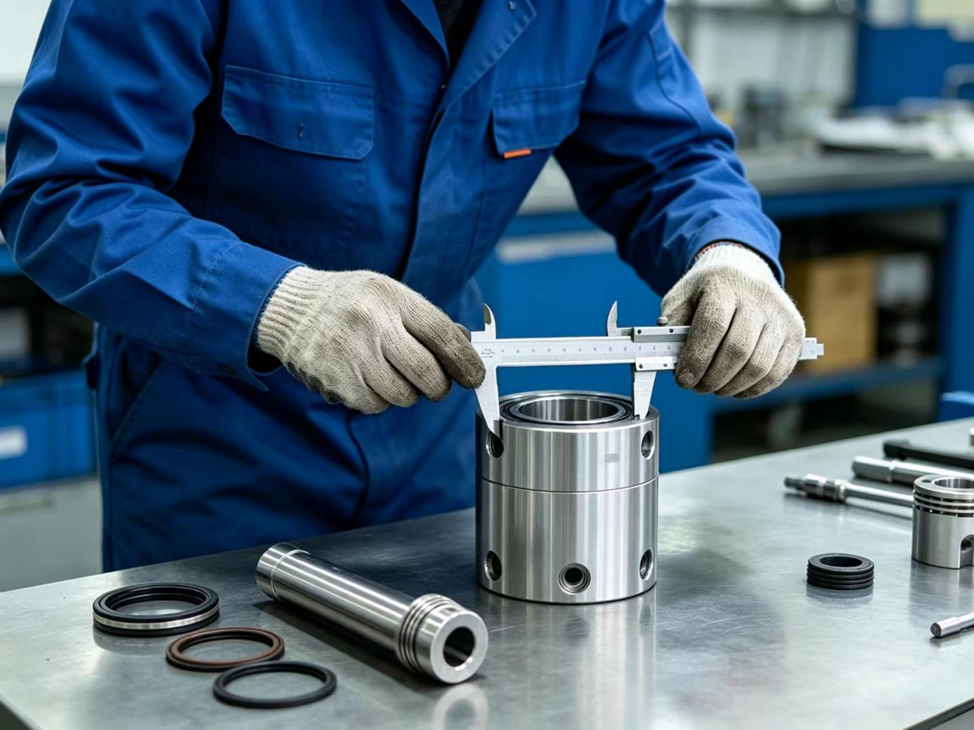
How Should Hydraulic Cylinder Seals Be Installed Correctly?
Incorrect installation is a leading cause of early hydraulic cylinder seal failure. The most common errors are installation damage to the seal lips, incorrect lubrication, and installation with contaminated or scratched rod or bore surfaces.
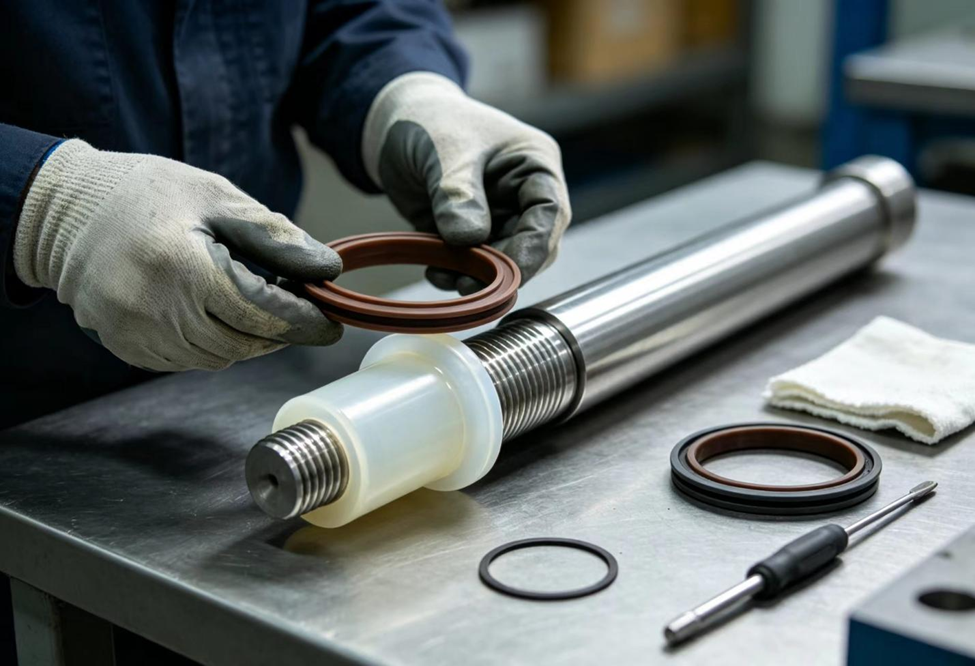
Rod seals must be installed over the rod end without cutting or folding the lips. If the rod has a sharp thread, keyway, or cross-hole that the seal must pass over during assembly, an installation sleeve or cone should be used to protect the lip during fitting. The seal should be lubricated with clean hydraulic oil of the type used in the circuit before installation — never with grease or incompatible lubricants unless the seal manufacturer specifically recommends otherwise.
The rod and bore surfaces must be clean and free from burrs, scores, or corrosion before new seals are installed. A scored rod surface that caused the previous rod seal to fail will fail the replacement seal at the same location. The groove must also be inspected for dimensional accuracy before a new seal is fitted — a groove that is excessively worn or out of tolerance will not provide the correct compression for the new seal.
Two practices from a published repair procedure illustrate acceptance control [1]. The seal is warmed to about 50 °C to expand it before fitting, which reduces installation damage, and the cylinder is accepted only if a pressure-hold test after assembly shows a pressure drop of 0.3 MPa or less. The same procedure restores an out-of-tolerance piston by hard chrome plating and honing to a clearance of 0.03 to 0.05 mm. These are values from one repair method and one cylinder size; use the cylinder manufacturer's specification for your own acceptance criteria. For the oil itself, the study recommends three-stage filtration of new oil (10, 5, and 3 μm), monthly particle counting, and oil change when cleanliness reaches NAS class 7 or water content exceeds 0.1%, again as one maintenance programme's targets rather than universal limits [1].
What Is the Role of Guide Rings and Wear Bands in Cylinder Seal Life?
Guide rings (also called bearing rings, wear rings, or wear bands) sit in grooves on the piston and in the cylinder head and support the piston and rod against lateral (side) loads. They prevent metal-to-metal contact between the piston and the bore or between the rod and the head bore, and they keep the seals aligned correctly during operation.
When guide rings are worn, the piston or rod can shift laterally under side load. This misalignment increases the contact pressure on one side of the seal lip and reduces it on the other, leading to uneven wear, leakage on the loaded side, and premature failure. Guide rings should be inspected and replaced as part of every cylinder overhaul — a new rod seal installed in a cylinder with worn guide rings is likely to fail well before its normal service life.
Guide ring materials include PTFE composite, acetal (POM), and filled phenolic resin, each with different load-carrying capacity, temperature range, and fluid compatibility. At Bauma China, confirm that the supplier includes guide rings in the seal kit for your cylinder model, and verify that the guide ring material is rated for your cylinder's side-load duty.
What Trends in Hydraulic Cylinder Sealing Are Relevant at Bauma China 2026?
Several developments in hydraulic cylinder sealing are visible at industry events in the 2020s. Manufacturers of construction equipment are increasing working pressures to extract more force from smaller and lighter cylinders, which raises the demands on seal extrusion resistance and compression set performance. Seal manufacturers are responding with harder PU compounds and improved PTFE composite formulations with tighter dimensional tolerances.
Biodegradable and ester-based hydraulic fluids are being adopted on equipment working in environmentally sensitive areas. Standard NBR and PU seals may be incompatible with some ester-based fluids; HNBR or FKM compounds are required. Seal suppliers who have tested their products against HEES (hydraulic environmentally acceptable fluid) fluid specifications and can provide immersion test data are better positioned for this market.
Longer planned maintenance intervals are a goal for fleet operators seeking to reduce ownership cost. Seal suppliers who can substantiate extended service life claims with validated test data — rather than marketing assertions — provide a more defensible basis for extending overhaul intervals on high-utilization equipment.
Condition monitoring is moving toward the seal itself. A 2026 study fitted piezoelectric ceramic sensors to the Y-ring seal of a hydraulic cylinder piston rod, extracted singular-value-entropy features from the decomposed stress signal, and used a random-forest classifier to distinguish the sealing stress state under static and moving conditions [7]. This remains at the research stage, but it points to a future in which sealing stress, not just leakage, is measured in service.
How Can Hovoo Seal Support Hydraulic Cylinder Sealing at Bauma China 2026?
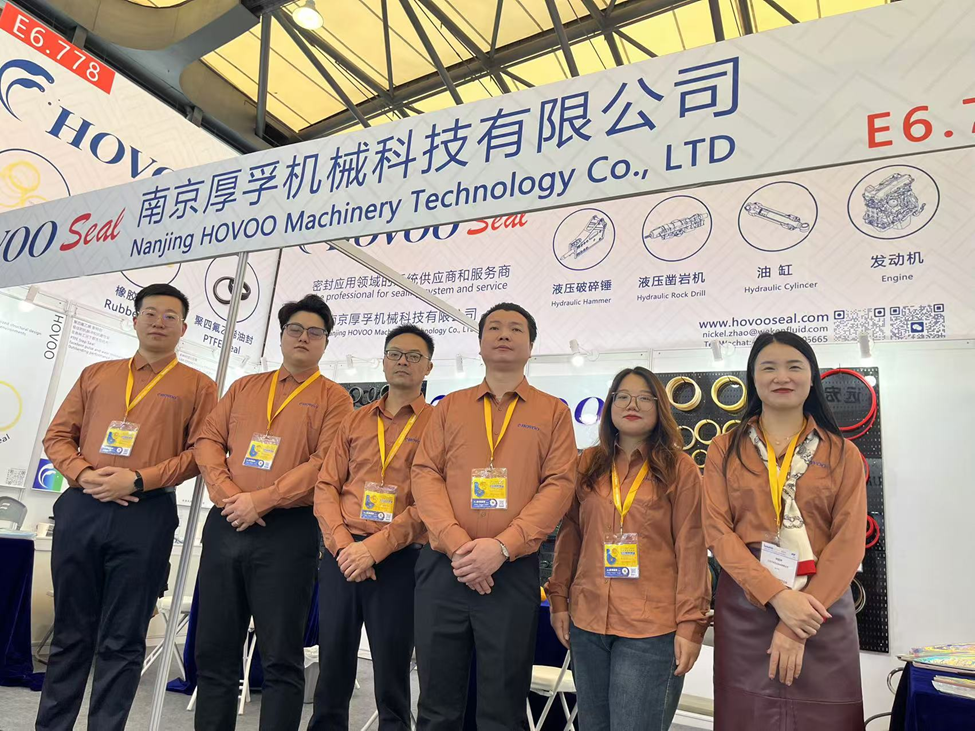
Hovoo Seal (Nanjing Hovoo Machinery Technology Co., Ltd) manufactures hydraulic cylinder sealing components including rod seals, piston seals, wiper seals, buffer seals, O-rings, and guide rings in standard and custom profiles. The product range covers ISO 7425 groove profiles in multiple compound options and extends to non-standard profiles produced to customer drawings. Technical support includes OEM part number cross-referencing, compound selection for non-standard fluids, and groove geometry review for legacy cylinders.
At Bauma China 2026, Hovoo Seal will be at Booth W2-579, Shanghai New International Exhibition Centre (SNIEC), from 24 to 27 November 2026. Buyers and technical teams are welcome to visit the booth with seal samples, cylinder drawings, OEM part numbers, or photographs of wear patterns for on-site technical consultation.
For advance preparation, send the cylinder bore and rod diameter, the groove profile type and dimensions, the hydraulic fluid specification, the working pressure range, and the operating temperature range. This allows the engineering team to prepare a material and profile recommendation before the show and to have representative samples available at the booth.
Conclusion: Hydraulic cylinder seals are a frequently replaced maintenance item whose selection directly affects cylinder reliability, leakage rates, and overhaul cost. Correct profile, compound, and installation practice all contribute to seal service life. Bauma China 2026 provides an efficient venue to evaluate suppliers and compare technical claims across multiple sources in a short time. Visit Hovoo Seal at Booth W2-579 to discuss your cylinder sealing requirements and review the product range for both standard and non-standard applications.
Frequently Asked Questions
How do I identify which seal profile I need for my hydraulic cylinder?
Measure the groove width and depth in the cylinder head (for the rod seal) or on the piston (for the piston seal), and the rod or bore diameter. A profile drawing or the ISO 7425 table will confirm which profile corresponds to those groove dimensions. If the cylinder was manufactured to OEM specifications rather than ISO 7425, contact the OEM or provide the cylinder model and serial number to a seal supplier for a cross-reference.
Can the same PU compound be used for both rod and piston seals?
In principle, yes, but compound hardness and profile geometry are optimized separately for rod and piston positions. Piston seals typically use harder or composite materials to resist extrusion at higher pressures and to provide low friction across a wider pressure range. Rod seals often use a softer compound that conforms better to minor surface variations on the rod. Using a rod seal profile in a piston groove or vice versa is not recommended without engineering review.
What causes a new rod seal to leak immediately after installation?
The most common causes are: installation damage to the seal lip during fitting over a sharp rod feature; a scored or corroded rod surface at the seal contact zone; incorrect groove dimensions that do not provide the specified compression for the seal profile; or a seal that was stored improperly and has hardened or cracked before installation. Check the rod surface and groove dimensions before concluding that the seal was defective.
How often should cylinder seals be replaced as a preventive measure?
Preventive replacement intervals depend on application, operating hours, and environmental exposure. There is no single correct answer applicable across all equipment types. The practical approach is to inspect seals at each major service interval, replace them at the first sign of external leakage or abnormal drift, and maintain a stock of complete seal kits for the most common cylinder sizes in the fleet so that replacements can be made promptly when needed.

References (Chinese-language sources; titles translated)
- Jin Kaixuan, Sun Delong, Cui Hua. Detection and treatment technology for leakage faults in hydraulic cylinders. China Sciencepaper Online Selected Papers, 2026, 19(1), pp. 133–. DOI: 10.3969/j.issn.1674-2850.2026.01.045.
- Tan Laijie. Analysis of deformation characteristics and internal leakage of a hydraulic cylinder variable-gap sealing structure. Master's dissertation, Yanshan University, 2025.
- Ren Luoyi. Introduction to the Zurcon D Glyd Ring. Fluid Power Transmission and Control, 2015, No. 5 (Serial No. 72), pp. 66–68.
- Wei Dongming. Application of the improved piston Glyd ring in the Tangsteel ultra-thin strip production line. Heavy Machinery Science and Technology, 2003, No. 2. DOI: 10.14145/j.cnki.51-1702/th.2003.02.010.
- Li Junliang. Design and durability analysis of a high-end hydraulic cylinder sealing structure. Industrial Design, 2025, No. 21, pp. 17–.
- Pang Xiaoqi, Dou Zhiwei, Li Guoyi, Wang Yong, Lü Xiaoren, Dang Wenlong. Tribological behavior of PTFE sealing materials filled with wollastonite fibre and stannous sulfide–phosphate. Lubrication Engineering, online first, 28 August 2026.
- Yan Peize, Li Hongfang. Measurement of stress sensing for Y-ring sealing of mechanical hydraulic cylinder piston rod under different working conditions. Chinese Journal of Sensors and Actuators, 2026, 39(4), pp. 935–940.
Table of Contents
- What Functions Do Hydraulic Cylinder Seals Perform?
- What Seal Profiles Are Used in Hydraulic Cylinders?
- What Are the Key Material Choices for Hydraulic Cylinder Seals?
- How Does ISO 7425 Govern Hydraulic Cylinder Seal Grooves?
- What Are the Common Failure Modes for Hydraulic Cylinder Seals?
- What Should Buyers Compare When Evaluating Cylinder Seal Suppliers at Bauma China?
- How Should Hydraulic Cylinder Seals Be Installed Correctly?
- What Is the Role of Guide Rings and Wear Bands in Cylinder Seal Life?
- What Trends in Hydraulic Cylinder Sealing Are Relevant at Bauma China 2026?
- How Can Hovoo Seal Support Hydraulic Cylinder Sealing at Bauma China 2026?


