33-99No. Mufu E Rd. Gulou District, Nanjing, China [email protected] | [email protected]
33-99No. Mufu E Rd. Gulou District, Nanjing, China [email protected] | [email protected]

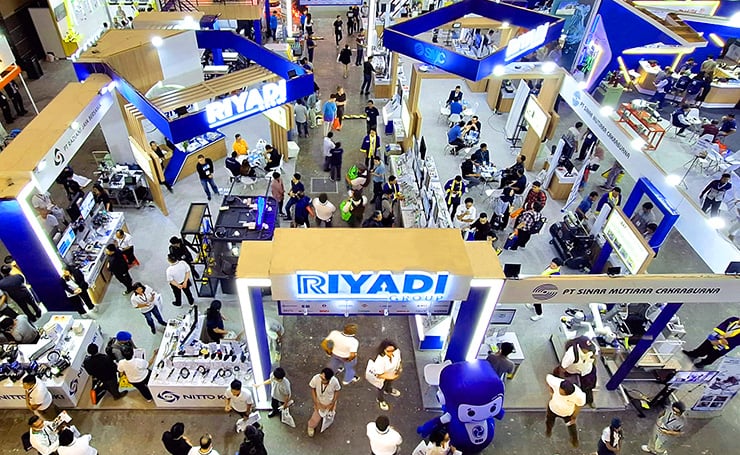 Indonesia's manufacturing sector rarely gets the international attention that Vietnam or Thailand receive, but the underlying numbers tell a different story. Forty-one thousand trade visitors attended Manufacturing Indonesia in 2025, drawn from 1,300-plus exhibiting companies across 29 countries. That scale makes it the largest manufacturing exhibition in Southeast Asia — bigger than comparable shows in Bangkok, Ho Chi Minh City, or Kuala Lumpur — and it reflects a domestic manufacturing base that has been quietly absorbing investment as companies diversify supply chains away from single-country concentration.
The 37th edition of Manufacturing Indonesia runs December 2 to 5, 2026 at the Jakarta International Expo in Kemayoran. Organised by PT Pamerindo Indonesia, the show runs concurrently with four co-located events — Machine Tool Indonesia, Tools & Hardware Indonesia, Industrial Automation Indonesia, and Production Logistics Indonesia — plus newly added Fastener Indonesia and Industrial Paint & Coatings Indonesia sections for 2026. That bundled structure means a single exhibition pass gives access to the complete manufacturing supply chain rather than a narrow product category.
Hydraulic and pneumatic components appear within the show's Air Power & Fluid Power category, alongside compressors, pumps, and valves. This is not a dedicated hydraulics hall in the way Hannover Messe's MDA zone or IFPE structure their fluid power content — at Manufacturing Indonesia, hydraulic components are positioned as one input among many that the broader manufacturing and machine tool buyer community needs to evaluate. That positioning is actually commercially useful for hydraulic component suppliers: the buyers walking through are machine tool operators, automation integrators, and production engineers who need hydraulic actuators and power units as part of complete manufacturing cell specifications, not specialists shopping exclusively within a fluid power silo.
Indonesia's manufacturing growth has been concentrated in automotive component production, electronics assembly, and the metal fabrication that supports both. Each of these sectors uses hydraulic press equipment, clamping systems, and material handling hydraulics at meaningful volume. Indonesian automotive parts manufacturers supplying Toyota, Honda, and Mitsubishi assembly operations in the country need hydraulic stamping presses and injection moulding clamping systems that meet the same quality standards their Japanese OEM customers expect — which creates demand for hydraulic components with documented reliability credentials rather than purely price-driven sourcing.
Category |
Details |
Event Name |
Manufacturing Indonesia 2026 (37th edition) |
Dates |
December 2–5, 2026 |
Venue |
Jakarta International Expo (JIExpo), Kemayoran, Jakarta, Indonesia |
Scale |
1,300+ exhibitors from 29+ countries; 41,000+ visitors (2025 data); organised by PT Pamerindo |
A distinctive feature of Manufacturing Indonesia is its Manufacturing Village area, which combines exhibitor presence with skills development content, business matchmaking, and certified professional training programmes. This structure reflects a deliberate effort by organisers and the Indonesian government to address a skills gap that has been identified as a constraint on manufacturing sector growth — Indonesia's industrial workforce is large but unevenly trained in the precision manufacturing and automation skills that modern production requires. Hydraulic equipment maintenance and troubleshooting skills are part of that broader gap, and component suppliers who participate in the training-oriented programming build a different kind of brand credibility than a purely transactional sales presence would generate.
For hydraulic pump and component manufacturers evaluating Southeast Asian market entry, Manufacturing Indonesia offers a lower-cost, lower-complexity alternative to separately targeting Thailand, Vietnam, and the Philippines. Indonesia's population of over 270 million and its position as ASEAN's largest economy mean that establishing distribution relationships through Jakarta can serve a domestic market large enough to justify the investment on its own — without requiring the immediate multi-country expansion that smaller Southeast Asian markets would necessitate.

Welcome to HOVOO, a Chinese seal factory. Production of PU, Rubber and PTFE seals. The seals include O-ring, piston seal, rod seal, Gray ring and gas seal.


 EN
EN
 AR
AR CS
CS DA
DA NL
NL FI
FI FR
FR DE
DE EL
EL IT
IT JA
JA KO
KO NO
NO PL
PL PT
PT RO
RO RU
RU ES
ES SV
SV TL
TL IW
IW ID
ID LV
LV SR
SR SK
SK VI
VI HU
HU MT
MT TH
TH TR
TR FA
FA MS
MS GA
GA CY
CY IS
IS KA
KA UR
UR LA
LA TA
TA MY
MY
