33-99No. Mufu E Rd. Gulou District, Nanjing, China [email protected] | [email protected]
33-99No. Mufu E Rd. Gulou District, Nanjing, China [email protected] | [email protected]

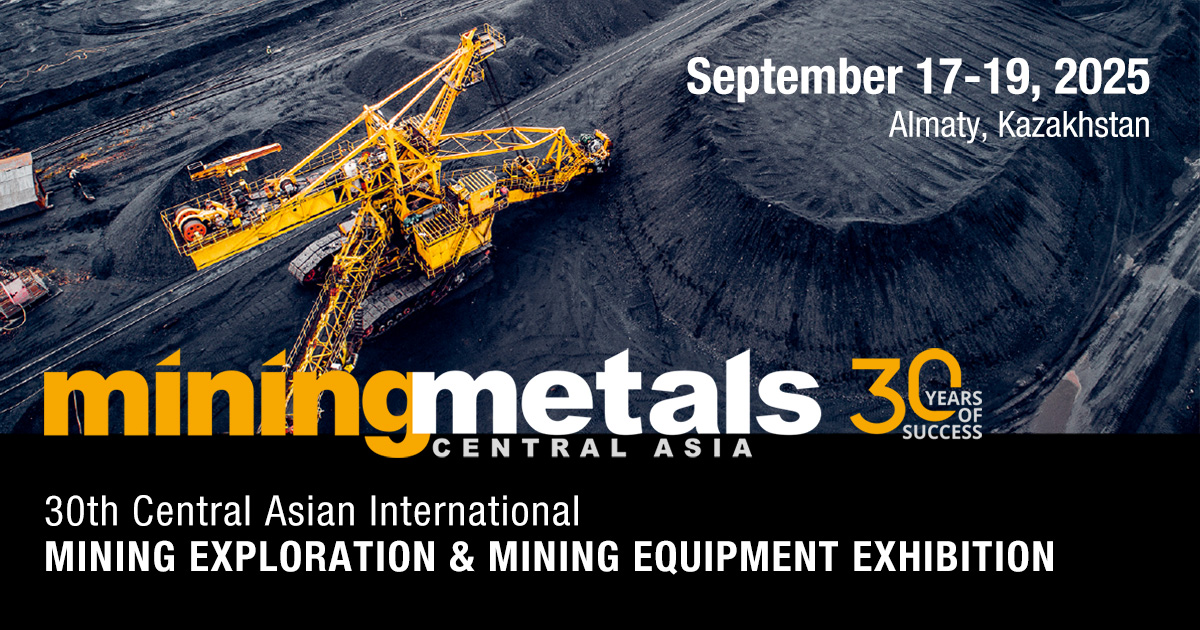
Central Asia doesn't get much attention in Western trade press, but the region sits on top of some genuinely significant mineral wealth. Kazakhstan alone ranks among the top global producers of uranium, chromite, lead, and zinc. It's also a major copper and gold producer. The countries surrounding it — Uzbekistan, Kyrgyzstan, Tajikistan — add further reserves to a region that has been quietly feeding global metals supply chains for decades.
Mining & Metals Central Asia, held in Almaty from September 17 to 19, 2025, is the show that serves this market. It's the 30th edition — a milestone that reflects how consistently the event has held its position as the primary trade platform for the region's mining and metallurgy sectors.
The exhibition takes place at Atakent International Exhibition Centre, a well-established venue on Timiryazev Street in Almaty. The combined indoor and outdoor floor space runs to roughly 9,000 square meters — enough to display heavy equipment alongside services, software, and technical presentations.
The 2025 edition is expected to draw over 500 companies from 40 or more countries. Past editions have pulled in exhibitors from Austria, Germany, the UK, India, Canada, China, Norway, Poland, and Finland — a mix that reflects both the European equipment suppliers and the growing Chinese presence in Central Asian mining investment. Visitor numbers historically land around 2,600 to 3,000 trade professionals.
Covered sectors include open-pit and underground mining equipment, mineral processing technology, geological exploration tools, conveyor and handling systems, drilling equipment, laboratory instruments, environmental protection solutions, and occupational safety gear. Digital mining solutions — fleet management, automation, remote monitoring — have grown as a category in recent years.
It's worth putting Kazakhstan's resource position in perspective. The country holds roughly 12% of the world's known uranium reserves and is consistently the world's largest uranium producer. Its copper deposits support operations by majors including KAZ Minerals and Kazakhmys. Gold production at sites like Kumtor (in neighboring Kyrgyzstan, though operated by regional conglomerates) feeds into the same supply chain networks.
The government has pushed hard to develop processing capacity alongside extraction, which means there's steady demand for both upstream and downstream equipment. A mine opening in Kazakhstan today needs everything from drill rigs and blasting consumables to ore processing mills and materials handling conveyors.
Almaty is no longer the capital — that moved to Astana in 1997 — but it remains Kazakhstan's commercial hub. The major mining companies keep offices here. Equipment distributors, import agents, and after-sales service networks are concentrated in the city. It's where purchasing decisions get made, not just where the ore gets dug.
The business program at Mining & Metals Central Asia typically includes 17 or more industry roundtables, presentations, and seminars. For international suppliers trying to understand the regulatory environment or identify new project pipelines, those sessions can be as useful as the exhibition floor itself.
Category |
Details |
Event Name |
Mining & Metals Central Asia 2025 |
Dates |
September 17–19, 2025 |
Venue |
Atakent International Exhibition Centre, Almaty, Kazakhstan |
Edition |
30th Anniversary |
Central Asia is often skipped by suppliers who focus on the better-known mining markets of Australia, North America, or West Africa. That's partly a legacy of complicated logistics and partly unfamiliarity. But equipment demand in Kazakhstan, Uzbekistan, and surrounding countries is real and growing. Open-pit copper, gold, and coal operations throughout the region use hydraulic breakers for secondary rock breaking, trench preparation, and demolition of concrete structures at processing sites. For companies already selling into the CIS market or looking for their first foothold, this show is the most direct path to the buyers who matter.

Welcome to HOVOO, a Chinese seal factory. Production of PU, Rubber and PTFE seals. The seals include O-ring, piston seal, rod seal, Gray ring and gas seal.


 EN
EN
 AR
AR CS
CS DA
DA NL
NL FI
FI FR
FR DE
DE EL
EL IT
IT JA
JA KO
KO NO
NO PL
PL PT
PT RO
RO RU
RU ES
ES SV
SV TL
TL IW
IW ID
ID LV
LV SR
SR SK
SK VI
VI HU
HU MT
MT TH
TH TR
TR FA
FA MS
MS GA
GA CY
CY IS
IS KA
KA UR
UR LA
LA TA
TA MY
MY
