

 EN
 AR
 CS
 DA
 NL
 FI
 FR
 DE
 EL
 IT
 JA
 KO
 NO
 PL
 PT
 RO
 RU
 ES
 SV
 TL
 IW
 ID
 LV
 SR
 SK
 VI
 HU
 MT
 TH
 TR
 FA
 MS
 GA
 CY
 IS
 KA
 UR
 LA
 TA
 MY

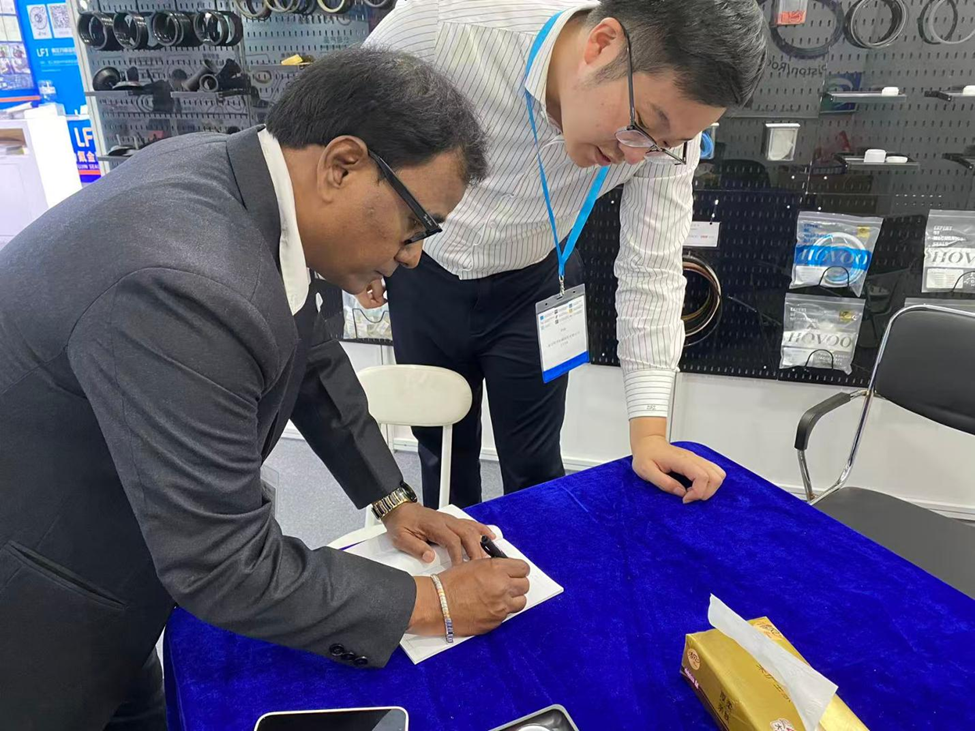
Bauma China 2026 runs from 24 to 27 November at the Shanghai New International Exhibition Centre (SNIEC). As the largest construction machinery trade event in Asia, it draws exhibitors spanning the full supply chain for earthmoving, lifting, concrete, and roadwork equipment. For sealing specialists, procurement managers, and fleet maintenance teams, the show concentrates the major seal suppliers in one location — enabling supplier comparison, product qualification, and technical discussion in a compressed timeframe.
Modern construction machinery is a hydraulic system at its core. An excavator alone may contain dozens of hydraulic cylinders, a travel motor, a swing motor, a main pump unit, and numerous valve bodies — each with its own sealing requirements. A wheel loader, motor grader, or tower crane adds further distinct seal positions across slew rings, gearbox output shafts, and loader arm cylinders. Managing seal maintenance across a mixed fleet requires both breadth — stocking the right components across many machine types — and depth, meaning the technical knowledge to specify the correct material and profile for each application. This article provides a framework for both.
Why Is Sealing Performance Central to Construction Machine Reliability?
Hydraulic systems in construction machinery operate at high pressure, with main working circuits commonly in the tens of megapascals (hundreds of bar), depending on the machine. At these pressures, even a small seal leak represents a significant oil flow rate. A hydraulic cylinder that bypasses internally can drift under load, compromising the safety of any suspended or held load. An excavator travel motor with a leaking case drain seal can overpressurize and destroy the motor housing. A worn hydraulic pump shaft seal gradually contaminates the machine understructure with oil, creates a fire risk in hot environments, and progressively reduces efficiency as internal leakage increases.
The consequences of seal failure in construction equipment extend beyond the cost of the seal itself. Unplanned downtime on a machine operating in a construction schedule has a cost in delayed progress that typically exceeds the repair cost by a large multiple. Emergency seal replacement at a remote site, without a stock of the correct parts, may require days rather than hours. The economics of seal maintenance in construction machinery strongly favor proactive replacement at planned intervals over reactive replacement after failure.
At Bauma China, seal manufacturers targeting the construction machinery market display products for the range of machine types and hydraulic system configurations that contractors and fleet operators manage. Evaluating multiple suppliers in a single visit makes it practical to consolidate the approved vendor list for critical seal types.
Engineering literature separates two kinds of hydraulic leakage that call for different checks. Internal leakage is oil crossing from the high-pressure side to the low-pressure side inside valves, pumps, motors and cylinders; external leakage escapes to the outside through pipe joints, seals, mating faces and housings [1]. A hydraulic cylinder illustrates the distinction: some oil film on the piston rod is needed, because a rod that ran completely dry would wear its seal faster, yet the rod must not leak when stationary [1]. The sealing task is therefore a controlled film, not zero oil.
What Are the Main Seal Categories in a Construction Excavator?
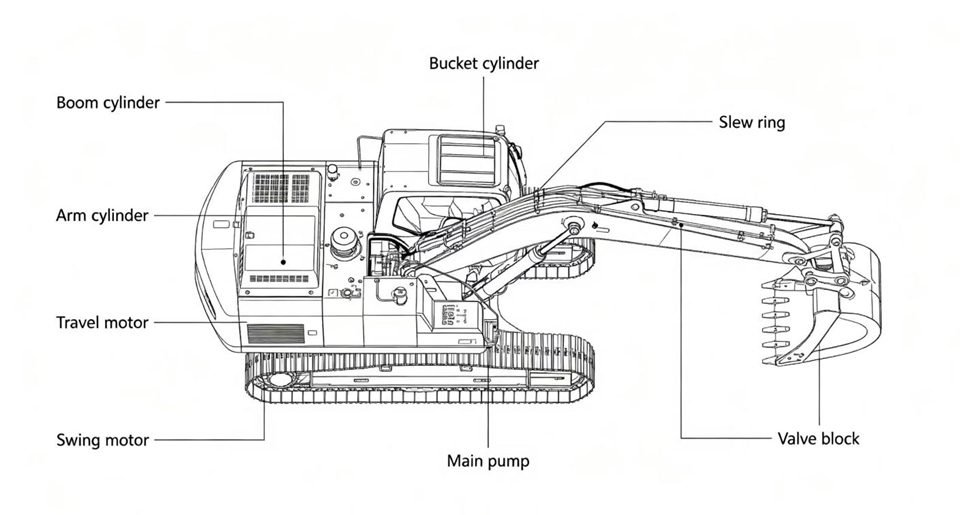
A hydraulic excavator is one of the most seal-intensive machines in the construction fleet. The main categories of seals across the excavator system illustrate the breadth of the sealing challenge that maintenance teams manage.
Cylinder seals cover the boom, arm, and bucket cylinders, as well as the dozer blade cylinder on machines equipped with one. Each cylinder requires a piston seal, rod seal, wiper seal, and static O-rings. The swing motor shaft seal, travel motor shaft seals (one per side), and the main hydraulic pump shaft seal are rotary dynamic seals with different speed and pressure requirements from the cylinder seals. The slew ring bearing, where the upper structure rotates on the undercarriage, is sealed against ingress of water and abrasive grit by lip seals designed for low-speed high-load conditions.
Valve body O-rings at directional control valves, pressure control valves, and solenoid valves are static seals that must resist both the hydraulic pressure and the chemical environment of the specific oil type. Quick-coupler seals on excavator attachments are exposed to frequent connection and disconnection cycles, requiring profiles specifically designed for repeated make-and-break service. A complete excavator seal maintenance program addresses all of these positions, not only the most visible ones.
Slewing bearing seals deserve separate attention because they are large-diameter static-to-slow-dynamic seals with their own design rules. A design paper from a slewing bearing manufacturer describes the usual L-section single-lip nitrile ring, which is cut to length, glued into a loop, and sits in a groove between the inner and outer rings [2]. The same paper contrasts it with a shaft lip seal: slewing bearing seals are commonly larger than 280 mm in diameter, usually have no metal case or spring, and rely on the elasticity of the rubber and the designed compression to seal, so their sealing performance is somewhat lower than a precisely assembled small shaft seal [2]. Where reliability requirements are high, such as shield tunnelling, wind power and radar, one-piece rings are used to avoid stretching during assembly, and a double-lip version is also used [2].
The paper gives design windows for NBR single-lip rings, which are useful as reference points for checking a drawing but should not replace the bearing maker's specification [2]. Lip front angle 30° to 45° and rear angle 25° to 35° as designed, moving after assembly to about 30° to 40° and 35° to 45°; overall lip compression about 1 to 2 mm, with the compression at the lip itself kept to 0.3 to 1 mm (and reduced by 0.5 to 0.8 mm where rotation torque matters); contact face roughness Ra 1.6 to 3.2 μm; groove depth tolerance 0 to +0.3 mm and groove width tolerance 0 to +0.2 mm [2]. It also explains the failure mechanism when the raceway wears: under overturning moment the two rings tilt slightly against each other, the lip compression drops, and a gap can open, letting grease out and mud in [2]. Excess compression has the opposite fault, producing dry contact that accelerates lip wear [2]. A practical consequence is that the swing bearing seal must be checked together with raceway clearance, not in isolation.
The same excavator literature notes that a typical swing bearing seal pair is a lip that thins to a feather edge and seals only by rubber deformation, which resists grease leakage only weakly and is not designed for pressure; over-greasing or heat build-up can therefore push grease past the seal [1].
How Do Environmental Conditions in Construction Sites Affect Seal Specification?
Construction sites present a range of aggressive environmental conditions that affect seal performance differently depending on the machine's role. Soil-moving equipment working in clay, sandy, or rocky ground generates abrasive fine particles that reach all exposed dynamic seal surfaces. The rod of a boom cylinder on an earthmoving excavator extends and retracts through an environment of suspended dust and grit on every work cycle. A wiper seal that does not effectively scrape these particles from the rod surface on each retraction stroke allows them to accumulate at the rod seal lip and abrade it from the outside.
Demolition equipment operates in concrete dust, which is alkaline and highly abrasive. The cement particle size in concrete dust is fine enough to pass through wiper seals that would stop coarser grit, requiring wiper seal compounds with tighter lip tolerances and higher abrasion resistance than those specified for general earthmoving duty.
Equipment operating in tropical or high-humidity environments is exposed to moisture ingress that can affect hydraulic oil quality and accelerate corrosion on rod surfaces. Rod corrosion creates surface irregularities that abrade rod seals, and the corroded surface is more abrasive than the smooth chrome or hard chrome coating it replaces. Slew ring seals on equipment operating in wet environments require lubricant-compatible rubber compounds and regular re-greasing to maintain the grease bead that excludes water.
What Seal Materials Dominate Construction Machinery Applications?
Polyurethane (PU) is the most widely used material for dynamic seals in construction machinery cylinders because it combines high abrasion resistance, tensile strength, and the compliance needed for reliable sealing contact across varying pressure conditions. PU rod seals and wiper seals are standard on excavators, wheel loaders, and cranes operating with mineral-based hydraulic oil in the typical construction site temperature range.
NBR remains the primary material for O-rings, static seals, and low-pressure rotary shaft seals. Its balance of cost, availability, and compatibility with mineral oil makes it suitable for the majority of static sealing positions in construction equipment valve bodies and port connections. HNBR extends the temperature and chemical resistance range compared to standard NBR and is used in higher-temperature applications such as engine-compartment hydraulic circuits and swing motor shaft seals.
FKM (Viton) is the premium compound for applications involving non-standard hydraulic fluids, elevated temperatures, or aggressive chemical environments. Its higher cost relative to NBR and PU is justified when the operating conditions fall outside the NBR service range. PTFE composite materials are used in guide rings, wear bands, and step seal piston seals where low friction and high load capacity are required simultaneously. At Bauma China, it is worth verifying that suppliers stock the full range of compound options rather than defaulting to a single material for all positions.
How Are Seal Requirements Different Across Construction Machine Types?
Different construction machine types impose distinct seal selection requirements, and a supplier with strong coverage across machine types is more valuable to a mixed-fleet operator than one specializing in a single category.
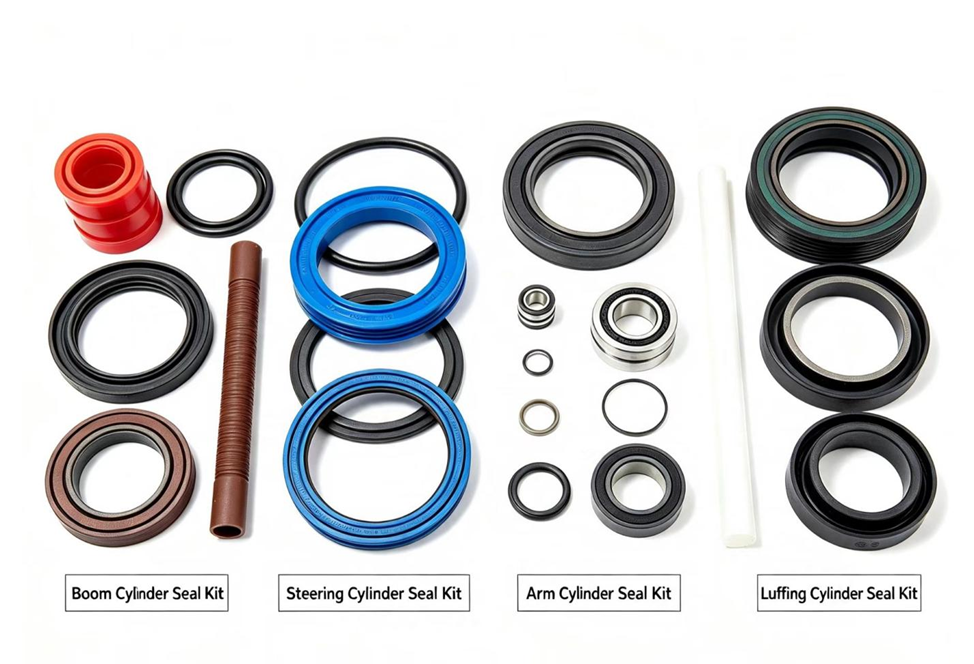
Wheel loaders and motor graders use long-stroke steering cylinders and bucket lift cylinders that operate at moderate speed but high cycle rate. The wiper seals on these cylinders accumulate significant dirt ingress because the cylinders are often near the machine ground line. Compact equipment — mini excavators, skid steers, and compact track loaders — uses smaller cylinder diameters and higher-pressure circuits to achieve force output from a smaller package, requiring seals with higher extrusion resistance for the bore diameter.
Tower cranes and mobile cranes have luffing, telescoping, and jib cylinders that must hold loads statically for extended periods without drift. The piston seal in a crane holding cylinder must maintain sealing force under long-term static load without developing compression set that would allow bypass to develop over time. Compactors and rollers expose their vibratory drum bearings and shaft seals to continuous oscillation rather than the reciprocating motion of a hydraulic cylinder — this requires different seal profile geometry and compound characteristics.
What Questions Should Fleet Maintenance Teams Ask at Bauma China?
A structured evaluation at Bauma China 2026 produces the most useful outcomes when procurement and maintenance teams arrive with a defined list of machine models, seal positions, and technical questions. The table below identifies the key discussion areas and the answers to seek from potential suppliers.
Discussion area |
Question to ask |
Target response |
Fleet coverage |
Which excavator, loader, and crane models are you able to supply seals for? |
Specific brand and model list; OEM part number cross-reference service |
Material range |
What compounds are available for cylinder rod seals, piston seals, and shaft seals? |
PU, NBR, HNBR, FKM, and PTFE options stated per seal position |
Custom profile capability |
Can you produce non-standard profiles to a customer drawing for legacy equipment? |
Drawing service offered; sample lead time quoted |
Complete seal kit offering |
Do you supply complete kits by machine model, or only individual seals? |
Kit list with model and position coverage per kit |
Stock and lead time |
What is in finished goods stock versus made to order, and what are the lead times? |
Stock list with quantities; standard and urgent lead time statements |
Technical documentation |
What material certificates and dimensional inspection records accompany shipments? |
ISO 9001 certificate; batch certificates on request; DXF drawings available |
How Should Seal Inventory Be Managed for a Construction Fleet?
Effective seal inventory management for a construction fleet balances the risk of stockout against the cost of holding excess inventory. For high-criticality machines — those on tight production schedules or hard to access for emergency repair — holding a complete seal kit for each cylinder model and motor type provides insurance against unplanned downtime. For lower-criticality equipment, maintaining stock of the highest-frequency consumables (wiper seals and rod seals for the most common cylinder sizes) with planned replenishment is more economical.
Consolidating the approved supplier list to two or three qualified sources for critical seal types reduces the number of vendor relationships to manage without compromising supply security. At Bauma China, the opportunity to assess multiple suppliers in a short time supports this consolidation exercise: a buyer who visits five seal booths in one day and evaluates documentation and samples from each leaves with enough information to narrow the approved vendor list more effectively than through individual factory visits spread over months.
Shelf life management is also an inventory consideration. Polyurethane and rubber seal compounds degrade under UV light, ozone, and heat even before installation. Seals that have been in storage for several years in suboptimal conditions may fail early in service. Establishing and enforcing a maximum stock age policy — with first-in-first-out rotation and periodic inspection of stored seals — protects the investment in seal inventory.
A steel-mill study of hydraulic leakage, though set in a fixed plant rather than on a mobile machine, identifies practices that transfer to equipment fleets: seal grooves must be cleaned thoroughly before seals are fitted, filter elements should be changed with closed oil drainage, threaded connections that loosen under vibration can be replaced by SAE flanges, high-pressure hoses can damp vibration at valve stands, and inspections should be recorded on a checklist that is closed out [3]. That paper attributes leakage to four root causes (seal failure, worn or defective components, piping, and maintenance or operating errors) and rates seal failure and loose pipe connections as the main direct causes in its plant [3].
What Role Does Hydraulic Oil Quality Play in Seal Service Life?
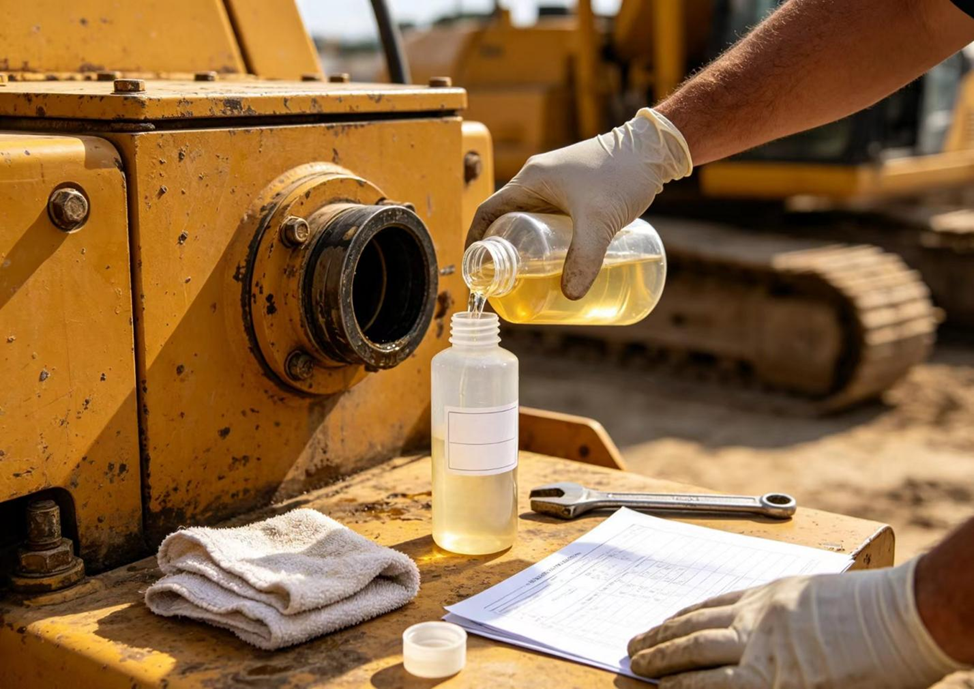
The condition of the hydraulic oil in a construction machine has a direct effect on the service life of every elastomeric seal in the system. Contaminated oil — with water, metal particles, or degraded additives — accelerates the chemical attack and abrasive wear that degrade seals from the inside. An oil contamination study of a hydraulic system that is consuming seals at an unexpected rate often reveals that the oil condition is the root cause rather than the seal specification.
Water contamination is particularly damaging. Water lowers the lubricity of the oil film at dynamic seal contact surfaces and promotes rust formation on cylinder rods and bores. Water-contaminated oil also accelerates the hydrolysis of polyurethane seal compounds, causing swelling, softening, and eventual loss of mechanical integrity. The source of water contamination in construction equipment is typically condensation in the hydraulic tank, rod retraction drawing moisture past a failed wiper seal, or contamination during maintenance.
Air is a third contaminant that is easy to overlook. Hydraulic oil at atmospheric pressure can dissolve roughly 10% air by volume, and under high pressure more [1]. When the pressure swings rapidly between high and low, the dissolved air forms bubbles that collapse violently on the high-pressure side; if component surfaces are already pitted, the oil jet attacks them and speeds up wear and leakage [1].
Particle contamination from worn components circulates through the hydraulic circuit and reaches every seal contact surface. A system contaminated with metal particles from a failing pump or motor distributes those particles to every cylinder and motor downstream. A seal failure investigation that does not include oil sampling and particle analysis may result in repeated seal replacement without addressing the contamination source.
How Can Hovoo Seal Support Construction Machinery Seal Requirements at Bauma China 2026?
Hovoo Seal (Nanjing Hovoo Machinery Technology Co., Ltd) supplies hydraulic sealing components across the construction machinery sector, including complete seal kits and individual seals for excavator cylinders, wheel loader cylinders, crane cylinders, travel motors, swing motors, and hydraulic pump shaft applications. The product range covers rod seals, piston seals, wiper seals, O-rings, backup rings, guide rings, and shaft seals in standard profiles and custom configurations produced to customer drawings.
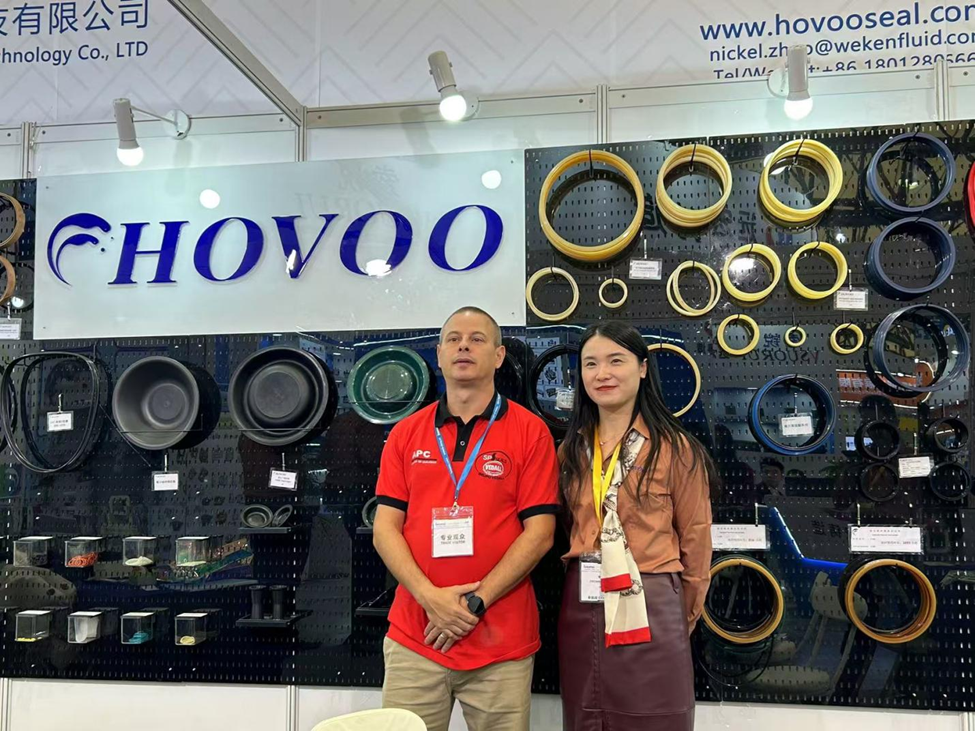
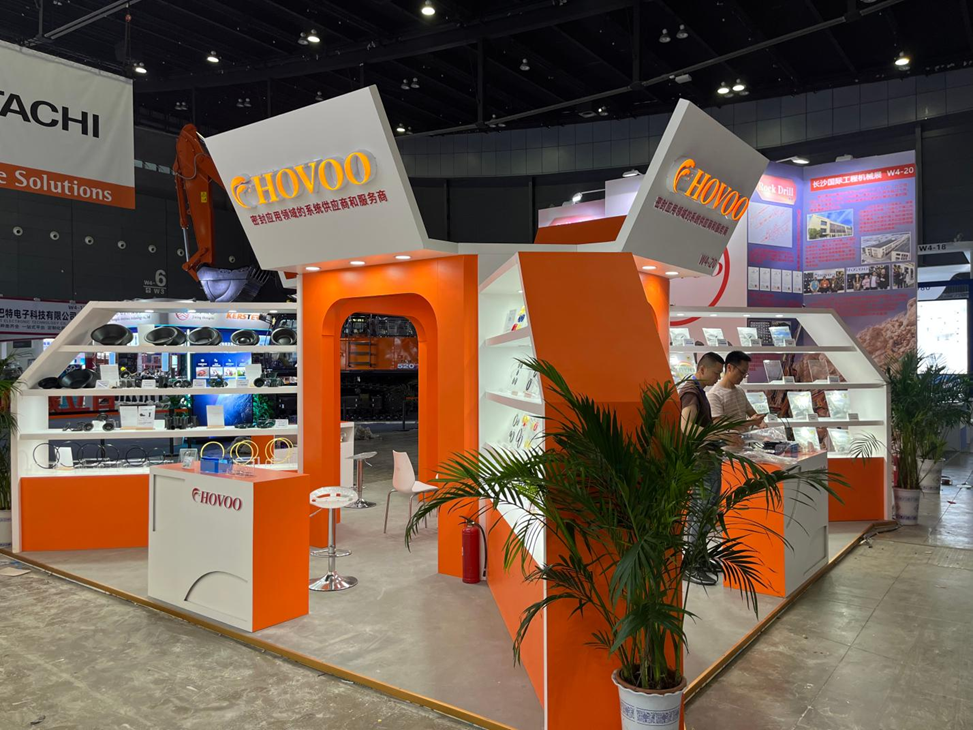
At Bauma China 2026, Hovoo Seal will exhibit at Booth W2-579, Shanghai New International Exhibition Centre (SNIEC), from 24 to 27 November 2026. Maintenance teams, procurement managers, and distributors are welcome at the booth to discuss machine-model coverage, review seal kit contents, and request on-site technical consultation. Bring OEM part numbers, machine model references, or physical seal samples for the most efficient discussion.
To prepare an inquiry before the show, provide the machine manufacturer and model, the cylinder bore and rod diameter or motor model designation, the hydraulic fluid type, and the operating environment description. This allows the team to identify the correct seal specifications and prepare relevant samples for the booth visit.
Conclusion: Construction machinery seal maintenance spans a broad range of machine types, hydraulic system architectures, and environmental conditions. Effective fleet maintenance programs require correct material specification for each application, reliable supply across the full range of machine models in the fleet, and systematic inventory management to prevent both stockouts and degradation of stored components. Bauma China 2026 provides the most efficient opportunity in Asia to evaluate multiple seal suppliers and to build the technical and commercial relationships needed for consistent fleet support. Visit Hovoo Seal at Booth W2-579 to discuss your fleet's sealing requirements.
Frequently Asked Questions
What is the most common cause of excavator hydraulic cylinder seal failure?
Wiper seal failure followed by rod seal abrasion is the most common cause on excavators in dusty or gritty environments. When the wiper seal degrades, particles reach the rod seal lip and abrade it on every retraction stroke. The rod seal then leaks externally, which is the first visible symptom. Replacing only the rod seal without also replacing the wiper seal results in rapid re-failure of the replacement seal.
How do I decide which cylinder seals to keep in stock versus order on demand?
Priority stock items are the rod seals and wiper seals for the highest-frequency cylinders on the machines with the tightest schedules. Complete seal kits for critical machine models and cylinder positions provide the fastest response to unplanned failures. Items for older or low-utilization machines can generally be ordered on demand, provided the supplier's lead time is acceptable. Review actual replacement frequency over the past 12 to 24 months to rank seal types by consumption rate.
Can aftermarket seals match OEM performance?
They can, provided the aftermarket seal is produced to the same dimensional specification and compound designation as the OEM part, and the supplier has quality documentation to support those claims. The risk with aftermarket seals lies not in the concept of using non-OEM parts, but in sourcing from suppliers who cannot provide material verification and dimensional inspection records. A qualified aftermarket supplier with ISO 9001 certification and traceable material certificates offers a comparable quality basis to OEM supply at a competitive price.
Why does the swing bearing seal on my excavator leak grease?
The common causes are raceway wear that opens the gap, a seal lip worn to a feather edge, and over-greasing or heat that raises pressure inside the bearing [1][2]. Check the seal compression and the raceway clearance together, and avoid pumping extra grease into a bearing that is already leaking.
What should I inspect on a returned cylinder before re-sealing it?
Inspect the rod surface for scoring, corrosion, or pitting in the seal contact zone. Inspect the rod seal groove for dimensional accuracy and clean the groove thoroughly before installing new seals. Check the bore surface for scoring or corrosion, especially near the wiper seal land. Inspect the guide rings for wear — a cylinder returned for rod seal replacement should have the guide rings measured and replaced if they are near the wear limit. Check the oil in the cylinder for evidence of water or particle contamination.

References (Chinese-language sources; titles translated)
- Zhang Yue. Leakage in excavator hydraulic systems and preventive measures. China Water Transport, 2008, 8(12), pp. 142–143.
- Zhu Yong, Dai Yongfen, Wang Yongming. Design and material selection of lip seal rings for slewing bearings. Construction Mechanization, 2014, No. 12, pp. 64–67. DOI: 10.13311/j.cnki.conmec.2014.12.025.
- Wei Yigao. Causes of leakage in mechanical hydraulic systems and control measures. Proceedings of the 2025 China Equipment Management New Trends Exchange, China Association of Plant Engineering, 2025(10), pp. 43–45.
Table of Contents
- Why Is Sealing Performance Central to Construction Machine Reliability?
- What Are the Main Seal Categories in a Construction Excavator?
- How Do Environmental Conditions in Construction Sites Affect Seal Specification?
- What Seal Materials Dominate Construction Machinery Applications?
- How Are Seal Requirements Different Across Construction Machine Types?
- What Questions Should Fleet Maintenance Teams Ask at Bauma China?
- How Should Seal Inventory Be Managed for a Construction Fleet?
- What Role Does Hydraulic Oil Quality Play in Seal Service Life?
- How Can Hovoo Seal Support Construction Machinery Seal Requirements at Bauma China 2026?
- Frequently Asked Questions


