33-99No. Mufu E Rd. Gulou District, Nanjing, China [email protected] | [email protected]
33-99No. Mufu E Rd. Gulou District, Nanjing, China [email protected] | [email protected]

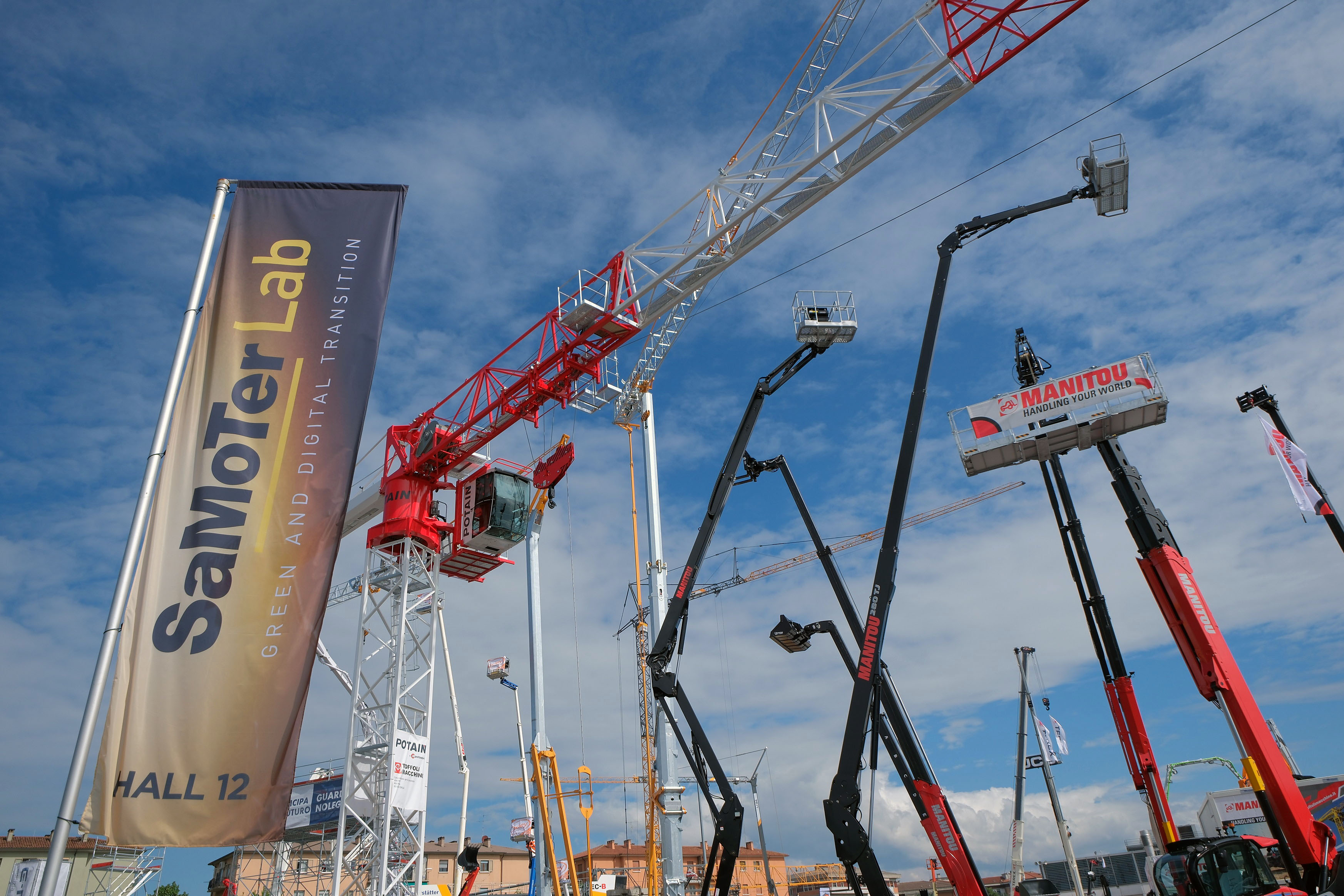
Italy is not the first country that comes to mind when people think about construction machinery markets. Germany has the engineering density, the US has the raw scale, and China now has the volume. But Italy has something those markets struggle to replicate: a cluster of precision machinery manufacturers — mostly in Emilia-Romagna and the Veneto — that have been building high-specification earthmoving attachments, demolition equipment, screening systems, and crushing plant since the 1960s. SaMoTer is where that cluster puts itself on display every three years, and after sixty-two years it remains the most important construction machinery event in southern Europe.
The 32nd edition runs May 6 to 9, 2026 at Veronafiere — the same exhibition grounds that have hosted the show since its relocation from Milan decades ago. This edition brings 526 confirmed exhibitors, of which 124 come from 22 countries outside Italy. Six indoor halls and three outdoor demonstration areas deliver 52,000 square metres of net exhibition space. Visitors for the 2026 edition are expected to exceed 86,000.
The first SaMoTer took place in 1964, on grounds that no longer exist, as part of a post-war Italian construction boom that needed a showcase. The show's longevity is not a matter of institutional inertia — it reflects the ongoing importance of northern Italy as a manufacturing hub for the construction machinery sector. Companies like MB Crusher, Simex, Cangini Benne, Mantovanibenne, and Demarec all have deep Italian manufacturing roots. When SaMoTer comes around, these companies don't consider whether to attend. The question is how large a stand to book.
The triennial cycle has worked in the show's favour. Three years is enough time for product generations to genuinely change — new hydraulic circuits, revised carrier interfaces, updated crushing geometries, different steel specifications. A company that exhibits at SaMoTer 2023 and comes back in 2026 is expected to show something that has moved forward in a way visitors can evaluate. The cycle creates commercial pressure to innovate, and that pressure keeps the exhibition floor from becoming a catalogue of stagnant products in new paint.
The earthmoving sector is the heart of the show — it has been since 1964. Excavators, loaders, graders, and telescopic handlers dominate the indoor halls, with the larger machines spilling into the outdoor areas where they can be demonstrated in operating conditions. The demolition, drilling, and crushing segment has grown substantially in recent editions, reflecting the increasing importance of urban demolition and aggregate recycling in European construction activity. Road construction machinery — pavers, rollers, milling heads — occupies a separate section co-located with Asphaltica, a road infrastructure event that runs alongside SaMoTer.
The Digital Construction Site, running in Outdoor Area F across 5,000 square metres, is the show's most explicitly forward-looking feature. Companies including CASE, Caterpillar CGT, Komatsu, Volvo CE, Leica Geosystems, Topcon, and Trimble are demonstrating integrated machine-control and site-management systems in live operating conditions — not on a screen in a conference room, but on a moving excavator carrying out actual earthmoving tasks under precision GPS guidance. That format is what distinguishes SaMoTer's approach to technology showcasing from most European trade fairs.
Category |
Details |
Event Name |
SaMoTer 2026 (32nd edition) |
Dates |
May 6–9, 2026 |
Venue |
Veronafiere, Viale del Lavoro 8, 37135 Verona, Italy |
Scale |
526 exhibitors (124 international, 22 countries); 86,000+ visitors; 52,000 m² net area |
A new element in 2026 is the SaMoTer Academy, developed in partnership with Engim Veneto — a vocational training institution with strong ties to the industrial north of Italy. The programme runs training and certification sessions on construction machinery operation, maintenance, and safety alongside the main exhibition. The Academy addresses something the industry has been discussing for years: the technical skills gap that is widening as experienced operators retire and younger workers enter the sector without equivalent hands-on background. Attaching a structured training programme to a trade fair creates a rare combination of commercial and educational value in the same venue over the same four days.
For hydraulic breaker, crusher bucket, and demolition attachment manufacturers, SaMoTer represents a specific type of commercial opportunity. Italian OEMs and rental companies are among the most technically demanding buyers of attachments in Europe. The construction site conditions in Italy — hard limestone and granite in the Apennines and Alps, dense urban environments requiring controlled demolition, and infrastructure rehabilitation programmes at significant scale — create real operational requirements that buyers know from direct experience. Exhibiting at SaMoTer puts attachment products in front of buyers who can immediately evaluate them against what they currently run. That quality of commercial conversation is harder to find at larger, more generalist shows where attachments compete for attention against the spectacle of a 100-tonne excavator on a rotating platform.

Welcome to HOVOO, a Chinese seal factory. Production of PU, Rubber and PTFE seals. The seals include O-ring, piston seal, rod seal, Gray ring and gas seal.


 EN
EN
 AR
AR CS
CS DA
DA NL
NL FI
FI FR
FR DE
DE EL
EL IT
IT JA
JA KO
KO NO
NO PL
PL PT
PT RO
RO RU
RU ES
ES SV
SV TL
TL IW
IW ID
ID LV
LV SR
SR SK
SK VI
VI HU
HU MT
MT TH
TH TR
TR FA
FA MS
MS GA
GA CY
CY IS
IS KA
KA UR
UR LA
LA TA
TA MY
MY
