33-99No. Mufu E Rd. Gulou District, Nanjing, China [email protected] | [email protected]
33-99No. Mufu E Rd. Gulou District, Nanjing, China [email protected] | [email protected]

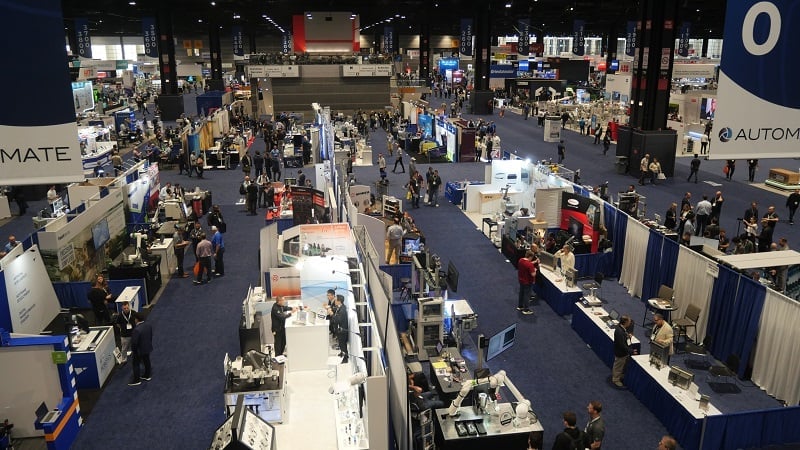
Industrial automation is often presented as an electric-motor story — servo drives, linear actuators, and robotic arms powered by precisely controlled electric motors rather than fluid power. That framing misses an important reality: hydraulic and pneumatic actuation remain essential in specific automation applications where force density, simplicity, or environmental tolerance make fluid power the better engineering choice. Automate, the largest robotics and automation trade show in North America, reflects that reality with a dedicated fluid power presence alongside its dominant robotics and vision technology content.
Automate 2026 runs in major US convention venues on its established biennial-adjacent schedule, organised by the Association for Advancing Automation. The show has grown substantially in recent editions as manufacturing labour shortages and reshoring investment have driven automation adoption across US industry. Robotic arms, machine vision systems, AI-driven quality inspection, and collaborative robots dominate the exhibitor list — but the hydraulic and pneumatic actuator companies present at Automate are there because real automated systems still need fluid power for specific functions.
Hydraulic actuation remains the preferred technology for high-force, compact applications: die-casting machine clamping systems, large-format press automation, and material handling equipment that needs to move heavy loads with simpler control architecture than an equivalent servo-electric system would require. Pneumatic actuation dominates high-speed, lower-force applications throughout automated assembly lines — pick-and-place mechanisms, clamping fixtures, and the countless small actuators that perform simple binary motions thousands of times per shift with minimal maintenance requirements.
The hydraulic component companies exhibiting at Automate are typically positioning their products specifically for integration into robotic and automated systems — compact hydraulic power units designed to fit within automated cell footprints, electrohydraulic actuators that combine the force density of hydraulics with the precise positioning control that automation engineers expect from electric servo systems, and the smart valve technology that allows hydraulic actuators to communicate status and diagnostic data to the same industrial network protocols that govern the rest of an automated production line.
Category |
Details |
Event Name |
Automate 2026 |
Dates |
2026 (confirm exact dates at automateshow.com) |
Venue |
Major US convention city (recent editions: Chicago, Detroit) |
Scale |
Organised by Association for Advancing Automation (A3); growing exhibitor base |
Automate's recent growth has been driven substantially by the same forces reshaping US manufacturing more broadly: persistent skilled labour shortages, the commercial logic of reshoring production closer to end markets, and the falling cost of robotics and vision systems relative to labour. As US manufacturers automate processes that were previously manual, the integration challenges that arise — fitting actuation systems into existing factory footprints, retrofitting older production lines with automated material handling — frequently favour hydraulic solutions precisely because of their force density and relative tolerance for the contamination and variable operating conditions found in older manufacturing facilities being upgraded rather than built from scratch.
For hydraulic pump and actuator manufacturers, Automate offers access to a buyer community — automation integrators, robotics engineers, and manufacturing engineering managers — that is differentiated from both the traditional industrial hydraulics market reached through Hannover Messe and the mobile equipment market reached through IFPE. The integrators and OEMs at Automate are assembling complete automated systems and need actuation components that integrate cleanly with electrical and software control architectures, which rewards hydraulic component suppliers who have invested in the digital and communication capabilities that modern automated systems require.

Welcome to HOVOO, a Chinese seal factory. Production of PU, Rubber and PTFE seals. The seals include O-ring, piston seal, rod seal, Gray ring and gas seal.


 EN
EN
 AR
AR CS
CS DA
DA NL
NL FI
FI FR
FR DE
DE EL
EL IT
IT JA
JA KO
KO NO
NO PL
PL PT
PT RO
RO RU
RU ES
ES SV
SV TL
TL IW
IW ID
ID LV
LV SR
SR SK
SK VI
VI HU
HU MT
MT TH
TH TR
TR FA
FA MS
MS GA
GA CY
CY IS
IS KA
KA UR
UR LA
LA TA
TA MY
MY
