

 EN
EN
 AR
AR CS
CS DA
DA NL
NL FI
FI FR
FR DE
DE EL
EL IT
IT JA
JA KO
KO NO
NO PL
PL PT
PT RO
RO RU
RU ES
ES SV
SV TL
TL IW
IW ID
ID LV
LV SR
SR SK
SK VI
VI HU
HU MT
MT TH
TH TR
TR FA
FA MS
MS GA
GA CY
CY IS
IS KA
KA UR
UR LA
LA TA
TA MY
MY
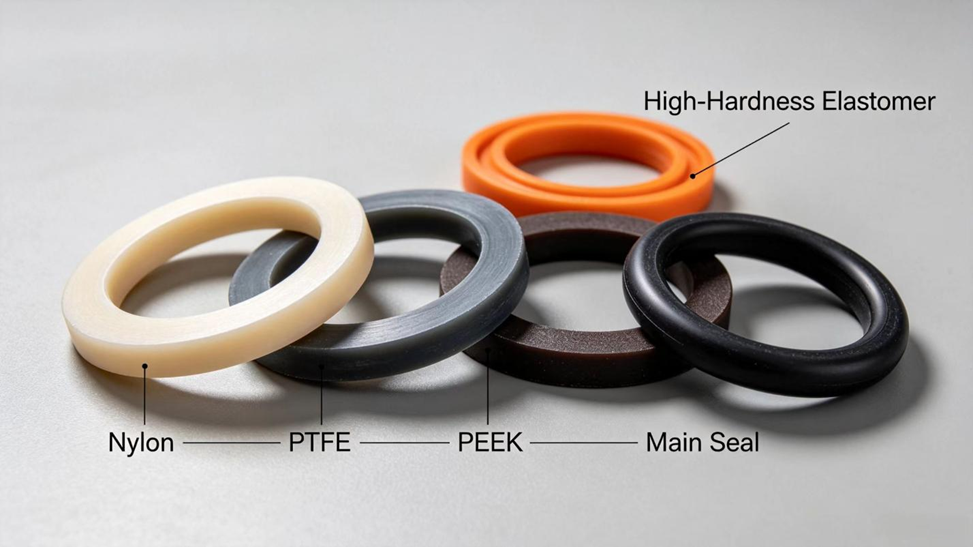
A backup ring has a simple purpose, which is to be harder than the seal beside it and so keep that seal out of the clearance gap. But “harder” is a relative term, and the materials used for backup rings span a wide range of strength, temperature capability, and cost. This article explains the materials most commonly used, what each one is good at, and how the trade-offs work in a hydraulic circuit with pulsating pressure. Figures quoted below come from published engineering studies, listed at the end. Many were measured on test specimens or in other industries, so they show trends and are not ratings for a particular ring.
What Is a Rock Drill Backup Ring Made Of?
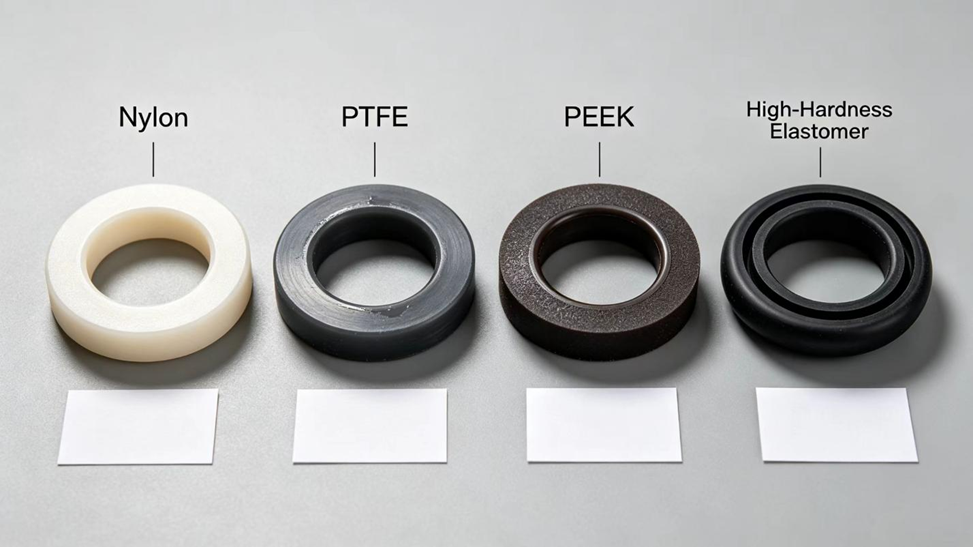
Backup rings are made from a small group of hard polymers. The most common are PTFE (including filled PTFE compounds), nylon (polyamide), and PEEK (polyether ether ketone). A fourth group is molded elastomer rings in high-hardness nitrile or fluoroelastomer, which are used where pressure is lower. The material is normally chosen by the seal manufacturer for the seal set and the pressure it is designed for, so the ring in your drill is part of a matched design and not an arbitrary choice.
What Does a Backup Ring Material Need to Do?
Four properties matter. The material must be hard enough to resist being pushed into the gap under pressure, because that is the whole purpose of the ring. It must keep its shape at the operating temperature of the oil. It must be compatible with the hydraulic oil, so that it does not swell or soften. And it must be gentle enough on the metal surfaces that it does not scratch the bore or the piston when it is pressed against them.
Stiffness is the property that links these. A finite-element study of rubber seals under pressure [1] shows how strongly stiffness controls extrusion: for the rubber compounds it studied, raising the hardness from 65 to 85 IRHD cut the extruded length from 0.291 mm to 0.086 mm, and the elastic modulus E (MPa) followed the hardness Hr (IRHD) as:
lg E = 0.0198 Hr − 0.5432 (1)
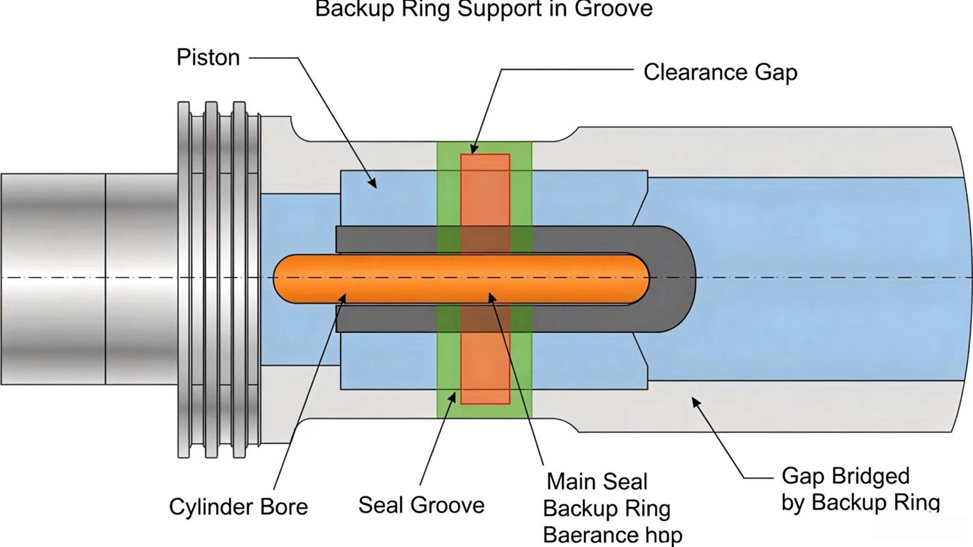
That relation gives about 5.5 MPa at 65 IRHD and 13.8 MPa at 85 IRHD. Backup ring plastics are stiffer than any rubber by a wide margin, which is why a thin ring can protect a seal that a harder rubber could not. The same study found that the clearance had the strongest effect of all: in its fit, each extra 0.1 mm of gap added about 0.1 mm of extrusion [1]. No material can fully offset a gap that has grown through wear.
These properties pull in different directions. A harder material resists extrusion better but is less forgiving of rough surfaces and of installation damage. That trade-off explains why there is no single best material, and why several are in regular use.
What Are the Properties of PTFE Backup Rings?
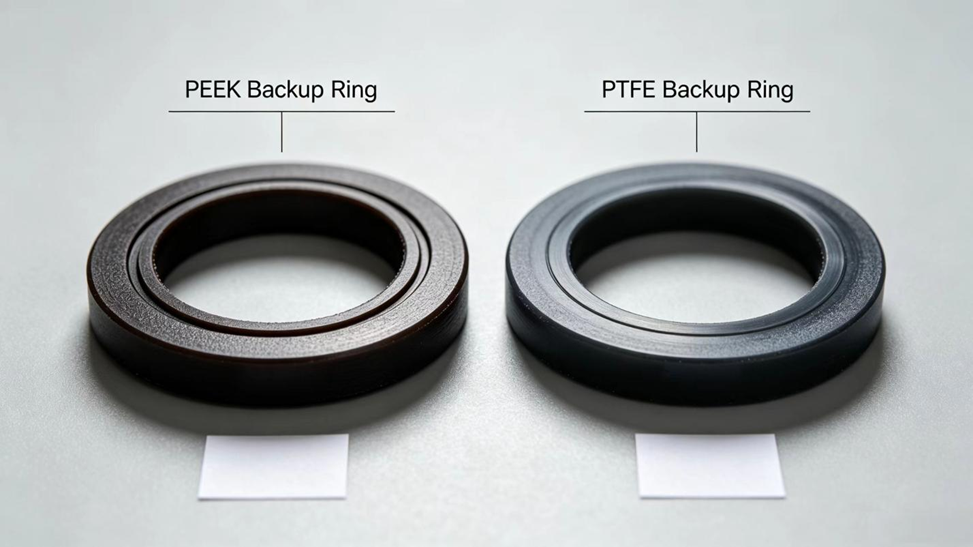
PTFE is widely used for backup rings, in solid, scarf-cut, and spiral forms. It is valued for very low friction, excellent chemical resistance, and tolerance of a wide temperature range. A 2026 review attributes this to its molecular structure: strong C–F bonds give chemical stability, and the helical chain wrapped in fluorine atoms gives weak forces between chains and a very low surface energy [2]. The same review gives a stable physical-property range from −250 to 260 °C. Because it is slippery, a PTFE ring does not drag against the piston and produces little heat.
PTFE is softer and more prone to slow deformation under load than nylon or PEEK, so it is typically used where pressure is moderate, or in a filled grade where the filler improves its resistance to deformation. The review notes that between −100 and 100 °C, creep can make PTFE wear faster even while its friction falls [2]. This is the property that matters most for a backup ring, because a ring that creeps slowly into the gap is gradually losing its ability to support the seal.
Fillers address this. In published tests, a composite of polyimide and PTFE (20% polyimide) showed creep deformation 62.6% lower than pure PTFE, and its volumetric wear fell to 4/1000 of the pure PTFE value [2]. In a separate reciprocating test, adding 5% carbon nanofiber and 10% graphene lowered the wear rate of PTFE from 1.05 × 10⁻⁴ to 4.7 × 10⁻⁶ mm³/(N·m), about 96% lower [3]. A molecular dynamics study of PTFE with carbon nanotubes and polyimide points the same way [4]. These are specimen-level results, but they show why filled grades behave differently from virgin PTFE, and why the grade matters as much as the material name.
Heat is also a concern. The same nanofiber/graphene study reports that the thermal conductivity of that composite is 0.61 W/(m·K), which is 165% higher than pure PTFE [3]. That implies a value of about 0.23 W/(m·K) for pure PTFE, so unfilled PTFE is a poor conductor and the fillers help heat leave the contact. For a ring of thickness L carrying a heat flux q, the temperature difference across the ring is:
ΔT = q · L / λ (2)
Here λ is the thermal conductivity. A low λ means a larger ΔT for the same heat flux, which is another reason why the temperature at the seal can be well above the temperature of the oil in the tank.
What Are the Properties of Nylon Backup Rings?
Nylon is a polyamide. It has good mechanical strength and is regularly used for backup rings in hydraulic and pneumatic systems. It is harder and stiffer than PTFE, so it resists extrusion better at a given clearance. One manufacturer's guidance cites typical use of nylon 6,6 backup rings up to about 186°F (about 86°C) and about 10,000 psi (about 69 MPa); these are general figures for a catalog material and are not a rating for any particular rock drill.
Nylon's main weakness is water. A 2026 study of two cast nylon 6 plate materials [5] reports that nylon can absorb up to about 10% of its mass in water from damp air, and 2% to 4% under ordinary humidity. Absorbed water lowers hardness, elastic modulus, yield strength, and tensile strength, and raises elongation. In that study, the tensile strength of surface specimens, which absorb the most moisture, averaged about 59 to 62 MPa, while specimens from the core of the plate averaged about 97 to 99 MPa. After boiling a modified cast nylon in water for 45 minutes, tensile strength fell from 67.4 to 58.2 MPa, a drop of 13.7%, and drying at 60 °C did not restore the original performance. Prolonged drying made the properties worse.
Two cautions apply when reading these numbers. They were measured on large cast plate stock and not on molded or machined backup rings, and the main take-away is the trend and not the values. In a hydraulic circuit the ring sits in oil, so moisture is mostly a concern for storage, handling, and for systems in which water has contaminated the oil. The study also found that shear strength was about 0.6 times tensile strength (65 MPa for one material and 62.7 MPa for the other) [5], which is a useful rule of thumb when estimating how a ring will resist being cut at the gap edge.
A simple estimate shows the scale of that load. Consider a ring bridging a radial gap g under pressure p, with an axial width w. The pressure acts on the exposed face over the gap, so the force per unit of circumference is p × g, and the average shear stress at the gap edge is:
τ ≈ p · g / w (3)
For illustration, take a peak pressure of 40 MPa, a radial gap of 0.15 mm (a diametral clearance of 0.3 mm), and an assumed ring width of 3 mm. Then τ is about 2 MPa, far below the shear strength of nylon. This suggests that ordinary backup ring failures are seldom a simple shear fracture. They are more often a matter of creep, of local deformation at the gap edge, or of fatigue from repeated pressure peaks. This is a first-order estimate that ignores creep, edge concentrations, and ring geometry, and it should not be used for design.
A known limitation of nylon is therefore its sensitivity to moisture. Its temperature limit is also lower than PEEK, so it is a less comfortable choice where oil runs hot.
What Are the Properties of PEEK Backup Rings?
PEEK is a high-performance engineering plastic with exceptional mechanical strength and chemical resistance. It is used for backup rings in demanding high-pressure and high-temperature service. The same manufacturer's guidance cites typical use of PEEK backup rings up to about 500°F (about 260°C) and about 20,000 psi (about 138 MPa), again as a general catalog figure.
A 2026 review describes PEEK as a high-temperature, semi-crystalline thermoplastic whose crystalline structure allows orientation and so gives high strength, together with a high glass transition temperature, chemical stability, and good resistance to radiation [6]. The review also points to a drawback relevant to seals: pure PEEK is a poor conductor of heat, with a thermal conductivity of only 0.2 to 0.3 W/(m·K) [6]. A ring made of it keeps heat near the contact, which is the situation Equation 2 describes. Research on filled PEEK is aimed at raising this value; for example, 5% by mass of a particular carbon nanotube raised the conductivity from 0.25 to 1.50 W/(m·K) [6]. That work was done for electronics cooling and not for seals, so it should be read as a sign of how much fillers can change PEEK, not as a property of seal-grade rings.
The trade-offs are cost and hardness. PEEK is considerably more expensive than PTFE or nylon, and because it is so hard it asks more of the metal surfaces it bears on: a rough or damaged bore will wear a seal and a hard ring alike. For many rock drill circuits the ring does not need PEEK's capability, so it tends to be reserved for the highest pressures and temperatures.
Where Do Elastomer Backup Rings Fit?
Contoured elastomer rings are molded from high-hardness nitrile (about 90 Shore A is a common grade) or fluoroelastomer, and are shaped to fit against an O-ring. They stretch over the piston and snap into the groove, which makes them easy to install. Because they are softer than the plastic rings, they suit lower-pressure positions and are not a substitute for PTFE, nylon, or PEEK where pressure peaks are high.
The choice between NBR and FKM follows the usual rubber trade-off. A survey of rubber sealing components describes NBR as oil-resistant, moderately elastic, and low in cost, suited to ordinary oil temperatures, while FKM resists high and low temperatures and chemicals but is harder, less elastic, and more expensive [7]. Oil compatibility must still be checked for each fluid. In one immersion test (100 °C, 72 hours), fluoroelastomer sealing rings shrank by 4.9% to 19.1% in three vehicle hydraulic fluids and their blends, and the authors recommended nitrile rubber instead [8]. Those fluids are not rock drill oils, so the lesson is the method and not the numbers: the rating of a material in general does not replace a test in the actual fluid.
How Do These Materials Compare Side by Side?
The table below summarizes the general positioning of each material. Specific limits depend on the grade and on the manufacturer's rating.
Material |
Common Forms |
Main Strength |
Main Limitation |
PTFE (virgin or filled) |
Solid, scarf-cut, spiral |
Low friction; chemical and temperature resistance |
Softer; deforms under sustained load |
Nylon (polyamide) |
Solid, scarf-cut |
Good strength and stiffness at moderate cost |
Moisture absorption; lower temperature ceiling than PEEK |
PEEK |
Solid, scarf-cut |
Highest strength and temperature capability |
Cost; demands good surfaces |
High-hardness NBR or FKM |
Contoured molded rings |
Easy to install; flexible |
Suited to lower pressure only |
How Do Pressure and Temperature Affect the Choice of Material?
Pressure and temperature work together. A material that resists extrusion at room temperature will be softer when the oil is hot, so a ring can be adequate in a cold workshop test and still extrude in a drill that has been working for an hour. The relevant temperature is the temperature at the seal, which can be higher than the bulk oil temperature.
In general, moderate pressure and temperature allow PTFE or nylon, and the highest pressure and temperature move the choice toward PEEK. Pulsating pressure should be treated as more demanding than steady pressure of the same average value, because peaks load the ring beyond its average duty. Measured drill data illustrate the point. In a prototype supplied at 18 MPa, pressure in the primary buffer chamber showed short peaks of the order of 40 MPa [9], and in a 15 MPa model, chamber pressure peaked at roughly 25 MPa, about 1.7 times the supply pressure [10]. A ring chosen for the supply pressure alone would be undersized for these peaks.
Frequency adds to the duty. At a percussion rate of about 95 blows per second [11], each ring sees on the order of 340,000 pressure cycles in an hour of drilling. At that count, fatigue and creep, and not static strength, decide how long a ring lasts.
How Do Ring Hardness and Gap Size Interact?
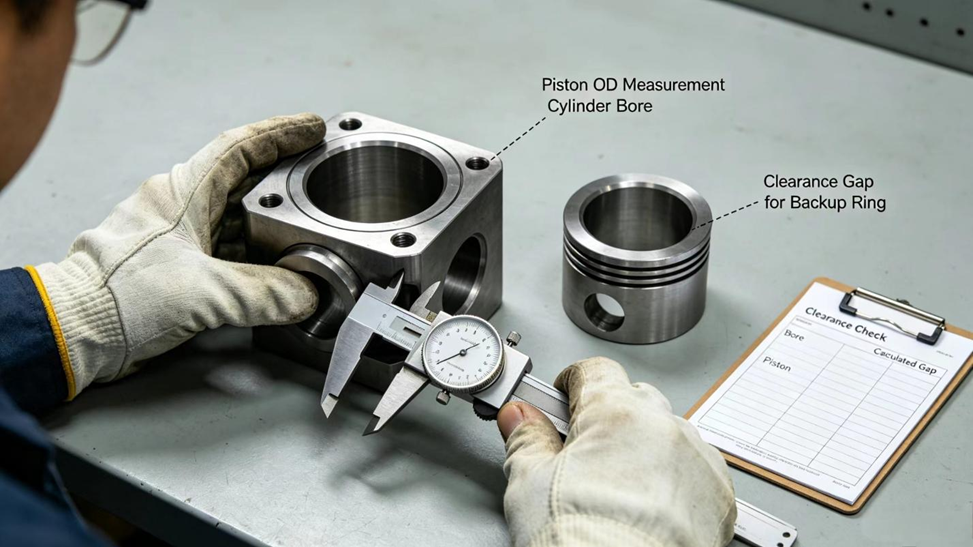
A harder ring does not make a large gap safe. The ring bridges the gap, and the larger the gap, the less of the ring is supported by metal. As the bore or piston wears and the clearance grows, a ring that was adequate when new may be asked to bridge a gap it was never designed for. A stronger material can extend the working range, but it cannot remove the need to restore the clearance when the metal parts are worn.
The size of the effect can be seen in the rubber extrusion study [1]. In its fitted relation, extrusion length grows by about 1.0 mm per mm of gap, but falls by only 0.0115 mm per IRHD point of hardness, so closing a gap by 0.1 mm does as much as raising the rubber hardness by roughly nine points. A published rock drill Step seal source gives a related rule for a design with a rigid PTFE ring: the maximum diametral clearance drops from 0.6–0.3 mm up to 20 MPa to 0.3–0.2 mm between 20 and 40 MPa for rod diameters of 30 to 36 mm [12]. The permitted gap shrinks as the pressure goes up, even with a rigid ring.
For that reason, repeated ring failures should send the inspection to the bore, the piston, and the guide, and not only to the ring material. A study on the optimal clearance between the impact piston and its cylinder in a hydraulic rock drill shows that clearance is a design variable that balances leakage against friction, so the correct value is a compromise and not simply 'as small as possible' [10].
How Can You Identify the Material of an Existing Backup Ring?
Appearance is not a reliable way to identify a backup ring material. Several of these polymers look similar, and fillers and dyes change the color. The dependable sources are the drill manufacturer's parts catalog and the seal supplier's written confirmation of the material and grade.
Where records are not available, a supplier that knows the drill model can often identify the material from the part number or from a sample of the old ring. Ask for the material, the form (solid, scarf-cut, or spiral), and the pressure and temperature range it was specified for, and compare these with the conditions in your drill.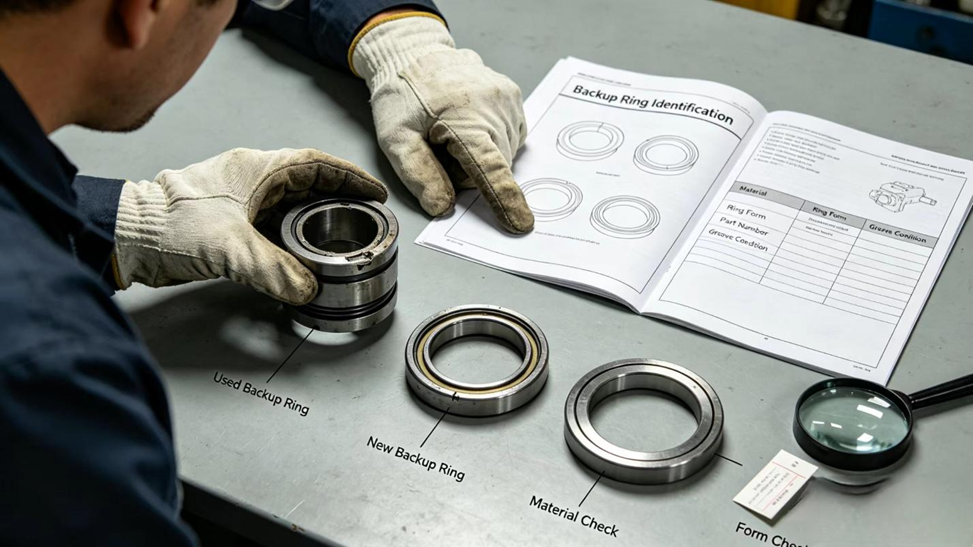
Selected technical references consulted for this article:
- Lu Yunjiang, Huang Le, Dai Changhao. Extrusion resistance analysis of O-ring based on Marc. Chinese Hydraulics & Pneumatics, 2020, (3): 84–89. (In Chinese)
- Cao Xiaoyu, Zhang Xu, Dang En, Luan Su, Hao Jianxu, Guo Chenhui, Yu Xiaojing, Zhao Kang. Research progress on the anti-friction performance of polytetrafluoroethylene materials. Polymer Materials Science & Engineering, 2026, online first. DOI: 10.16865/j.cnki.1000-7555.2026.0127. (In Chinese)
- An Lihui, Miao Xuemei, Liu Hao, Yang Song, Su Yujie, Wei Shijie. Synergistic modification of PTFE by graphene and carbon nanofiber: tribological properties and dynamic thermal/electrical conductivity mechanism. Tribology, 2026, online first. (In Chinese)
- Wang Shuai, Ge Zhenghao, Wang Chaobao, Zhang Xiaoliang, Wang Haoyu. Molecular dynamics analysis of friction and wear properties of PI and CNTs filled PTFE. Plastics Science and Technology, 2025, (10): 30–33. (In Chinese)
- Zhao Zhangxian, Zhang Junhao, Hu Yi. Study on mechanical properties of nylon materials in material selection. Machinery Research & Application, 2026, 39(6): 97–100. (In Chinese)
- Han Zhichao, Chen Chaochan, Zheng Liangping, Xiang Lixue, Tang Bo, Wu Xinfeng. Review on the preparation methods of polyetheretherketone thermal conductive composites. China Plastics Industry, 2026, 54(8): 1–7. (In Chinese)
- Qin Shuai, Cheng Pin, Wang Shidu. Structural optimization design of rubber components in mechanical equipment sealing devices. China Tire Resources Comprehensive Utilization, 2026, (8). (In Chinese)
- Feng Dongliang, Zhao Ning, Chang Feng, Cai Wenbin, Wang Yongli, Yang Xin. Experimental study on compatibility of fluorine rubber seal ring and hydraulic oils. Lubrication Engineering, 2018, 43(5): 111–114. (In Chinese)
- Wang Jiansen, Yang Guangsheng, Liu Shaojun, Feng Huai, Wen Yongqiang. Analysis of the overpressure phenomenon in the primary buffer chamber of a dual-chamber-controlled hydraulic rock drill. Chinese Hydraulics & Pneumatics, 2026, 50(7): 57–67. (In Chinese)
- Wang Jiansen, Yan Hongliang, Zhang Xin, Wang Yanjun, Liu Bin, Wei Liejiang. Optimal clearance design between impact piston and cylinder of a dual-chamber-controlled hydraulic rock drill. Chinese Hydraulics & Pneumatics, 2025, 49(4): 79–91. (In Chinese)
- Yang Mingming. Experimental study on the impact performance of a hydraulic rock drill. Equipment Management and Maintenance, 2025, (10). (In Chinese)
- Li Chuan, Yan Tianjun, Li Tiehui. Impact piston sealing and the Step seal of hydraulic rock drills. Rock Drilling Machinery & Pneumatic Tools, 2003, (3): 8–12. (In Chinese)
Table of Contents
- What Is a Rock Drill Backup Ring Made Of?
- What Does a Backup Ring Material Need to Do?
- What Are the Properties of PTFE Backup Rings?
- What Are the Properties of Nylon Backup Rings?
- What Are the Properties of PEEK Backup Rings?
- Where Do Elastomer Backup Rings Fit?
- How Do These Materials Compare Side by Side?
- How Do Pressure and Temperature Affect the Choice of Material?
- How Do Ring Hardness and Gap Size Interact?
- How Can You Identify the Material of an Existing Backup Ring?


