

 EN
EN
 AR
AR CS
CS DA
DA NL
NL FI
FI FR
FR DE
DE EL
EL IT
IT JA
JA KO
KO NO
NO PL
PL PT
PT RO
RO RU
RU ES
ES SV
SV TL
TL IW
IW ID
ID LV
LV SR
SR SK
SK VI
VI HU
HU MT
MT TH
TH TR
TR FA
FA MS
MS GA
GA CY
CY IS
IS KA
KA UR
UR LA
LA TA
TA MY
MY
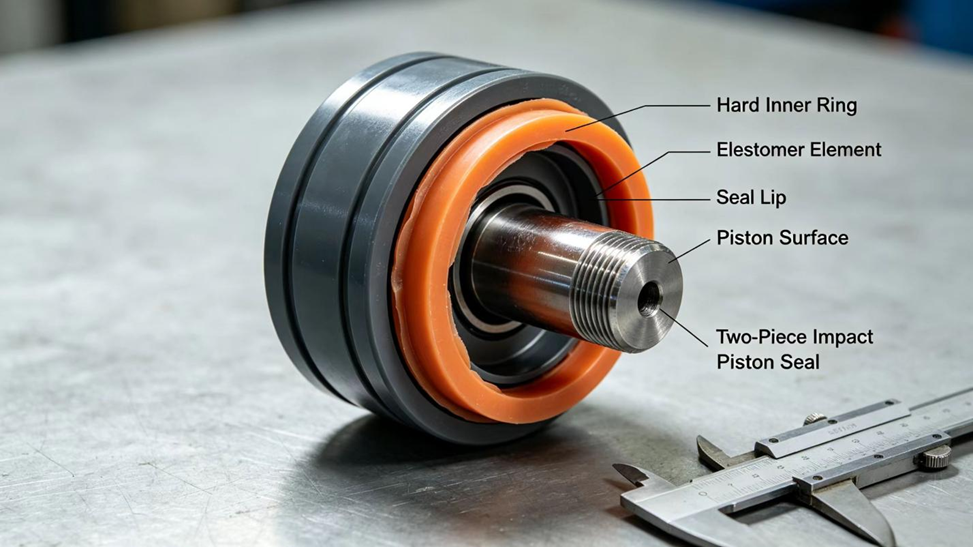
An impact piston seal works in one of the harshest positions in a hydraulic circuit. The oil around it is hot, the pressure is pulsating, and the piston it seals against moves quickly in a short stroke, many times a second. No single material handles all of these demands well, which is why most percussion piston seals are built from more than one. This article explains what these materials are, what each one contributes, and how the trade-offs affect the way the seal behaves in service. Figures quoted below come from published engineering studies, listed at the end; most of them were measured on test pieces or in other applications, so they show trends and should not be read as ratings for a particular seal.
What Is a Rock Drill Impact Piston Seal Made Of?
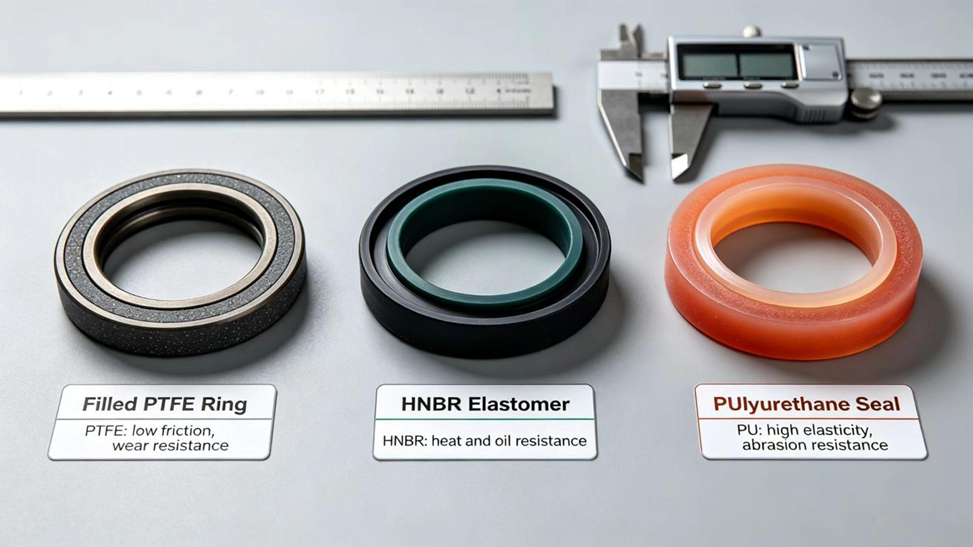
Published designs for sealing devices in hydraulic percussion apparatus commonly describe a two-part construction [1]. The inner ring, which touches the piston, is made of a hard, Teflon-based plastic, meaning a PTFE-type material. Around it sits an elastomer element that seals against the housing and presses the inner ring toward the piston. The elastomer may be a nitrile (NBR), hydrogenated nitrile (HNBR), or fluoroelastomer (FKM) compound, depending on the oil and temperature. Some drill models instead use a single-material lip seal, most often polyurethane (PU). Which construction your drill uses depends on the model and manufacturer.
Each part has a different job, so the two are selected separately. The plastic ring is chosen for sliding and wear. The elastomer is chosen for elasticity, oil and heat resistance, and cost. A rubber survey of sealing devices makes the same split: NBR is oil-resistant, moderately elastic, and low in cost, and suits ordinary oil temperatures, while FKM tolerates high and low temperatures and chemical attack but is harder, less elastic, and more expensive [2].
Why Does Material Choice Matter So Much in a Percussion Unit?
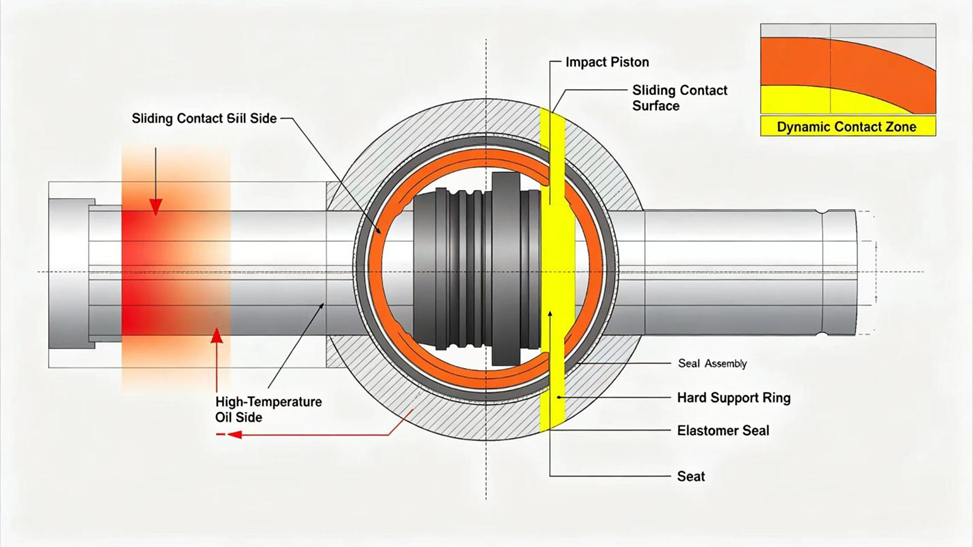
Three conditions act on the seal together. The first is temperature: the oil in a working drill is well above ambient, and the contact adds frictional heat of its own. The second is load: pressure at the seal is pulsating rather than steady. In one prototype supplied at 18 MPa, measured pressure in the primary buffer chamber carried short peaks of the order of 40 MPa on top of a working level of 18 to 20 MPa [3], so the material has to survive peaks well above the nominal pressure. The third is sliding speed: the piston is moving at the seal surface for as long as the drill is operating.
The heat generated at a sliding contact can be estimated from the friction coefficient μ, the contact pressure pc, and the sliding speed v. Per unit of contact area, the heating rate is:
q = μ · pc · v (1)
Three levers follow directly from this expression. Lower friction (a better ring material) lowers q in proportion. Lower contact pressure (a gentler elastomer preload) lowers it as well, but only down to the pressure needed to seal. And q rises with piston speed, which the designer cannot choose. This is why a low-friction material sits in the sliding position, and why the elastomer behind it must not push the ring harder than necessary.
A material that is not suited to this combination shows it in recognizable ways: a lip that hardens and cracks from heat, a plastic ring that wears quickly, an elastomer that swells in the oil, or a soft lip that is pushed into the clearance gap under a pressure peak.
Why Is the Piston-Contact Ring Made From PTFE?
PTFE has a very low coefficient of friction, tolerates higher temperatures than most rubber compounds, and resists chemical attack by hydraulic oils. A 2026 review of PTFE tribology traces these properties to its molecular structure [4]. The very strong C–F bond gives the chemical stability. The fluorine atoms wrap the carbon backbone in a helix, which gives a very low surface energy and weak forces between neighboring chains. As a result the chains slide over each other easily under shear, which is the origin of the low friction. The review also gives a stable physical-property range from −250 to 260 °C for PTFE, a range that is much wider than that of any rubber compound.
The same review describes how PTFE wears. Friction is governed by chain slip and by a thin transferred film of PTFE that builds up on the mating surface. Wear is mainly adhesive, with fatigue playing a smaller part, and the formation and breakdown of the transfer film control the wear rate. Two practical consequences follow. A smoother counter-surface helps the film form and reduces wear, and a rougher one does the opposite. And within a −100 to 100 °C range, the review notes that creep can cause the wear rate to rise even while the friction coefficient falls, so a low friction value alone does not show that a PTFE ring will last.
PTFE also has limits in this role. It has almost no elastic memory, so it cannot press itself against the piston as the contact wears. It also deforms slowly under sustained load, a behavior known as creep. Both limits are addressed in the design: the elastomer element provides the preload, and fillers added to the PTFE reduce creep and wear.
What Do Fillers Add to the PTFE?
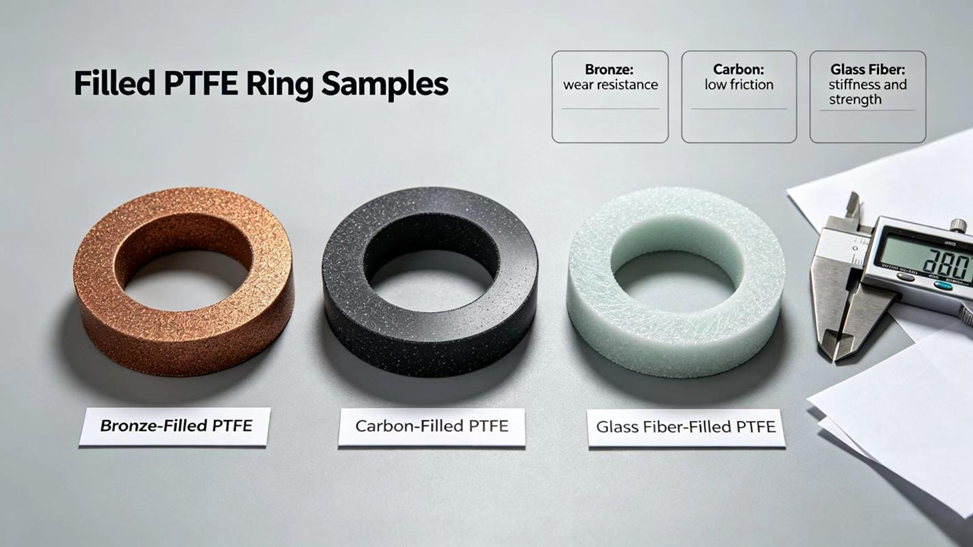
Unfilled PTFE wears too quickly for a high-duty dynamic seal, so the compound is usually blended with a filler. Common fillers are bronze, carbon, graphite, and glass fiber, sometimes in combination. In general terms, fillers improve wear resistance and resistance to creep. Wear is usually expressed as a specific wear rate, the volume lost per unit of load and sliding distance:
k = ΔV / ( F · s ) (2)
Here ΔV is the volume lost in mm³, F is the normal load in N, and s is the sliding distance in m, so k is in mm³/(N·m). Published tests show how much a filler can change k:
- In a reciprocating test (50 N, 5 Hz, 30 minutes, 316 stainless steel pin), pure PTFE had a wear rate of 1.05 × 10⁻⁴ mm³/(N·m). With 5% carbon nanofiber it fell to 2.7 × 10⁻⁵, and with 5% carbon nanofiber plus 10% graphene it fell to 4.7 × 10⁻⁶, about 96% lower than pure PTFE [5].
- A review of PTFE composites reports that 25% graphite by volume brought the friction coefficient down to 0.19 and cut volumetric wear by two orders of magnitude, and that a blend of two lengths of short carbon fiber reduced the specific wear rate by more than 90% [4].
- The same review reports a polyimide/PTFE composite with 20% polyimide whose friction coefficient fell to 0.18, whose volumetric wear fell to 4/1000 of pure PTFE, and whose creep deformation fell by 62.6% [4].
- A molecular dynamics study found that adding 5% carbon nanotubes and then 10% polyimide to PTFE lowered the simulated friction coefficient by 6.7% and the wear rate by 11.6% relative to the nanotube composite [6]. This is a simulation result and not a bench test.
These numbers describe laboratory specimens against a steel pin and not a finished seal ring on a piston, and they were obtained with fillers (nanofibers, graphene, nanotubes) that are not necessarily those used in commercial seal compounds. They show that filler type and loading can change wear by an order of magnitude or more. The choice of filler also changes the secondary properties: bronze generally gives strong wear and load performance but reduces chemical resistance, carbon keeps chemical resistance closer to unfilled PTFE, graphite lowers friction, and glass fiber raises hardness but can be more abrasive to the counter-surface.
The exact filler and its proportion are set by the manufacturer for each seal and are not normally visible from the outside. They are one of the reasons two PTFE seals of the same size and profile can perform differently.
What Is the Elastomer Element Made Of, and Why Does It Matter?
The elastomer behind the PTFE ring has two jobs: it supplies the elastic preload that keeps the ring in contact with the piston, and it seals statically against the housing. Because the PTFE ring will tolerate heat that the rubber will not, the elastomer is often the part that sets the seal's temperature limit.
- NBR is the general-purpose choice for mineral hydraulic oil, with a continuous-use ceiling commonly cited around 100–120°C depending on the compound.
- HNBR keeps NBR's oil resistance and adds better resistance to heat and aging, with a ceiling commonly cited around 150°C. It is a frequent choice where oil runs hot.
- FKM has the highest temperature capability of the three, commonly cited up to about 200°C, and broader chemical resistance, at higher cost and with less flexibility at low temperatures.
These are general figures. The limit for a particular seal depends on the compound formulation and on the local temperature at the lip, which can be higher than the bulk oil temperature.
The reason HNBR outlasts NBR in hot oil is chemical. NBR has unsaturated carbon–carbon double bonds in its chains, and these are prone to oxidation and ozone attack, which degrades its stability and ageing behavior. Hydrogenating the chain turns most of these double bonds into saturated bonds, giving HNBR with a highly saturated backbone that keeps the oil and wear resistance of NBR and adds heat, chemical, and oxidation resistance [7]. A 2026 review reports that modern hydrogenation catalysts achieve a hydrogenation degree above 90% and in some cases above 99% [7]. Filled HNBR compounds in that review were ageing-tested at 125 °C for 7 days and at 160 °C for 20 days, which gives an idea of the temperature range HNBR is evaluated in, although the test results depend on the filler.
Ageing speeds up with temperature in a roughly exponential way. The Arrhenius relation, widely used to describe thermally driven degradation, expresses this:
r = A · exp ( − Ea / R T ) (3)
Here r is the rate of degradation, A is a constant, Ea is the activation energy, R is the gas constant, and T is the absolute temperature. The practical meaning is that a modest rise in the temperature at the lip shortens the life of the elastomer far more than a proportional change would suggest, which is why the local temperature at the seal matters more than the tank temperature.
The stiffness of the elastomer also matters, because it sets the preload on the PTFE ring. For rubber compounds in the range of 65 to 85 IRHD, a regression from a finite-element study relates the elastic modulus E (MPa) to the hardness Hr [8]:
lg E = 0.0198 Hr − 0.5432 (4)
Every 10 IRHD points multiplies the modulus by 10^0.198, which is about 1.58. A compound 10 points harder is therefore roughly 58% stiffer, so a small change in hardness changes the preload more than might be expected. This is one reason a replacement elastomer should match the original compound and not simply be 'about the same hardness.'
Where Does Polyurethane Fit?
Polyurethane is known for abrasion and tear resistance that is generally better than conventional rubber, and for good strength under load. It is used for some piston and rod seals in hydraulic equipment, including some percussion applications. Its main limitation is a lower continuous-use temperature than HNBR or FKM, so it is better suited to drills where oil temperature stays moderate and where contamination or abrasion is the dominant problem.
PU should not be selected only because it appears stronger on a datasheet. In a percussion seal the first question is whether the oil temperature at the lip stays inside the PU compound's limit. The studies consulted for this article do not cover PU, so no numerical limits are quoted here; the compound's own datasheet is the proper source.
How Do These Materials Compare Side by Side?
The table below summarizes the typical role and the main limitation of each material discussed above. Actual performance depends on the compound and the manufacturer.
Material |
Typical Role in the Seal |
Main Strength |
Main Limitation |
Filled PTFE |
Hard ring in sliding contact with the piston |
Low friction; heat and chemical resistance |
No elastic memory; creep without filler |
NBR |
Elastomer energizer or housing seal |
Good mineral-oil resistance; moderate cost |
Lower heat ceiling |
HNBR |
Elastomer energizer, hotter duty |
Better heat and aging resistance than NBR |
Higher cost than NBR |
FKM |
Elastomer energizer, high temperature |
Highest heat and chemical capability |
Cost; stiffer in the cold |
Polyurethane |
Single-material lip seal in some designs |
Abrasion and tear resistance |
Lower heat ceiling |
How Do Oil Type and Temperature Affect Material Choice?
The hydraulic oil in a rock drill is normally a mineral-based oil, and NBR, HNBR, FKM, PU, and PTFE-type materials are all compatible with it in typical use. If a drill runs a fire-resistant or synthetic fluid, compatibility must be checked for each material, because a seal that is excellent in mineral oil can swell or degrade in another fluid.
Compatibility is tested by immersion. A seal sample is weighed in air and in water before and after soaking in the oil (a typical test uses 100 °C for 72 hours), and the volume change is calculated, following the method in the Chinese standard GB/T 1690:
ΔV = [ ( m3 − m4 ) − ( m1 − m2 ) ] / ( m1 − m2 ) × 100% (5)
In this expression m₁ and m₂ are the sample's mass in air and in water before immersion, and m₃ and m₄ are the same masses after immersion. A positive ΔV means the rubber has swollen, and a negative ΔV means it has shrunk, which usually means that part of the rubber's plasticizer has been extracted. Either can cause leakage.
A published test shows why this matters [9]. Fluoroelastomer sealing rings were immersed at 100 °C for 72 hours in three hydraulic fluids used in an armored-vehicle suspension and in blends of them. Every result was a shrinkage, ranging from −4.9% to −19.1%, and the worst values were beyond the 4% limit of the relevant Chinese standard, so the authors recommended nitrile rubber for that application. Those fluids are not rock drill oils, so the numbers do not say that FKM is unsuitable for a drill. What they show is that a material rated as chemically resistant in general can still be a poor match for a specific fluid.
The same applies to mixing oils. A review of oil compatibility tests [10] notes that when two hydraulic oils are mixed, additives can interact and produce precipitates that block filters and fine valve passages, and describes tests that blend the oils in ratios such as 1:9, 5:5, and 9:1 and store them at 65 °C for 168 hours. If a drill's oil is topped up with a different brand, the seal and the circuit are both affected.
Temperature has two effects. In a hot climate or a long duty cycle, the elastomer reaches its limit first, which pushes the design toward HNBR or FKM. In cold conditions, a stiff material can make the seal slow to follow the piston until the oil warms up, which is where NBR and HNBR generally have an advantage over FKM and some PU grades.
How Does the Piston Surface Interact With the Seal Material?
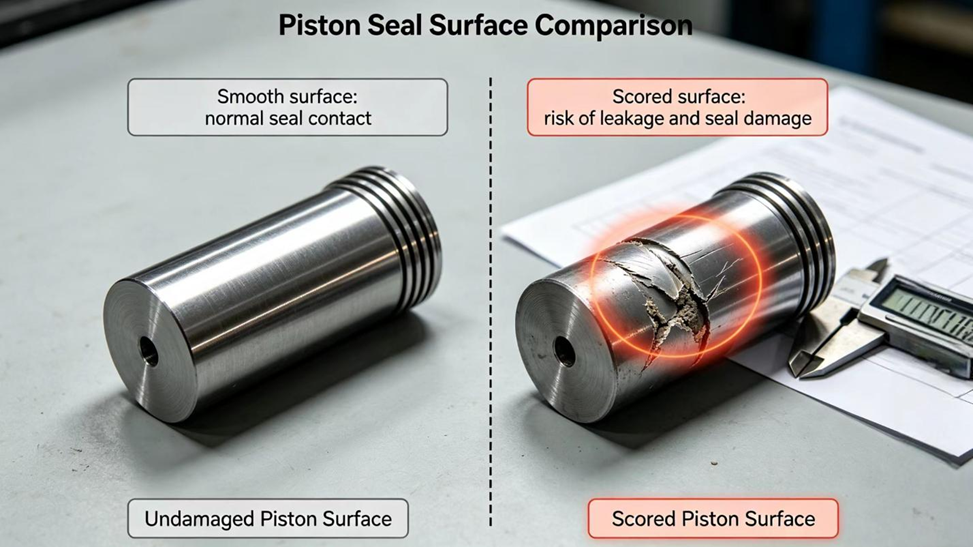
The seal and the piston wear as a pair. A hard filler such as bronze or glass fiber improves the seal's own wear resistance, but it also asks more of the counter-surface: the piston should be hard enough and smooth enough that the filler does not polish or score it. A scored piston wears any seal quickly, whatever the material.
The PTFE literature supports this. As noted above, a smoother mating surface helps the transfer film form and lowers wear, and a rougher one raises it [4]. In one study of counter-faces, pure PTFE wore most against a hard WC-10Co-4Cr coating, while polymer/PTFE composites wore less than pure PTFE against chromium plating, and lower chrome roughness gave lower wear [4]. The friction coefficient itself changed little with the counter-face, but the wear mechanism did.
This is why a seal that has failed early should be examined together with the piston. If the piston surface is damaged, changing to a different seal material alone is unlikely to fix the problem.
How Can You Identify the Material of an Existing Seal?
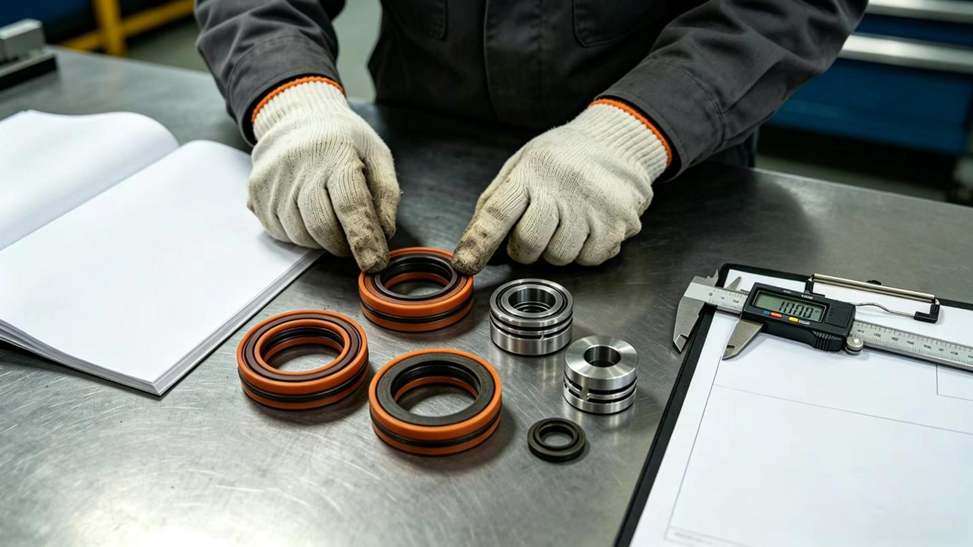
Color and feel are not reliable ways to identify a seal compound, because color is not standardized and fillers change the appearance of PTFE. The dependable sources are the drill manufacturer's parts catalog, which usually lists the specified material against the part number, and the supplier's written confirmation of the material grade.
If the original specification is not available, a supplier that is familiar with the drill model can usually identify the construction from the part number or from a sample of the failed seal. Ask for the material of each component, the hard ring and the elastomer separately, because the two are chosen independently.
Selected technical references consulted for this article:
- Li Chuan, Yan Tianjun, Li Tiehui. Impact piston sealing and the Step seal of hydraulic rock drills. Rock Drilling Machinery & Pneumatic Tools, 2003, (3): 8–12. (In Chinese)
- Qin Shuai, Cheng Pin, Wang Shidu. Structural optimization design of rubber components in mechanical equipment sealing devices. China Tire Resources Comprehensive Utilization, 2026, (8). (In Chinese)
- Wang Jiansen, Yang Guangsheng, Liu Shaojun, Feng Huai, Wen Yongqiang. Analysis of the overpressure phenomenon in the primary buffer chamber of a dual-chamber-controlled hydraulic rock drill. Chinese Hydraulics & Pneumatics, 2026, 50(7): 57–67. (In Chinese)
- Cao Xiaoyu, Zhang Xu, Dang En, Luan Su, Hao Jianxu, Guo Chenhui, Yu Xiaojing, Zhao Kang. Research progress on the anti-friction performance of polytetrafluoroethylene materials. Polymer Materials Science & Engineering, 2026, online first. DOI: 10.16865/j.cnki.1000-7555.2026.0127. (In Chinese)
- An Lihui, Miao Xuemei, Liu Hao, Yang Song, Su Yujie, Wei Shijie. Synergistic modification of PTFE by graphene and carbon nanofiber: tribological properties and dynamic thermal/electrical conductivity mechanism. Tribology, 2026, online first. (In Chinese)
- Wang Shuai, Ge Zhenghao, Wang Chaobao, Zhang Xiaoliang, Wang Haoyu. Molecular dynamics analysis of friction and wear properties of PI and CNTs filled PTFE. Plastics Science and Technology, 2025, (10): 30–33. (In Chinese)
- Zhang Xia, Gao Zhixing, Wu Shujuan, Xu Huiren, Shang Quanmin, Wang Fushan. Research progress on preparation, reinforcing fillers and applications of hydrogenated nitrile butadiene rubber. Petrochemical Technology, 2026, 55(4): 611–623. (In Chinese)
- Lu Yunjiang, Huang Le, Dai Changhao. Extrusion resistance analysis of O-ring based on Marc. Chinese Hydraulics & Pneumatics, 2020, (3): 84–89. (In Chinese)
- Feng Dongliang, Zhao Ning, Chang Feng, Cai Wenbin, Wang Yongli, Yang Xin. Experimental study on compatibility of fluorine rubber seal ring and hydraulic oils. Lubrication Engineering, 2018, 43(5): 111–114. (In Chinese)
- Zhang Wentian, Hu Chunling, Wang Jianhua, Shang Peihua, Ma Guoliang. Analysis of hydraulic oil and turbine oil compatibility test methods. Lubricating Oil, 2023, 38(4): 55–59. (In Chinese)
Table of Contents
- What Is a Rock Drill Impact Piston Seal Made Of?
- Why Does Material Choice Matter So Much in a Percussion Unit?
- Why Is the Piston-Contact Ring Made From PTFE?
- What Do Fillers Add to the PTFE?
- What Is the Elastomer Element Made Of, and Why Does It Matter?
- Where Does Polyurethane Fit?
- How Do These Materials Compare Side by Side?
- How Do Oil Type and Temperature Affect Material Choice?
- How Does the Piston Surface Interact With the Seal Material?
- How Can You Identify the Material of an Existing Seal?


