

 EN
EN
 AR
AR CS
CS DA
DA NL
NL FI
FI FR
FR DE
DE EL
EL IT
IT JA
JA KO
KO NO
NO PL
PL PT
PT RO
RO RU
RU ES
ES SV
SV TL
TL IW
IW ID
ID LV
LV SR
SR SK
SK VI
VI HU
HU MT
MT TH
TH TR
TR FA
FA MS
MS GA
GA CY
CY IS
IS KA
KA UR
UR LA
LA TA
TA MY
MY
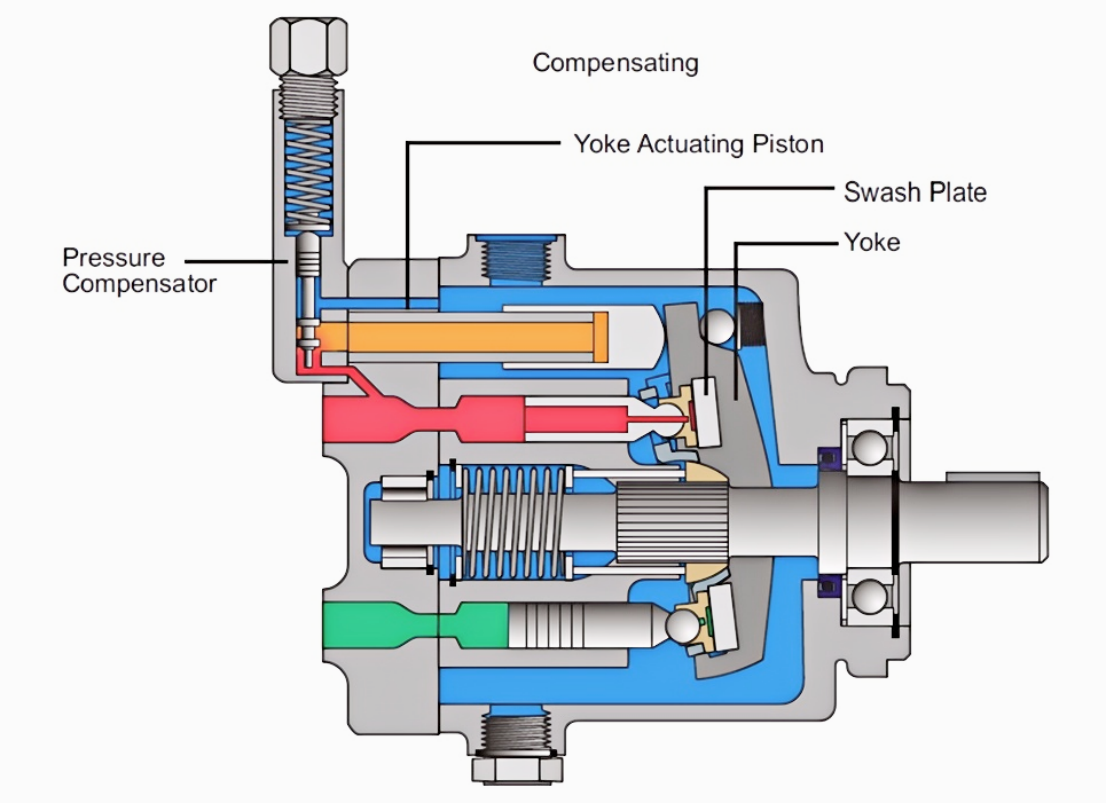
The energy comparison between fixed and variable displacement pumps only makes sense when you specify the duty cycle — the percentage of time the machine operates at full load versus partial load. At 100% load factor, a high-quality fixed piston pump (volumetric efficiency 95–97%) is often more efficient than a variable pump under identical conditions, because the variable pump carries the additional losses from its displacement control mechanism. The advantage of variable displacement appears at partial load factors below 70%, and it grows substantially as the partial load fraction increases. An industrial machine running at 35% average load for 70% of its operating time will show dramatically different energy savings than a press running at 95% load for 90% of its cycle.
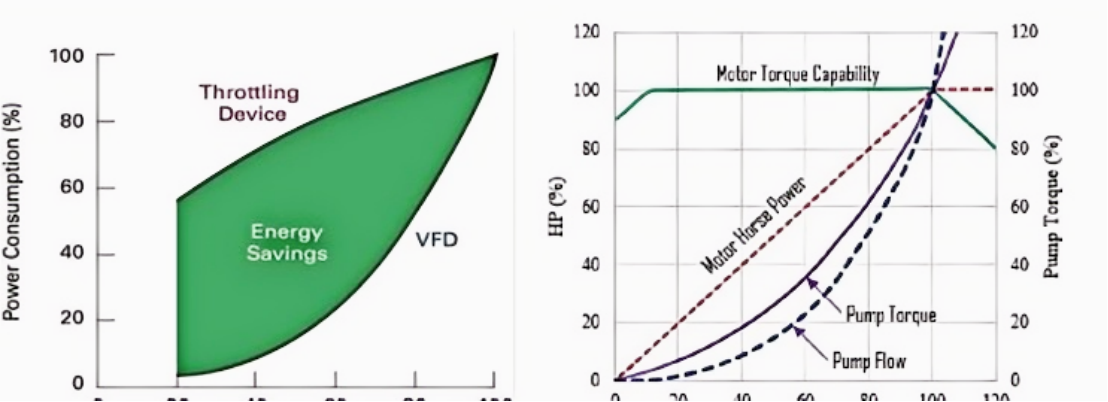
The crossover calculation: a Danfoss Series 45 variable pump at 35% load displacement draws approximately 38–42% of its full-load input power. An equivalent fixed pump at 35% load with a pressure-relief unloading valve draws 52–58% of full-load power — the excess going to heat through the unloading path. That 10–16 percentage point gap at 35% load, multiplied across the operating hours where partial load dominates, produces the energy saving. In a 2,000-hour annual operating machine at 40% average load factor, the variable pump saves 850–1,400 kWh per year compared to a fixed pump of the same flow class — equivalent to $85–180/year in electricity cost at European industrial rates, and 380–630 kg CO₂ annually.
Energy Consumption Comparison: Fixed vs Variable at Different Load Factors
Load Factor (% of Max Flow) |
Fixed Pump Power Draw |
Variable Pump Power Draw |
Variable Pump Saving |
100% load — full displacement demand |
100% of rated input |
102–104% — variable control mechanism adds small overhead |
Fixed pump marginally better at full load — variable adds 2–4% |
70% load — moderate partial demand |
73–78% — relief unloading or throttling losses |
72–75% — displacement matched to 70% demand |
Variable saves 1–5% at 70% — marginal advantage appears here |
50% load — half demand (common in agricultural) |
58–64% — significant unloading loss |
51–55% — displacement at 50% with minimal control loss |
Variable saves 7–12% at 50% load — advantage clearly positive |
35% load — light duty standby or slow speed |
52–58% — majority of input to heat via relief |
36–42% — displacement proportional to demand |
Variable saves 14–20% at 35% — dominant saving range |
20% load — near idle with minor demand |
48–54% — full pump turning, almost all to heat |
21–26% — displacement near minimum stop |
Variable saves 26–32% at 20% — most significant range |
For machines running above 85% load for more than 80% of operating time — certain hydraulic presses, compactors — the variable pump payback period exceeds 5–7 years and a high-efficiency fixed pump is the better investment. For agricultural combines, excavators, and industrial machines with highly variable load profiles, the variable pump payback is typically 18–36 months at current European energy prices. HOVOO supplies variable displacement pump service components and seal kits for Danfoss Series 45 and H1 platforms to maintain the efficiency that justifies the investment. Full references at hovooseal.com.


