

 EN
EN
 AR
AR CS
CS DA
DA NL
NL FI
FI FR
FR DE
DE EL
EL IT
IT JA
JA KO
KO NO
NO PL
PL PT
PT RO
RO RU
RU ES
ES SV
SV TL
TL IW
IW ID
ID LV
LV SR
SR SK
SK VI
VI HU
HU MT
MT TH
TH TR
TR FA
FA MS
MS GA
GA CY
CY IS
IS KA
KA UR
UR LA
LA TA
TA MY
MY
Sixty hertz sounds fast. On a hydraulic rock drill, it means the impact piston completes a full forward-and-return cycle 60 times per second—but whether those 60 cycles each deliver useful energy to the rock face is a different question entirely. The limiting factor isn't the piston mass or the hydraulic pressure; it's the spool valve's ability to switch direction fast enough to match piston motion without the two mechanisms falling out of phase.
When the spool valve switches prematurely—before the piston has completed its full designed stroke—the piston undergoes a secondary impact against the back of the bore rather than striking the shank cleanly. That trapped-oil phenomenon dissipates energy as heat and vibration instead of useful percussion work. The drill runs at 60 Hz but delivers impact energy equivalent to something closer to 45 Hz. High-frequency design is therefore not just about running the piston faster; it's about keeping the piston-valve coupling in phase at elevated frequency so that every cycle converts to real drilling.
The Piston–Spool Coupling: What Sets the Frequency Ceiling
Every hydraulic percussion system shares the same fundamental constraint: the front and rear chambers of the impact piston alternate between high pressure and return line pressure at a frequency controlled by the spool valve. The spool valve itself is moved hydraulically—a pilot channel pressurized by the piston position triggers reversal. If the pilot channel pressurizes too early (advance amount too large), the piston reverses before it reaches the design impact point. If too late, the piston overshoots, compressing oil in the front chamber and generating the secondary impact that wastes energy.
Research using laser-based measurement of piston velocity at 60 Hz confirms that the advance amount—how early the return-signal chamber starts pressurizing before the piston reaches end-stroke—and the gas pre-charge pressure of the high-pressure accumulator jointly determine whether the impact system stays in stable period-one motion or drifts into period-two chaos. The optimum high-pressure accumulator pre-charge for sleeve-valve high-frequency designs falls in the 80–90 bar range. Below that window, the accumulator can't buffer the instantaneous flow demand. Above it, the diaphragm faces accelerated fatigue from overcharge cycling.
Short Piston vs. Long Piston at High Frequency
Two piston geometries dominate high-frequency designs, and they make different tradeoffs. Short pistons produce higher peak impact energy per blow—measured average of 346 J in controlled stress-wave testing at matched working pressure—and achieve higher energy utilization efficiency (approaching 57% of hydraulic input). Long pistons run at higher frequency (peak average 62 Hz in the same test series) but deliver lower peak energy per blow, with a wave pulse shape better suited to sustained rock contact in deep holes where rod string damping reduces effective energy at the bit.
The practical implication: short-piston high-frequency designs suit surface bench drilling and tunnel face applications where hole depth is modest and per-blow energy determines penetration rate. Long-piston designs, despite lower per-blow energy, maintain more consistent energy delivery across 30-meter rod strings where stress wave attenuation matters more than peak force. Matching piston geometry to application is the selection step that most procurement teams skip.
High-Frequency vs. Standard-Frequency: Operational Comparison
Parameter |
Standard Frequency (30–45 Hz) |
High Frequency (55–65 Hz) |
Where HF Wins |
Blow frequency |
1,800–2,700 bpm |
3,300–3,900 bpm |
All conditions |
Peak energy per blow |
Higher (short stroke) |
Lower per blow |
Standard in very hard rock |
Energy utilization rate |
45–50% of hydraulic input |
Up to 57% (optimized) |
HF when well-tuned |
Penetration rate |
1.2–1.5 m/min (100 MPa rock) |
1.8–2.5 m/min (same conditions) |
HF in 80–180 MPa formations |
Accumulator sensitivity |
Moderate |
High — 80–90 bar pre-charge |
Standard easier to maintain |
Rod stress |
Higher cyclic peak load |
Lower peak, higher cycle count |
HF gentler on rod body |
Seal wear rate |
Standard cycle count |
+33% cycles vs 45 Hz unit |
Standard longer intervals |
The penetration rate advantage is real but bounded. Below 60 MPa, standard-frequency drills are already penetrating fast enough that the high-frequency gain disappears into ceiling effects—cuttings removal rather than impact energy becomes the constraint. Above 250 MPa, neither design penetrates efficiently; bit carbide life is the bottleneck. The 80–180 MPa window is where high-frequency equipment earns its cost premium.
The Double Damping System: Keeping Bit-to-Rock Contact Between Blows
High-frequency designs running at 60 Hz have 16.7 milliseconds between blows. In that interval, the bit must maintain contact with the rock surface—if the bit lifts between impacts, the next blow hits air rather than rock and the percussion energy radiates back into the drifter body. The double damping system addresses exactly this. It uses a damping piston and accumulator to hold the drill tool against the rock face during the return stroke, maintaining contact pressure between impacts. Research on damping flow and feed force combinations found that maximum impact power above 400 J was achieved with damping flow in the 8–9 L/min range and feed force of 15–20 kN. Outside that window, impact energy dropped to below 250 J in some combinations.
The Sandvik RD930 specifies the stabilizer accumulator at 40 bar with adjustable stabilizer pressure from 60 to 110 bar—those are not arbitrary ranges. They represent the operating envelope where the shank adapter stays in optimal position against the piston across the full frequency cycle. Drilling outside those limits doesn't just reduce efficiency; it moves wear into the guide sleeve and shank face rather than distributing it evenly across the contact surface.
Seal Maintenance Interval Recalculation for High-Frequency Units
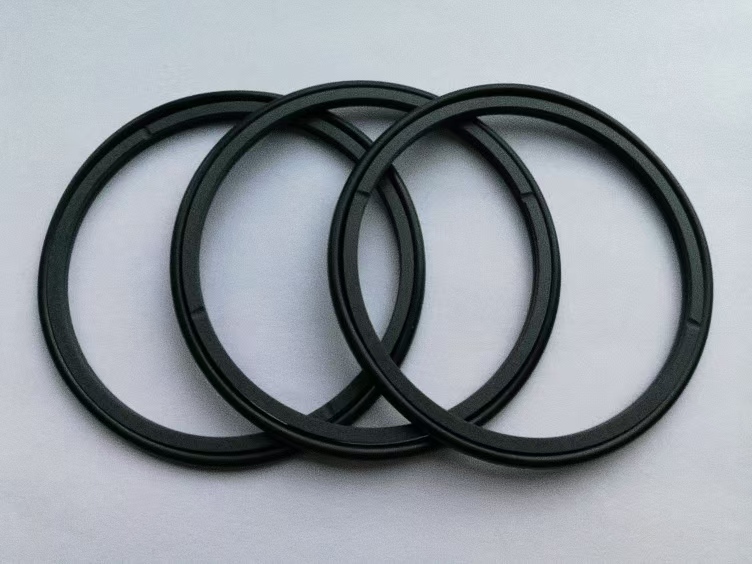
A drifter running at 60 Hz accumulates 216,000 piston cycles per operating hour—roughly a third more than a 45 Hz unit at the same percussion hours. The standard 500-hour seal inspection interval that applies to mid-frequency equipment was developed for lower cycle rates. Running a high-frequency drifter to 500 hours before first percussion seal inspection accepts 108 million more piston cycles than the same interval on a 45 Hz unit. In abrasive rock environments or elevated oil temperatures, 350–400 hours is a more defensible threshold for first inspection.
HOVOO supplies seal kits for high-frequency drifters including Sandvik RD series, Epiroc COP high-frequency models, and Chinese-manufactured high-frequency drifters—with HNBR compounds for hot mine applications where oil return temperature exceeds 80°C. Model references at hovooseal.com.
Table of Contents
- The Piston–Spool Coupling: What Sets the Frequency Ceiling
- Short Piston vs. Long Piston at High Frequency
- High-Frequency vs. Standard-Frequency: Operational Comparison
- The Double Damping System: Keeping Bit-to-Rock Contact Between Blows
- Seal Maintenance Interval Recalculation for High-Frequency Units


