

 EN
EN
 AR
AR CS
CS DA
DA NL
NL FI
FI FR
FR DE
DE EL
EL IT
IT JA
JA KO
KO NO
NO PL
PL PT
PT RO
RO RU
RU ES
ES SV
SV TL
TL IW
IW ID
ID LV
LV SR
SR SK
SK VI
VI HU
HU MT
MT TH
TH TR
TR FA
FA MS
MS GA
GA CY
CY IS
IS KA
KA UR
UR LA
LA TA
TA MY
MY
There's a reason experienced drillers talk about 'feel' when they're setting up a new face. Percussion pressure, rotation pressure, and feed force don't operate independently—they're coupled through the drill bit in ways that make adjusting one parameter without considering the others produce unpredictable results. In rotary-percussion drilling, the piston's working stroke actually changes length depending on the feed force and rotational conditions at the bit. Excessive preload reduces piston travel; the velocity at impact drops, and so does blow energy. Too little preload and the bit loses contact between blows, wasting each impact into free air.
That coupling is documented going back decades in field drilling mechanics research. The practical implication: parameter adjustment is a balancing act across all four controls—percussion pressure, percussion frequency, rotation speed, and feed force—not a single-variable optimization. Understanding what each control actually does to the system is the starting point before touching any valve.
What Each Parameter Controls—and What It Doesn't
Percussion pressure drives piston acceleration during the power stroke. Higher pressure produces higher piston velocity at impact, translating to higher blow energy. But the relationship follows a parabola, not a straight line. Working pressure data from YZ45 sleeve-valve drills shows that energy efficiency peaks at 12.8–13.6 MPa and declines on both sides. Below the peak: insufficient piston velocity. Above it: excess pressure causes the piston to arrive at the shank too fast—the coupling between piston timing and valve reversal desynchronizes and energy efficiency drops.
Percussion frequency distributes the same hydraulic power differently—more blows per second at lower energy each, or fewer blows at higher energy. For a given hydraulic flow and pressure, they're a tradeoff. Adjusting frequency via the regulating plug or stroke-setting screw on the percussion module shifts where on that tradeoff curve the drill operates. Neither extreme is inherently correct; formation hardness and penetration mechanism determine the better setting.
Rotation speed sets how far the bit rotates between consecutive blows. If the bit rotates too far, each new impact hits virgin rock without the benefit of cracks from the previous blow—efficiency drops. Too little rotation and the carbide re-strikes the same wear scar, producing fine powder that's harder to flush and thermally stresses the carbide. Research at LKAB's Malmberget mine monitoring in-hole ITH drills found that rotation pressure variability was a reliable indicator of rock mass fracturing ahead—a reminder that rotation isn't just about bit positioning, it's also a diagnostic signal.
Feed force holds the bit against the rock face between blows. In vertical holes, feed pressure must compensate for increasing drill string weight as hole depth grows—data from the same LKAB study showed feed pressure increasing with hole length in a way that matched the theoretical counter-force from rod string weight. In angled holes, the calculation changes. Feed force set for a vertical hole at 20 meters will either over-push or under-push the bit at the same depth in a 60-degree inclined hole.
Interaction Table: What Happens When One Parameter Is Wrong
Parameter Set Too High |
Symptom |
What Actually Happens |
Correct Action |
Percussion pressure |
Drill sounds harsh; rod vibration excessive |
Piston overshoots; valve desync; secondary impact |
Reduce to rated window for formation |
Feed force |
Rotation slows or stalls; bit jams |
Piston stroke shortens; blow energy drops |
Reduce feed; check rotation torque margin |
Rotation speed |
Carbide heats rapidly; bit life drops |
Bit outruns crack pattern; re-strikes worn crater |
Reduce RPM; match to blow rate |
Percussion frequency |
Rod fatigue increasing; difficult at depth |
Cyclic stress exceeds rod design tolerance |
Lower frequency; use long-piston design |
Parameter Set Too Low |
Symptom |
What Actually Happens |
Correct Action |
Percussion pressure |
Penetration rate low; long per-hole time |
Piston arrives slow; insufficient rock crack depth |
Increase to optimal window |
Feed force |
Drill bounces; bit lifts off face between blows |
Impact energy dissipates into empty air |
Increase feed; target firm contact |
Rotation speed |
Bit drills straight channels; no fresh carbide |
Re-striking same impact point; powder buildup |
Increase RPM to 5–10 deg/blow target |
Percussion frequency |
Slow advance; underuse of available hydraulics |
Low meters/hour despite adequate pressure |
Increase frequency; check accumulator |
Setting Parameters for Different Formation Types
Soft rock below 60 MPa doesn't need maximum percussion pressure. Each blow penetrates readily, so the constraint shifts to cuttings removal rather than rock fracture. Running full percussion in soft limestone or chalk produces rapid penetration that overwhelms the flushing circuit—the hole fills with fine cuttings faster than they can be cleared, creating backpressure that deflects the hole. Reduce percussion pressure to 60–70% of rated and increase rotation speed to assist cuttings removal.
Hard granite above 180 MPa needs the opposite setup: maximum percussion pressure, firm feed force to hold bit-rock contact through the high-impact-resistance face, and lower rotation speed to let the carbide work the crack it just made before moving to a new position. Rotation pressure variability—the measure of bit resistance to turning—runs high in hard granite and low in fractured zones. Watching the rotation pressure gauge while drilling gives the operator advance warning of formation changes before the penetration rate drops.
Fractured and clay-intruded formations are the most demanding to set correctly. Impact pressure should be reduced from the hard-rock setting because each blow transfers into fissure walls rather than intact rock, producing higher effective penetration but also unpredictable rod deflection. Anti-jamming function—where the control system detects rotation stall and briefly reverses or reduces percussion—is standard on modern jumbos precisely because fractured ground is where string jams happen. On manual machines, the operator needs to recognize the rotation pressure spike that precedes a jam and reduce feed force proactively.
The Feed Pressure Gradient in Deep Holes
One parameter interaction that doesn't show up clearly in static setting tables: feed pressure must increase as hole depth increases to maintain constant force on the bit. The drill string's own weight provides an increasing counter-force as rods are added. A feed pressure that held the bit firmly at 5 meters depth is providing net negative force at 25 meters if it hasn't been compensated. Field data from production drilling monitoring shows feed pressure increasing linearly with hole length in correctly operated drills.
On rigs with automated parameter control, this compensation happens automatically through the feed pressure regulation loop. On manually controlled machines, operators typically set feed pressure at the start of a rod and don't adjust it through the full string length. The result is over-aggressive feed at shallow depth and insufficient feed at depth—both affecting energy efficiency and hole straightness in opposite ways within the same drill hole.
When Adjustment No Longer Helps: Seal Condition as the Hidden Variable
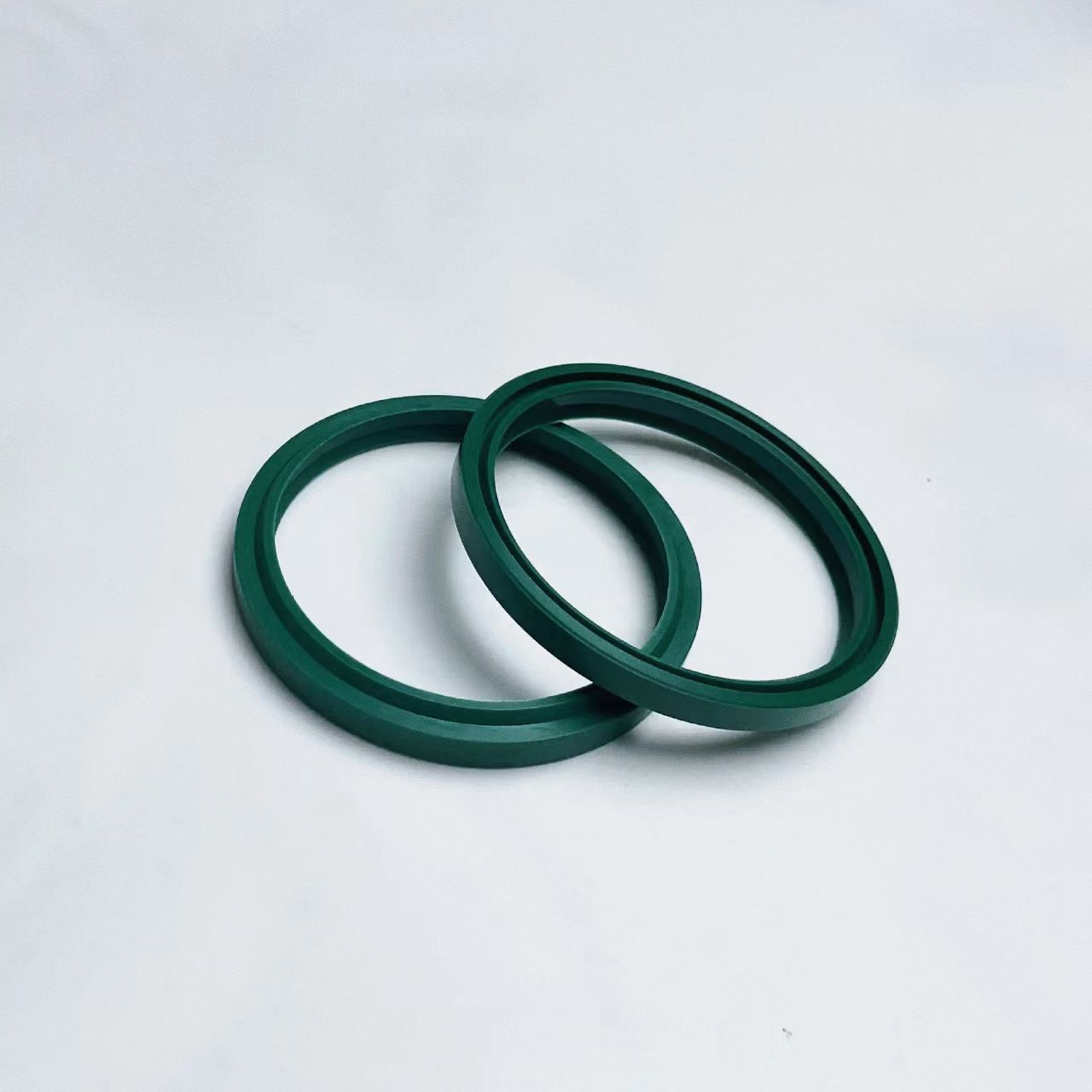
There's a boundary beyond which parameter adjustment can't recover productivity: when the percussion piston seal is bypassing hydraulic pressure, every setting on the control panel is working against a system that's no longer operating as designed. The available percussion energy drops in proportion to bypass volume regardless of where the pressure set point sits. Reduced penetration rate in that situation isn't a parameter problem—it's a maintenance problem.
The diagnostic distinction: a correctly set drifter with worn seals shows reduced penetration at normal gauge pressure and elevated return oil temperature. A drifter with misconfigured parameters shows the same reduced penetration but normal return oil temperature. Temperature is the giveaway. HOVOO supplies seal kits for all major drifter brands in PU and HNBR compounds matched to operating temperature range. Full model references at hovooseal.com.


