

 EN
EN
 AR
AR CS
CS DA
DA NL
NL FI
FI FR
FR DE
DE EL
EL IT
IT JA
JA KO
KO NO
NO PL
PL PT
PT RO
RO RU
RU ES
ES SV
SV TL
TL IW
IW ID
ID LV
LV SR
SR SK
SK VI
VI HU
HU MT
MT TH
TH TR
TR FA
FA MS
MS GA
GA CY
CY IS
IS KA
KA UR
UR LA
LA TA
TA MY
MY
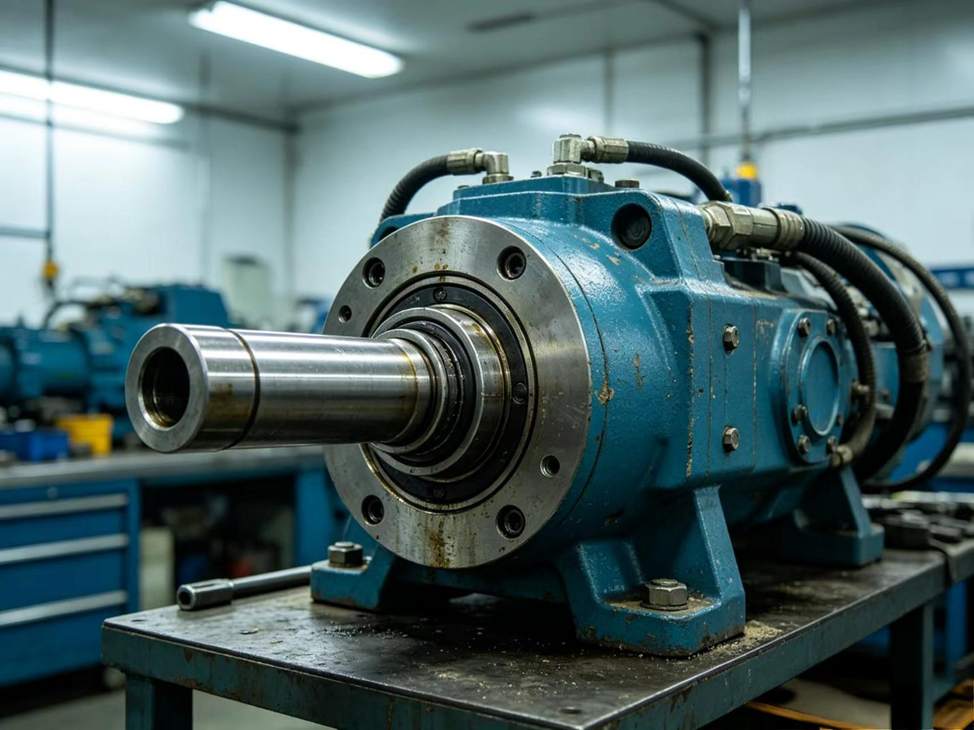
The hydraulic motor that rotates a rock drill's shank adapter has an output shaft spinning continuously inside a case full of lubricating oil, and a small rubber seal is all that keeps that oil from working its way out along the shaft. This seal sees a different kind of duty from the cup seal or diaphragm covered elsewhere: it is not holding back high pressure, it is holding back a continuously rotating shaft, indefinitely, for as long as the drill runs. This article explains how a rotation motor shaft seal actually works, why it fails the way it does, and what to check before ordering a replacement.
What Is a Rotation Motor Shaft Seal in a Hydraulic Rock Drill?
The rotation motor shaft seal is a radial lip seal fitted around the output shaft of the hydraulic motor that turns the rock drill's shank adapter. It sits where that shaft passes out of the motor's case, sealing the case's lubricating oil in while keeping the shaft free to spin continuously at operating speed.
This type of seal is also commonly called a rotary shaft seal, radial lip seal, or oil seal, and the same basic design is used across a huge range of rotating machinery, from automotive gearboxes to industrial motors. What makes the rock drill application specific is the operating environment: continuous duty, vibration transmitted from the percussion mechanism, and a location exposed to the same dust and debris the front head deals with.
How Does a Rotary Lip Seal Actually Hold Back Oil on a Spinning Shaft?
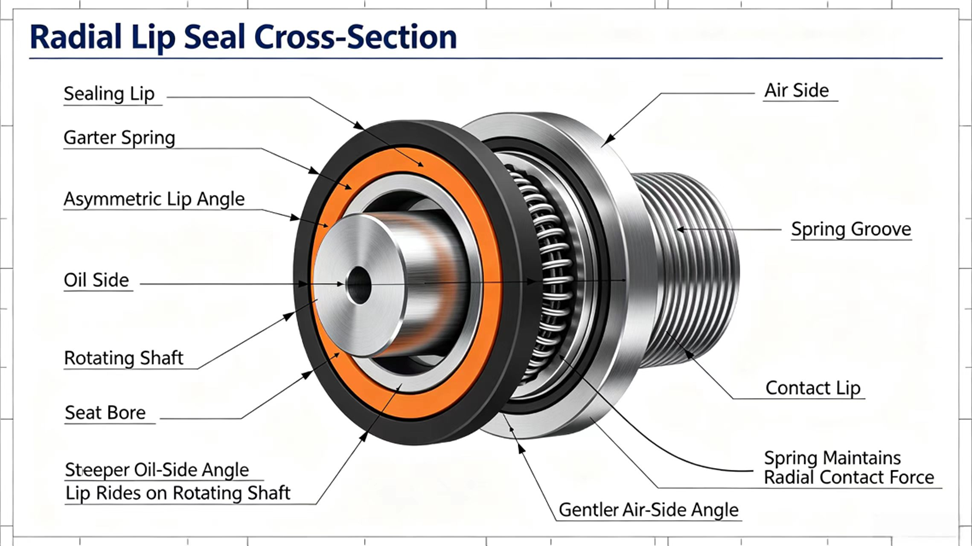
A rotary lip seal works through a flexible sealing lip that rides in continuous contact with the rotating shaft, typically pressed against it by a small circular garter spring that maintains contact force as the lip wears over time. The lip's cross-section is usually asymmetric, with a steeper angle on the oil side than on the air side, which does more than just hold the lip in place: as the shaft rotates, this asymmetry creates a slight hydrodynamic pumping action that actively works oil back toward the case rather than simply relying on the lip to block it passively.
More sophisticated designs add fine spiral grooves or ridges to the lip surface specifically to reinforce this pumping action, in some cases engineered to work regardless of which direction the shaft rotates. In a rock drill's rotation motor, where the shaft may rotate in either direction depending on drilling and rod-changing operations, this bidirectional capability matters more than it would in a motor that only ever turns one way.
The basic condition any such seal has to meet, at any point around the shaft's circumference, is that the lip's contact pressure must stay above the pressure of whatever it is holding back. Finite-element studies of spring-loaded rotary lip seals confirm this directly, and also show how much dynamic capability a well-designed seal actually has: in one study of a seal subjected to 0.2 mm of radial shaft runout (the shaft wobbling slightly off-center as it turns) under 0.2 MPa of internal pressure, the optimized design maintained contact pressure consistently above the medium pressure at every position around the full rotation, with no localized pressure collapse, and held measured leakage to roughly half a gram per hour. That kind of dynamic tracking, not just static contact when the shaft is perfectly still and centered, is what the garter spring and the lip's flexibility are actually there to provide.
Why Is a Rotation Motor Shaft Seal Not Designed to Hold Pressure?
It is a common and costly misunderstanding to treat a rotary shaft seal as if it were a pressure seal. It is not. A standard lip seal is generally only rated for a modest pressure differential across it, commonly cited in the range of a few bar, well below the working pressure found elsewhere in the drill's hydraulic circuit. The seal is designed on the assumption that the motor's internal case cavity, where the seal actually lives, is kept close to atmospheric pressure by the motor's case drain circuit.
This distinction matters because it reframes what actually protects the seal: not the seal's own strength, but the health of the case drain line that keeps pressure off it in the first place. A perfectly good shaft seal can fail quickly if that supporting circuit is not doing its job, which is a large enough topic to deserve its own detailed look.
What Happens When the Rotation Motor Shaft Seal Fails?
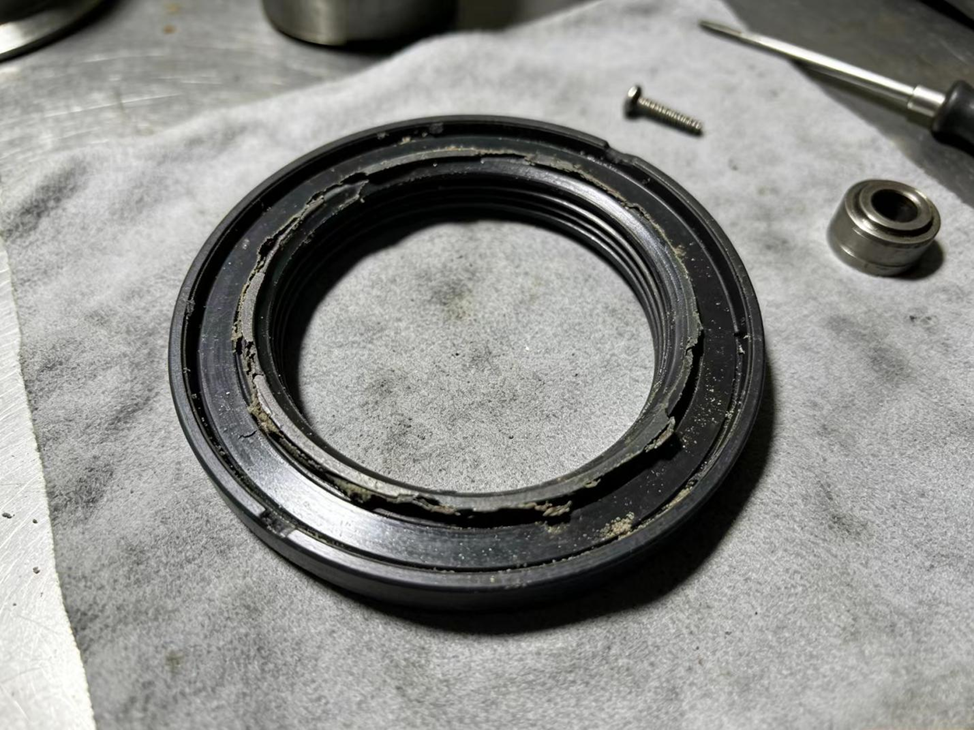
Once the lip loses contact with the shaft, or the garter spring loses tension, oil can migrate out of the motor case along the shaft. In mild cases this shows up as a slow oil weep at the motor's shaft area; in more advanced failures, especially where the case has been running under excess pressure, the seal lip can be pushed out of its bore entirely, producing a much faster loss of oil.
Beyond the visible leak, a failed shaft seal also opens a path for dust and drilling debris to work its way into the motor case from the outside, since the same lip that holds oil in is also what excludes contamination. A shaft seal failure can therefore become a contamination problem for the whole motor, not just an oil-leak problem at one point.
How Can You Tell If Your Rotation Motor's Shaft Seal Has Failed?
A failing shaft seal generally shows up as one or more of the following:
- Visible oil weeping or dripping from the rotation motor's shaft area during or after operation.
- A drop in the motor's case oil level, or oil contamination showing up where it shouldn't.
- A visible groove worn into the shaft at the seal's contact point, found during inspection.
- Dust or debris found inside the motor case at teardown, indicating the seal has been letting contamination in as well as oil out.
- Unusual case drain pressure readings, which point toward the underlying cause rather than the seal itself.
The table below connects these symptoms to likely causes and a sensible next check.
Symptom |
Likely Cause |
Next Check |
Oil weeping at the motor shaft |
Worn seal lip or lost garter spring tension |
Check case drain pressure before assuming the seal alone is at fault |
Seal lip pushed out of its bore |
Case drain pressure exceeded the seal's rated limit |
Inspect the case drain line for blockage or restriction |
Grooved wear visible on the shaft |
Long-term lip contact wear, often from contamination or misalignment |
Assess whether the shaft needs a sleeve or repair, not just a new seal |
Debris found inside the motor case |
Seal has failed as an exclusion barrier as well as an oil seal |
Inspect the full case interior for contamination damage |
Repeated seal failures on the same motor |
An underlying case drain or circuit problem rather than a bad seal batch |
Investigate the case drain circuit and valve behavior |
What Causes Premature Shaft Seal Failure?
Several conditions shorten a rotation motor shaft seal's service life, and the first one on this list is by far the most common in the field:
- Excess case drain pressure from a restricted, kinked, blocked, or undersized case drain line, which is widely recognized across hydraulic motor troubleshooting as the leading cause of shaft seal failure.
- A control valve that closes its return path before its supply path when centering, causing a momentary pressure spike in the motor's return circuit that has nowhere to go but through the shaft seal.
- Contamination reaching the seal lip from a failed or missing dust seal, accelerating lip wear directly.
- A worn or corroded shaft surface at the seal's contact point, which prevents even a new, correctly rated seal from sealing properly.
- Incorrect installation, including a damaged or dislodged garter spring, or a seal installed at an angle in its bore.
The lip's pre-compression against the shaft also has to land in a fairly narrow window, similar in spirit to the pre-charge sensitivity discussed for other seal types elsewhere in this series. Simulation studies of a comparable spring-loaded elastomer seal around a rotating shaft found that increasing pre-compression from 8% to about 10% steadily improved contact stress and sealing performance, but pushing it further, to around 14%, shifted the point of maximum stress to the seal's chamfer and produced severe, localized stress concentration there — the mechanical signature of the elastomer being squeezed into any small clearance gap it can reach. The same body of work found that as internal pressure rose in the presence of even a small clearance, the rubber was pressed into that gap and local stress at the extrusion point climbed sharply, from roughly 10 MPa to as much as 75 MPa over a several-fold increase in pressure. A shaft seal does not have an adjustable pre-compression in the field, but this research explains why a seal that has lost its designed fit — from a worn bore, a dislodged spring, or the wrong replacement part — tends to fail at a specific, localized point rather than wearing evenly.
Alignment is a related but separate issue from pre-compression. Beyond simple off-center runout, research on rotary lip seals has also looked specifically at angular misalignment — the seal sitting slightly tilted relative to the shaft axis rather than being installed square to it. That work found that angular misalignment changes the lip's contact pattern in a genuinely three-dimensional way, with contact width and pressure becoming distinctly uneven around the circumference even when average leakage does not necessarily get worse. The practical takeaway for installation is straightforward even though the underlying mechanics are complex: a shaft seal should be seated square in its bore, not just centered, since uneven contact concentrates wear at specific points rather than spreading it evenly around the lip.
Why Does Case Drain Pressure Matter So Much for This Seal?
A rotary lip seal's rated pressure capability is modest by hydraulic standards, and the motor's case drain line exists specifically to keep the seal operating well within that rating by giving internal leakage a low-resistance path back to tank. When that path is restricted — by a clogged line, an undersized fitting, a filter element creating backpressure, or a valve configuration that traps pressure in the return circuit — the case cavity pressure rises, and that pressure acts directly on the seal lip.
The practical result is that a shaft seal replaced without addressing a case drain problem tends to fail again on a similar timeline, since the new seal is exposed to the same excess pressure that damaged the old one. This is why experienced hydraulic technicians treat repeated shaft seal failures on the same motor as a case-drain-circuit problem until proven otherwise, rather than assuming a run of bad parts.
What Should You Check Before Replacing the Shaft Seal?
Before ordering a new shaft seal, a few checks help confirm the failure and avoid a repeat:
- Inspect the case drain line for kinks, blockage, or an undersized fitting, and confirm it runs to tank without passing through a restrictive filter or valve.
- Check the motor's case drain pressure against its rated limit if test equipment is available, rather than assuming the line is clear because it looks intact.
- Inspect the shaft surface at the seal's contact point for grooving, pitting, or corrosion that could prevent a new seal from sealing correctly.
- Confirm whether repeated failures point to a valve or circuit issue elsewhere in the hydraulic system, particularly one that could cause pressure spikes when the motor is stopped or reversed.
- Check the condition of any dust seal protecting the shaft seal from external contamination, and replace it at the same time if it shows wear.
How Do You Choose the Right Replacement Shaft Seal?
With the root cause addressed, three factors determine the right replacement seal:
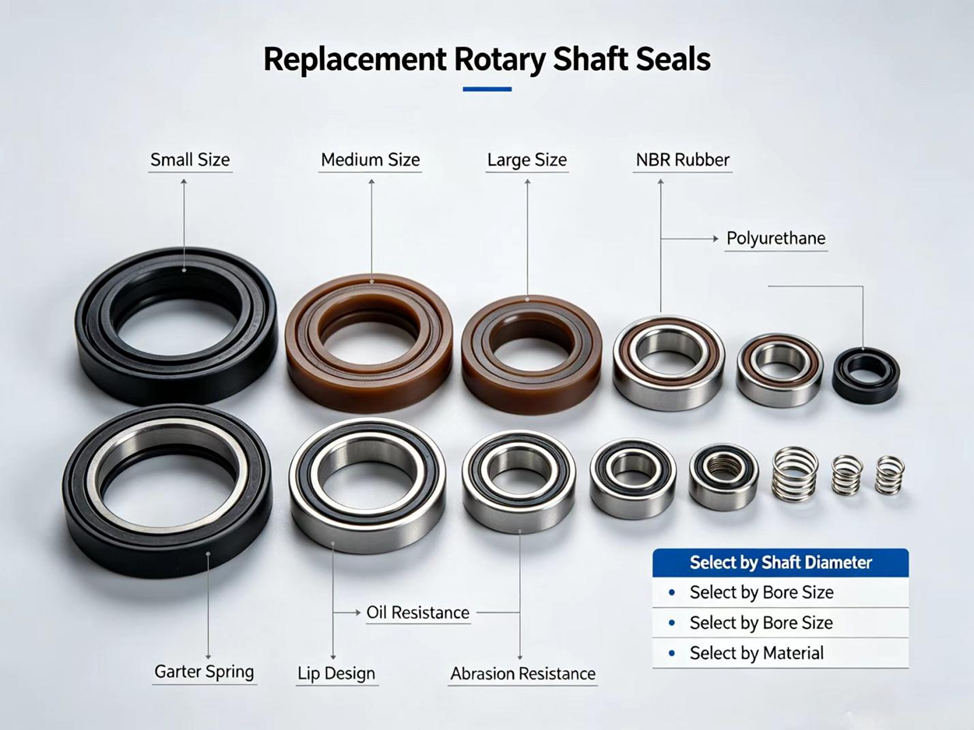
- Exact dimensional match to the motor's shaft diameter, bore, and seal width, since rotary lip seals are sized precisely and are not generally interchangeable across motor models.
- A material and lip design suited to the case oil type, operating temperature, and rotation pattern (one direction versus reversing duty), covered in more detail in a companion article on shaft seal materials.
- Confirmation of the garter spring's condition and correct seating, since a seal with a displaced or missing spring will not maintain lip contact force even if the elastomer itself is otherwise correct.
Where Can You Source a Reliable Replacement Shaft Seal?
Because shaft seal dimensions are specific to each motor model, sourcing comes down to finding a supplier who can match your motor's exact specification rather than a generically sized part.
Nanjing Hovoo Machinery Technology Co., Ltd, a Chinese seal manufacturer founded in 2013, produces PU, rubber, and PTFE sealing components, including rotary shaft seals for the hydraulic motors used on rock drills and drilling rigs, cross-referenced to major equipment brands, and states that it provides free technical support to help confirm the correct dimensions and material for a given motor before an order is placed.
If you are unsure which shaft seal your motor needs, providing the motor's model or the seal's existing part number, along with a note on your typical operating conditions (temperature, rotation pattern, and case oil type) to a supplier that can cross-reference against known motor specifications is the most reliable way to get a seal that fits and lasts.
.
Selected technical references consulted for this article:
- Sun H., Zhang X., Liang X., Wang H., Yang Y. “Modeling and Simulation Research on the Eccentric Shaft Hole Rotating Sealing Structure.” Hydraulics Pneumatics & Seals, 2026, (05): 29–36.
- Xu X., Luo B., Jia X., Chen S., Guo F. “Optimization Design of Radial Lip Seals under High-Pressure and Radial Runout Conditions.” Lubrication Engineering, published online ahead of print, 2026.
- Xu L., Li Z., Qiu H., Zou G., Liu C., Guo F. “Influence of Angular Eccentricity on the Performance of Rotary Lip Seals.” Lubrication Engineering, published online ahead of print, 2026.
Table of Contents
- What Is a Rotation Motor Shaft Seal in a Hydraulic Rock Drill?
- How Does a Rotary Lip Seal Actually Hold Back Oil on a Spinning Shaft?
- Why Is a Rotation Motor Shaft Seal Not Designed to Hold Pressure?
- What Happens When the Rotation Motor Shaft Seal Fails?
- How Can You Tell If Your Rotation Motor's Shaft Seal Has Failed?
- What Causes Premature Shaft Seal Failure?
- Why Does Case Drain Pressure Matter So Much for This Seal?
- What Should You Check Before Replacing the Shaft Seal?
- How Do You Choose the Right Replacement Shaft Seal?
- Where Can You Source a Reliable Replacement Shaft Seal?


