

 EN
EN
 AR
AR CS
CS DA
DA NL
NL FI
FI FR
FR DE
DE EL
EL IT
IT JA
JA KO
KO NO
NO PL
PL PT
PT RO
RO RU
RU ES
ES SV
SV TL
TL IW
IW ID
ID LV
LV SR
SR SK
SK VI
VI HU
HU MT
MT TH
TH TR
TR FA
FA MS
MS GA
GA CY
CY IS
IS KA
KA UR
UR LA
LA TA
TA MY
MY
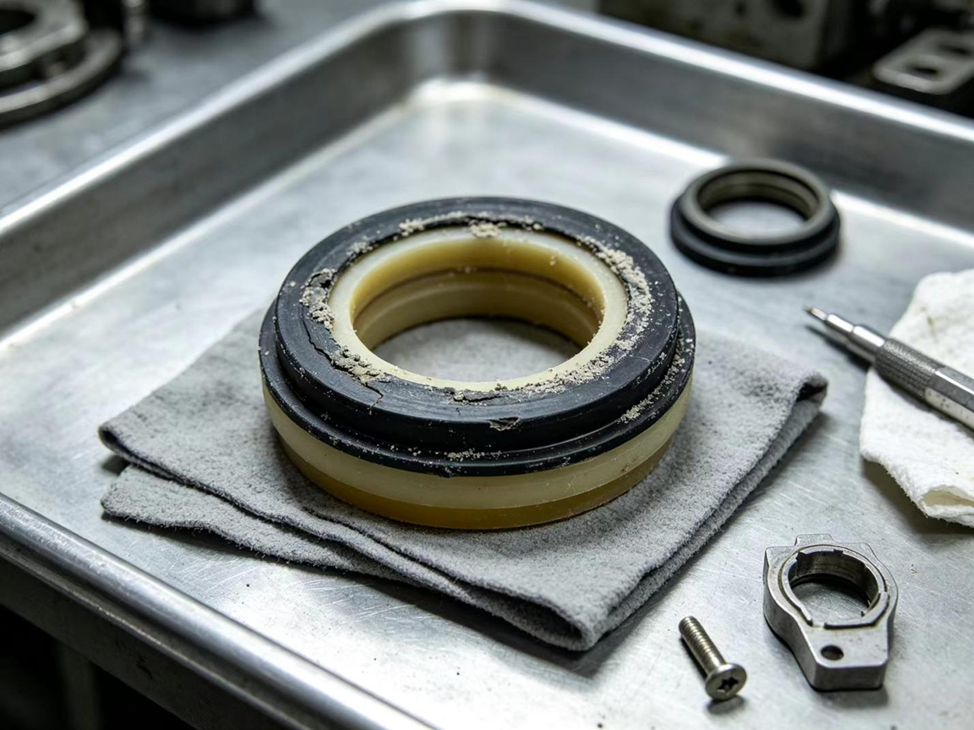
A rock drill dust seal has a narrower job than most other seals on the machine — it excludes contamination rather than holding back pressurized fluid — but that narrower job still comes with its own material demands. This article looks at the materials most commonly used for rock drill dust seals, why an exclusion seal's material choice differs somewhat from a pressure seal's, and what that means for how it behaves in service.
What Is a Rock Drill Dust Seal Made Of?
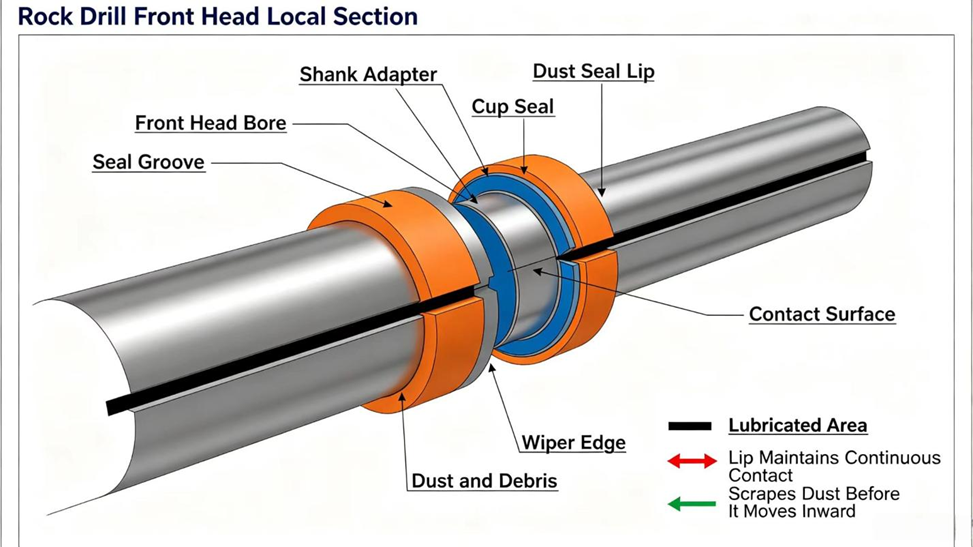
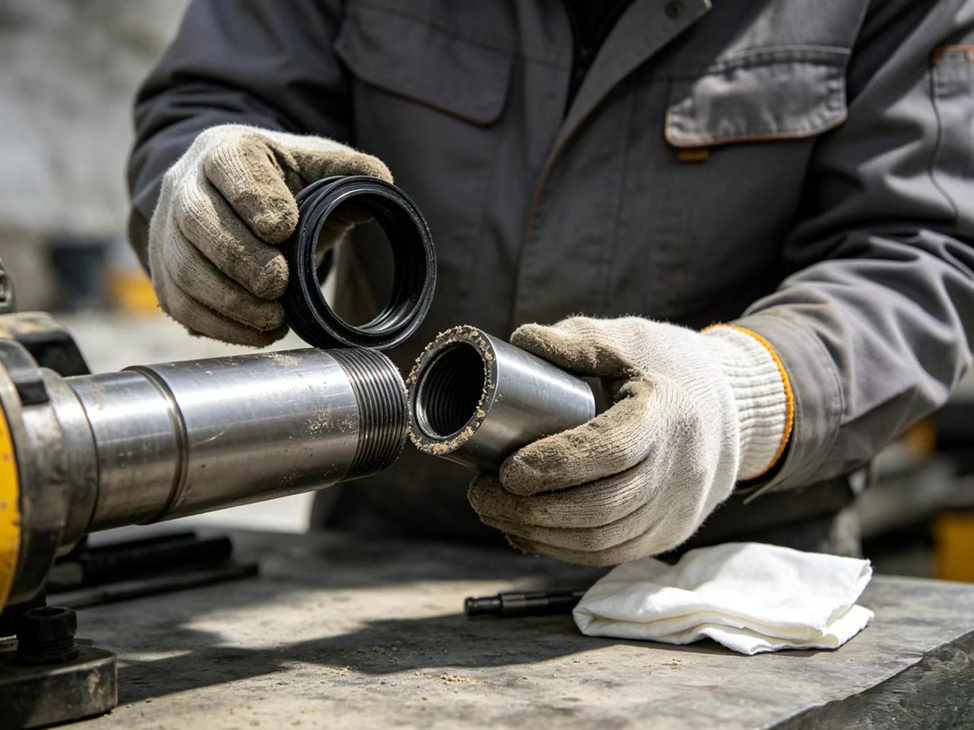
Rock drill dust seals are most commonly molded from polyurethane (PU) or nitrile rubber (NBR). Depending on the manufacturer, the same component may also be listed as a wiper seal, scraper seal, or front cover seal, but all of these refer to the outermost sealing element fitted around the shank adapter where it exits the front head.
Why Does Dust Seal Material Matter for an Exclusion Seal?
It is tempting to assume that a seal which only has to keep dust out, rather than hold back pressurized fluid, is not particularly demanding on its material. In practice, a dust seal's material still has to survive continuous sliding and rotating contact against the shank adapter, resist abrasion from the very contamination it is excluding, and tolerate outdoor exposure to sunlight, ozone, and temperature swings at the very front of the machine, often with less lubrication and cooling than seals further inside the front head.
A material that is a poor match for these conditions shows it in familiar ways: rapid lip wear from abrasive dust, cracking and hardening from heat and ozone exposure, or a lip that loses its shape and stops maintaining contact with the shank adapter.
What Is Polyurethane (PU) and Why Is It Common for Dust Seals?
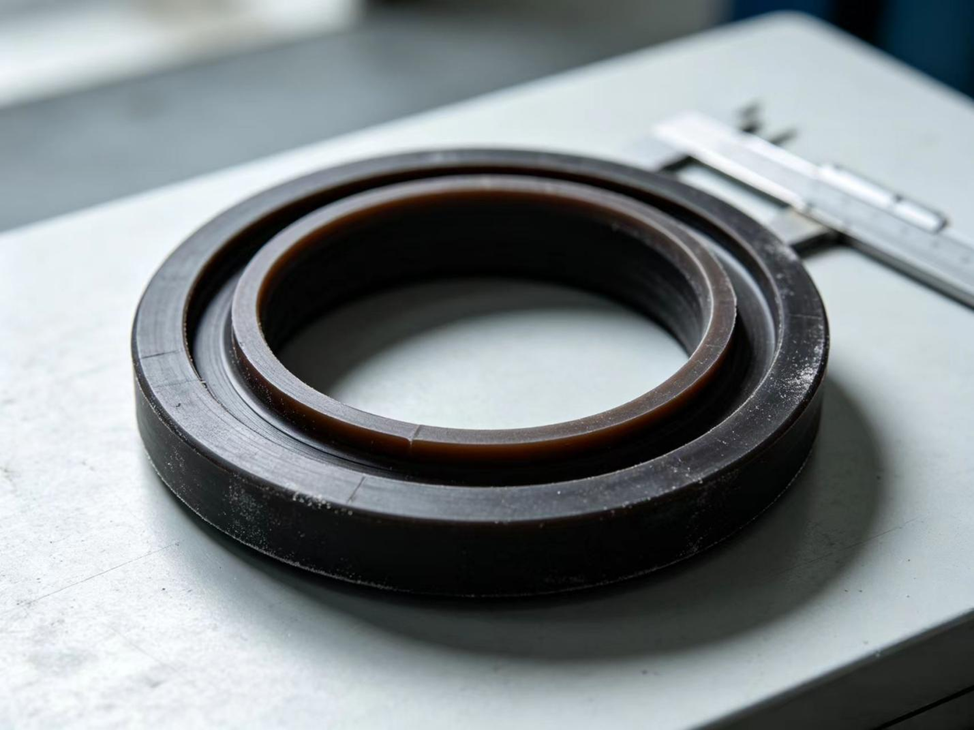
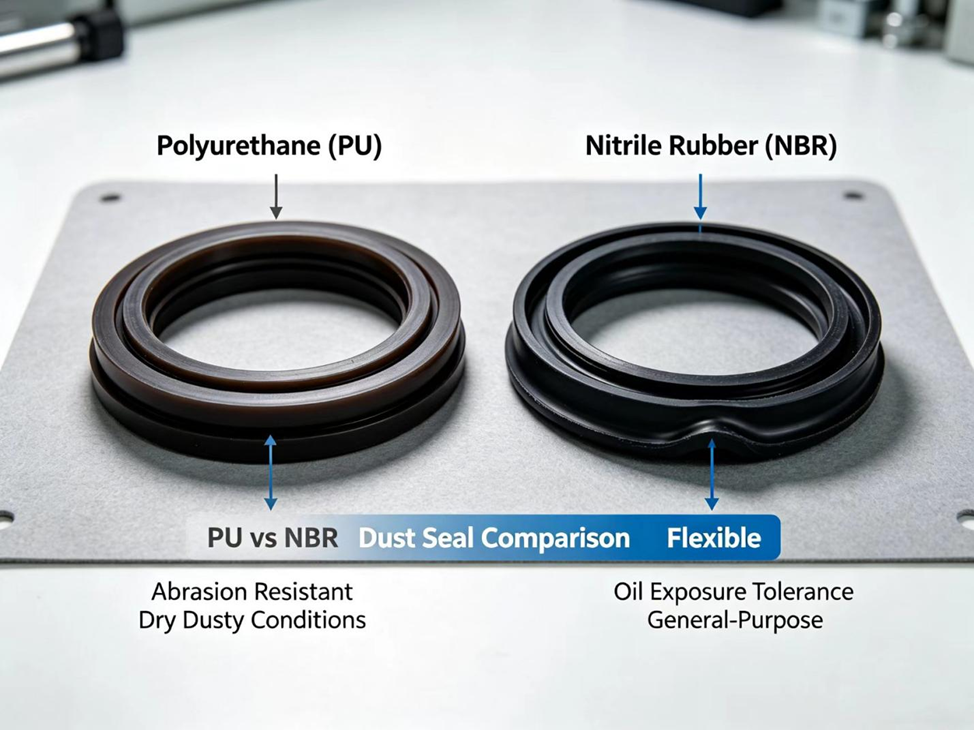
Polyurethane's defining strength, abrasion and tear resistance well ahead of most conventional rubber compounds, lines up closely with what a dust seal actually needs: it is in constant contact with hard, abrasive rock dust and drilling fines, and a material that wears quickly from that contact will stop excluding contamination long before it visibly fails.
PU dust seals are a common default for dry, dusty drilling conditions where abrasion resistance is the dominant concern. Their main limitations are a lower continuous-use temperature ceiling than some specialty compounds, and comparatively lower flexibility at very low temperatures.
What Is NBR and When Is It Used for Dust Seals Instead?
NBR is a general-purpose elastomer valued for its balance of flexibility, cost, and resistance to oil contact, which matters here because a dust seal sits close enough to lubricated components that some incidental oil exposure is possible even though oil resistance is not its primary function. NBR also tends to retain flexibility at low temperatures somewhat better than PU, which can matter in cold-climate drilling.
Where abrasion resistance is less of a dominant factor — for example, wetter drilling conditions where mud rather than dry grit is the main contaminant — NBR is a reasonable and more cost-effective alternative to PU for the dust seal position.
Does a Dust Seal Need Oil Resistance If It Isn't Sealing Oil?
A dust seal's primary function does not require oil resistance, but a modest degree of it is still a practical consideration. The dust seal sits close to grease or oil that may be present at the front head during routine maintenance, and a material that swells or degrades badly on contact with common lubricants is a poor choice even for a part whose main job is exclusion rather than fluid retention.
Both PU and NBR offer adequate resistance to incidental contact with mineral-based greases and oils, which is part of why these two materials, rather than a water-focused or purely mechanical material, remain the standard choices for this position.
How Do These Materials Compare Side by Side?
The table below summarizes the general trade-offs described above. Exact performance depends on the specific compound formulation used by a given manufacturer.
Material |
Abrasion Resistance |
Low-Temperature Flexibility |
Cost |
Typical Limitation |
Polyurethane (PU) |
Very good, generally the best of the group |
Moderate; can stiffen in cold conditions |
Moderate |
Lower heat ceiling than specialty compounds |
NBR |
Moderate |
Good, generally better than PU at low temperatures |
Lower |
Less abrasion resistance in dry, dusty conditions |
PU and NBR cover the overwhelming majority of rock drill dust seal applications, but they are not the only materials used for exclusion duty across sealing engineering generally. In unusually demanding conditions — high temperature combined with corrosive exposure, for example — published dust seal designs for other pressure-retaining equipment have used a glass-fiber-filled PTFE composite for the sealing element, paired with a corrosion-resistant metal alloy spring rather than the elastomer's own memory to maintain contact force. This kind of construction is considerably more specialized and costly than a standard PU or NBR lip, and is generally reserved for conditions well outside typical rock drill service, but it illustrates that the two materials discussed here are a practical default rather than the only technical option available.
How Does Lip Design (Not Just Material) Affect Dust Exclusion?
Material is only part of how well a dust seal excludes contamination; the lip's geometry matters just as much. A single-lip wiper design is simpler and lower friction, while a double-lip design adds a second contact line that can catch contamination the first lip missed, at the cost of slightly more friction and heat generation. Some designs also add a small excluder groove ahead of the main lip specifically to capture larger debris before it reaches the sealing contact point.
Because lip design and material work together rather than independently, a replacement dust seal should match both the original material and the original lip profile rather than treating either one as the single deciding factor.
How Does Abrasive Content in the Environment Affect Material Choice?
Sites drilling in hard, silica-bearing rock generally produce finer, harder, and more abrasive dust than sites in softer formations, and that difference shows up directly in dust seal wear rates. On highly abrasive sites, the wear-resistance gap between PU and NBR becomes more decisive, generally favoring PU despite its higher cost. On sites where contamination is present but less aggressively abrasive, NBR's lower cost and somewhat better cold-weather flexibility can make it the more sensible default.
Because abrasive content varies so much by rock type and drilling method, matching the dust seal material to actual site conditions, rather than defaulting to whichever material shipped with the machine, is generally the more reliable approach.
How Does Temperature Affect Dust Seal Material Performance?
The dust seal sits at the very front of the machine, which generally means less exposure to the sustained internal heat that oil-side seals experience, but more exposure to ambient conditions: direct sunlight, outdoor temperature swings, and in cold climates, the stiffening effect of low temperature on either material. PU's somewhat higher stiffness at low temperature can translate into reduced sealing effectiveness on very cold mornings until the machine and its seals warm up, while NBR tends to retain usable flexibility slightly further into cold conditions.
At the other end, sustained high ambient temperature combined with limited airflow at the front head can accelerate the same heat-related hardening and cracking that affects elastomers generally, which is part of why a dust seal's outward appearance — cracking, hardening, loss of flexibility — is often the most practical indicator of when replacement is due, regardless of exact operating hours.
How Can You Identify the Right Material for Your Site Conditions?
Because dust seal material choice depends on the specific balance of abrasive content, moisture, and temperature at a given site, the most reliable approach is to describe those conditions to whoever is supplying the replacement part rather than assuming the original material is automatically the best fit.
Where records or a parts catalog are available, they will usually specify the material originally fitted; where they are not, a supplier familiar with the rock drill model can generally confirm the standard specification and advise on whether the site's drilling conditions justify a different choice.
Selected technical references consulted for this article:
- Zhao S., Huo H., Pang C., Cheng W., Wang T., Wei R. “Development and Application of a Corrosion- and High-Temperature-Resistant Dust Seal for Safety Valves.” Equipment Management & Maintenance, 2026 (04).
Table of Contents
- What Is a Rock Drill Dust Seal Made Of?
- Why Does Dust Seal Material Matter for an Exclusion Seal?
- What Is Polyurethane (PU) and Why Is It Common for Dust Seals?
- What Is NBR and When Is It Used for Dust Seals Instead?
- Does a Dust Seal Need Oil Resistance If It Isn't Sealing Oil?
- How Do These Materials Compare Side by Side?
- How Does Lip Design (Not Just Material) Affect Dust Exclusion?
- How Does Abrasive Content in the Environment Affect Material Choice?
- How Does Temperature Affect Dust Seal Material Performance?
- How Can You Identify the Right Material for Your Site Conditions?


