

 EN
EN
 AR
AR CS
CS DA
DA NL
NL FI
FI FR
FR DE
DE EL
EL IT
IT JA
JA KO
KO NO
NO PL
PL PT
PT RO
RO RU
RU ES
ES SV
SV TL
TL IW
IW ID
ID LV
LV SR
SR SK
SK VI
VI HU
HU MT
MT TH
TH TR
TR FA
FA MS
MS GA
GA CY
CY IS
IS KA
KA UR
UR LA
LA TA
TA MY
MY

Seal specification by scale — Nanjing Hovoo (HOVOO / HOUFU)
Scale Changes the Failure Mode, Not Just the Size
A small hydraulic breaker and a large one share the same working principle: oil drives a piston, nitrogen stores energy, a valve shifts, the chisel strikes. They do not share the same dominant failure mode. A compact breaker on a 3-tonne urban excavator runs at 800–1,200 BPM — its valve seals cycle thousands of times per hour, generating fatigue damage in a way that a large mining breaker at 150 BPM never experiences. The large mining breaker runs at 200–250 bar for eight-hour shifts, sustaining oil temperatures above 85°C that degrade standard NBR seals in ways that a compact breaker running for 2-hour urban demolition windows never reaches. The selection criteria for different project scales are therefore not simply 'more power for bigger jobs' — they are structurally different engineering and maintenance challenges that happen to look like a size comparison.
The most common selection error is applying the maintenance protocol of one scale class to the other. A construction firm that upgrades from a mid-class demolition breaker to a heavy mining unit for a quarry contract often keeps the same seal replacement interval — 2,000–2,500 hours, which is appropriate for their previous application. The mining unit running two shifts daily in 35°C ambient air needs a full seal kit replacement at 800–1,200 hours to prevent accumulator diaphragm fatigue and piston seal extrusion at sustained 220 bar. Missing that interval by 500 hours does not produce a gradual performance decline — it produces a sudden internal failure when a fatigued accumulator diaphragm ruptures during a peak-pressure cycle, contaminating the hydraulic circuit and triggering a rebuild that costs ten times the seal kit that would have prevented it.
At the small end, the comparable error is treating the compact breaker as a lower-maintenance item because its purchase price and parts cost are lower. A compact breaker on an urban utility crew cycles its valve seals 700–1,400 times per minute in concrete dust environments. The front dust seal protecting the piston bore accumulates contamination faster in confined spaces with concrete grit than on open sites. Replacing that front dust seal on schedule — at 400 hours in urban grit environments rather than the 800-hour standard construction interval — costs less than a single shift of downtime when the bore becomes contaminated. Nanjing Hovoo's HOUFU dust wiper compounds, with PTFE-coated lips for abrasion resistance, are designed specifically for this application and extend the effective protection interval compared with standard NBR alternatives.
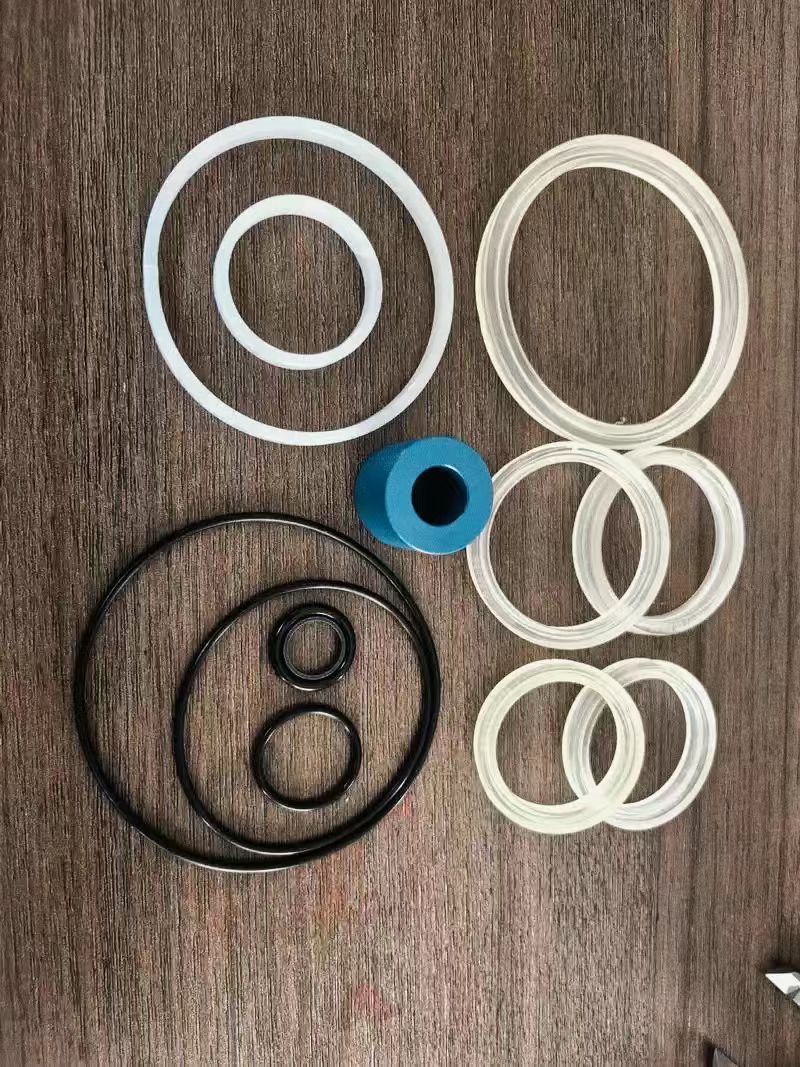
Four Dimensions — Small Breaker vs Large Breaker Compared
Right column notes the HOVOO / HOUFU seal specification that controls the dominant failure mode at each scale.
Dimension |
Small (compact–mid) |
Large (heavy–mining) |
Scale-specific seal note (HOVOO / HOUFU) |
Carrier & flow class |
0.7–8 t carrier; 15–80 L/min; 80–140 bar; 700–1,400 BPM; 0.1–5 kJ/blow |
20–100 t carrier; 100–300 L/min; 180–330 bar; 80–400 BPM; 15–300 kJ/blow |
Small: valve and piston rod seals cycle 700–1,400 times/min — high fatigue, low thermal load; HOUFU NBR-H low-compression-set seals. Large: fewer cycles but 200–330 bar sustained pressure + 85–100°C oil — HOVOO FKM seals rated to 120°C continuous |
Primary application |
Urban utility trenching; interior demolition; footpath and kerb; confined-space access; residential concrete |
Hard rock quarrying; primary mining; large foundation demolition; bridge pier removal; offshore and tunnel primary face |
Small: noise compliance often mandatory (box-type); work cycles short and intermittent — seals see many thermal start-stop cycles, which degrade standard NBR faster than sustained heat. Large: continuous two-shift duty — accumulator diaphragm needs fatigue-rated compound, not standard construction grade |
Dominant failure mode |
Front dust seal contamination from confined-space concrete dust; valve seal fatigue from high BPM cycling; chisel bore abrasive paste in urban grit |
Seal extrusion at sustained 200+ bar pressure; accumulator diaphragm fatigue from 8-hour continuous cycling; piston scoring from oil temperature above 80°C |
Small: HOUFU PTFE dust wiper reduces abrasive paste formation in concrete grit; replace at 400 h in urban environments. Large: HOVOO FKM accumulator diaphragm extends rebuild interval from ~800 h to ~1,400 h in continuous mining duty |
Maintenance priority |
Grease every 1–2 h (high BPM generates heat at bushing faster); daily front seal inspection; box-type damper pads every 500 h; nitrogen check every 3 months |
Grease every 2 h; oil temperature monitoring every shift; through-bolt torque at 250 h; accumulator nitrogen weekly on cold unit; full seal kit replacement at 800–1,200 h rather than 2,500 h for construction-class |
Small: seal kit cost is low — replace on schedule, not on symptom; the savings of deferring a $40 seal kit is erased by one failed valve requiring a full internal service. Large: HOVOO/HOUFU full kit replacement at 800 h prevents the piston scoring that becomes a $4,000+ rebuild |
The Mid-Class Breaker — Where Scale Ambiguity Creates the Most Procurement Errors
The selection challenge is sharpest not at the extremes but in the mid-class range of 8–20-tonne carriers. A mid-class breaker can be deployed on light quarry secondary breaking, on urban road demolition, or on general construction foundation work — three applications with significantly different thermal loads, contamination profiles, and duty cycles. A buyer who specifies a mid-class unit by carrier weight alone gets the right physical fit but potentially the wrong specification for the dominant application. A unit destined for summer quarry secondary breaking needs FKM accumulator seals and a 1,000-hour service interval. The same model destined for winter municipal road repair needs standard NBR or NBR-H and can run to 1,500 hours before the first seal service. Specifying 'mid-class' without specifying the operating environment leaves the service interval and seal compound choice undefined — and those two choices largely determine whether the unit delivers its rated performance for the full expected service life.
Fleet managers who maintain mixed-scale fleets — compact urban units alongside mid-class demolition and heavy quarry breakers — face an inventory challenge that a single seal supplier covering all three scale classes resolves efficiently. A HOVOO/HOUFU supplier relationship that covers PTFE dust wipers for compact urban units, NBR-H valve seals for mid-class construction, and FKM full kits for heavy continuous-duty units means one purchase order covers the seal requirements across the entire fleet. The alternative — three separate OEM seal kit sources across three scale classes — multiplies the minimum order quantities, the stock SKU count, and the procurement effort. In markets where parts availability matters as a distributor differentiator, being able to supply the correct compound-grade seal kit for any scale in the fleet from a single source is a practical competitive advantage.
One dimension of the small-vs-large comparison that procurement guides rarely address is residual value. A small compact breaker with documented seal replacement history at the correct interval retains significantly more resale value than an identical unit with no service records — because the buyer cannot verify whether the bore and piston are clean. A large mining breaker with a documented HOVOO/HOUFU FKM seal kit replacement at 800 hours and an accumulator diaphragm service record commands a premium over an identical unit where the maintenance history is unknown. Across both scale extremes, the seal service record is the most verifiable indicator of internal condition, and buyers in the used equipment market increasingly ask for it.


