

 EN
EN
 AR
AR CS
CS DA
DA NL
NL FI
FI FR
FR DE
DE EL
EL IT
IT JA
JA KO
KO NO
NO PL
PL PT
PT RO
RO RU
RU ES
ES SV
SV TL
TL IW
IW ID
ID LV
LV SR
SR SK
SK VI
VI HU
HU MT
MT TH
TH TR
TR FA
FA MS
MS GA
GA CY
CY IS
IS KA
KA UR
UR LA
LA TA
TA MY
MY
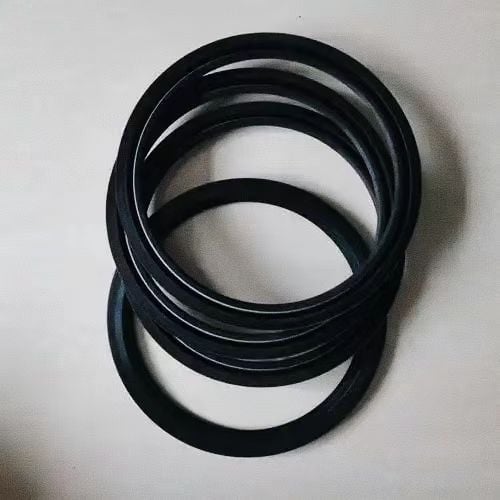
The question of which seal material is best has a frustrating but accurate answer: it depends on which failure mode you're trying to avoid. PU (polyurethane) fails through thermal compression set above 90°C. HNBR (hydrogenated nitrile rubber) fails through surface abrasion in high-particle-load environments. PTFE (polytetrafluoroethylene) fails through extrusion into bore clearances if it's not backed properly in dynamic applications. Each material has a dominant failure mode, and the right choice is the one whose dominant failure mode is least likely in your specific operating conditions.
That sounds like a materials science problem. In practice it's a site conditions assessment with three inputs: operating temperature, fluid chemistry, and dynamic load cycle rate. Get those three inputs right and the material selection follows logically. Get them wrong—or use a generic 'standard PU kit' for an application that needs HNBR—and the seal fails in the way PU fails when it's overheated: gradually and silently, with no external leak until the compression set is complete and bypass flow has been building for months.
PU: The Default Dynamic Seal and Its Temperature Ceiling
Polyurethane is the workhorse material for percussion piston seals, guide sleeve seals, and dynamic flushing box seals in hydraulic rock drills. The reasons are practical: PU has excellent abrasion resistance, high tensile strength under dynamic loads, and good elasticity for maintaining sealing contact at cyclic percussion frequencies of 30–60 Hz. It tolerates mineral hydraulic oils without significant swelling, and it's dimensionally stable across the temperature range typical of surface and temperate-climate underground operations.
The limit is thermal. At sustained temperatures above 90–95°C, PU undergoes accelerated compression set—the elastomer loses its elastic recovery and the seal lip conforms permanently to the bore groove dimensions without rebounding to its designed sealing contact geometry. The seal looks physically intact; it has simply stopped functioning as a spring-loaded sealing element. Percussion chamber bypass begins before any external leak is visible.
Deep mines running hot—ambient face temperatures above 35°C, hydraulic return oil above 75°C—regularly exceed PU's temperature window during extended continuous percussion. Surface operations in tropical climates without adequate oil cooling can do the same. In those environments, using PU isn't economically wrong because it's cheap; it's wrong because the service interval at which it fails is unpredictable, and failed seals in the percussion circuit don't produce an obvious warning.
HNBR: The High-Temperature and Chemical Resistance Upgrade
Hydrogenated nitrile rubber addresses PU's temperature weakness by saturating the unsaturated carbon-carbon double bonds in the nitrile backbone with hydrogen. The resulting polymer retains nitrile's oil resistance—the polar C≡N groups that resist swelling in mineral oils are preserved—while the saturated backbone resists thermal degradation and chemical attack from ozone, aggressive water chemistry, and ester-based hydraulic fluids.
HNBR maintains useful sealing properties to 150°C sustained—a 60°C margin above PU. In hot mine environments, that margin translates directly into longer, more predictable service intervals. A drifter in a deep gold mine where return oil temperature consistently hits 95°C will produce HNBR seals that outlast PU by 40–70% in the percussion circuit. That's not a marginal improvement; over a 5,000-hour equipment life it's the difference between 12 and 8 seal kit changes per unit.
HNBR also handles acidic mine drainage and saline groundwater better than PU. In copper and gold operations where formation water is acidic (pH 4–5), the PU backbone is attacked by the hydrogen ion concentration in a way that HNBR's saturated polymer resists. The symptom is accelerated surface crazing on PU seals—micro-cracks that grow inward and create bypass flow paths—while HNBR seals in the same circuit show normal wear patterns.
PTFE: Chemically Inert but Mechanically Demanding
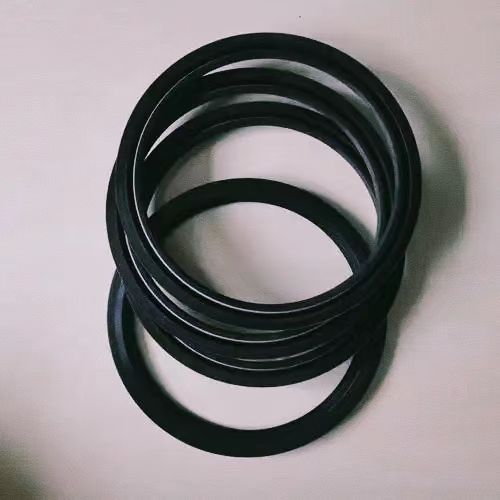
Polytetrafluoroethylene—PTFE—is in a different category from PU and HNBR. Its carbon-fluorine backbone is essentially chemically inert; it doesn't swell in acids, bases, solvents, or any of the aggressive fluids encountered in mining. It has extremely low friction, requiring less lubrication than elastomeric seals, and it maintains its properties across a wide temperature range.
The mechanical reality is that PTFE has very low elasticity. It won't conform to bore geometry the way an elastomer does—it needs a spring energizer or a backup element to maintain sealing contact as the surface wears. In dynamic percussion applications, a bare PTFE seal without a backup ring extrudes into the clearance gap between piston and bore under the cyclic pressure spikes of 160–220 bar percussion. The extruded material fails within hours.
PTFE's appropriate role in a rock drill seal kit is the static circuits: O-rings at the accumulator port, flushing water inlet seat seals, valve block static interfaces. In a fast-stroke hydraulic rock crusher tested in a bauxite mine, HNBR elastomer piston seals were failing from contamination and high temperature. Replacing them with self-energized PTFE-bodied seals eliminated the frequent replacement cycle—because for that specific fast-stroke, contaminated environment, PTFE's wear resistance and chemical inertness outweighed its lower elasticity. That's a specific application; it doesn't generalize to all dynamic percussion seals.
Material Comparison by Rock Drill Circuit and Condition
Seal Position |
Standard Condition |
Hot / Chemical Environment |
Why |
Percussion piston |
PU – standard abrasion life |
HNBR – sustains 90°C |
PU compression set above 90°C; HNBR stable to 150°C |
Guide sleeve / bushing |
PU – high wear resistance |
PU or HNBR depending on temp |
PU abrasion advantage; switch to HNBR if temp is primary concern |
Flushing box dynamic |
PU – handles particle load |
HNBR if pH <5 or T >80°C |
Acidic water attacks PU backbone; HNBR resists pH 3–11 |
Accumulator port O-ring |
NBR or HNBR |
HNBR or PTFE compound |
Static load; PTFE compound viable for aggressive fluids |
Valve block O-rings |
NBR standard |
HNBR or PTFE for static seats |
Low cycle; chemical resistance more important than elasticity |
Shank wiper / dust seal |
PU – particle exclusion |
HNBR if chemically challenged |
PU standard lip geometry; HNBR for chemical environments |
Making the Right Call Without a Laboratory
Most sites don't have oil analysis or mine water chemistry data at the point where a seal kit is ordered. Three field indicators make the call reliable without formal testing. First: what's the hydraulic oil return temperature? Use an infrared thermometer on the return hose after 30 minutes of percussion. Above 80°C consistently = HNBR for the percussion circuit. Second: what does the mine water look like at the drill face? Green or orange tinting = mineral acid content; HNBR for flushing seals. Third: have previous PU kits failed early with surface crazing or compression set rather than abrasive wear? If yes, the failure mode is temperature or chemistry, not mechanical—switch compounds.
HOVOO supplies rock drill seal kits in PU and HNBR for all major drifter models, with PTFE-compound static seal options for chemically aggressive applications. The kit reference includes compound designation so orders are explicit rather than defaulting to a single standard. Full model and compound references at hovooseal.com.


