33-99No. Mufu E Rd. Gulou District, Nanjing, China [email protected] | [email protected]
33-99No. Mufu E Rd. Gulou District, Nanjing, China [email protected] | [email protected]

The handbook's organization method is very worth replicating. It expands step by step from O-ring definition, sealing principle, groove design, dimension standards, elastomer material, chemical compatibility, quality assurance, failure analysis, related sealing products and technical reference.
How this handbook is organized, the remainder is divided into these eight sections: Section Two covers basic O-ring seal gland design guidelines for male gland, female gland and face seals, and this section should serve as an excellent starting point for adding an O-ring seal to an application. Section Three — Global O-Ring Size Reference Guide: inch and metric dimensions with tolerances for most major global O-ring size standards can be found in Section Three. O-rings can be supplied in most of these sizes without a tooling charge. Dichtomatik is also tooled for a very modest number of non-standard sizes and can certainly make a tool for any size that is required, usually for a very modest tooling charge. Section Four — O-Ring Sealing Elastomers: this section offers a very brief introduction to the world of sealing elastomers. Volumes have been written on elastomers and new materials are constantly being developed. This section is intended to cover just the basics; for further assistance in selecting an elastomer for your application, please contact Dichtomatik North America. Section Five — Chemical Compatibility Guide: Section Five offers ratings for several elastomer families in contact with the listed chemicals and fluids. There is sometimes a great deal of variation in terms of chemical compatibility within an elastomer family, but this guide will serve as a good starting point. Section Six — Quality Assurance: the quality assurance section deals mostly with surface quality defect standards for O-rings. It also touches on manufacturing quality systems and shelf life recommendations. Section Seven — Troubleshooting & Failure Analysis: occasionally, problems with an O-ring seal will arise. Section Seven provides an overview of the most common O-ring failure modes and offers possible causes and solutions for each. Section Eight — Other Related Products: Dichtomatik North America can supply a great deal more than O-rings. Make Dichtomatik your One-Stop Shop for all of your sealing needs. Section Nine — Technical Reference: Section Nine contains several technical resources that may be useful when dealing with sealing applications.
Page 10's explanation shows the subsequent chapters include: groove design, global dimension standards, sealing elastomers, chemical compatibility, quality assurance, failure and troubleshooting, related products and technical reference.
The first point Chinese enterprises can learn from: upgrade the enterprise material from a "sample book" to a "selection handbook." A sample book answers "what do I have"; a selection handbook answers "how should the customer select, why select this way, how is the specification determined." The latter more easily enters the technical decision chain of main factories, engineering companies, maintenance departments and export customers.
It is recommended Chinese enterprises restructure their own technical material into the following seven modules:
Module |
Approach in the Handbook |
How Domestic Enterprises Can Reuse |
Design Calculation |
Groove, compression rate, fill rate, gap, chamfer, surface roughness |
Make a calculator, Excel tool, selection mini-program |
Dimension Standard |
AS568, ISO, DIN, BS, JIS, NF standards and cross tables |
Build international/domestic/euro/japanese/customer specification cross-database |
Material Selection |
NBR, FKM, EPDM, VMQ, PU and other material explanations |
Build own-formula material selection matrix, not just write "oil resistant, high temperature" |
Media Compatibility |
Chemical media and elastomer compatibility rating |
Build a chemical compatibility database customers can query |
Quality Judgment |
Surface defect, storage life, quality system |
Build inspection atlas, defect boundary sample piece, incoming/outgoing goods standard |
Failure Analysis |
Extrusion, over-compression, aging, spiral failure, installation damage etc |
Build after-sales failure diagnosis SOP and technical service report template |
Product Combination |
O-ring, D-ring, X-ring, spare parts ring, U-ring, oil seal, custom parts |
Move from single-item selling to sealing solution selling |
Chapter 2 is one of the highest engineering-value chapters of the whole book.
This handbook explicitly states this groove design guide is mainly used for static seal, pressure not exceeding 1500 PSI scenarios; dynamic applications and higher pressure need separate evaluation. It also emphasizes that material name alone cannot represent quality — maximum/minimum tolerance stacking must also be checked, that is, the "large O-ring, small groove" and "small O-ring, large groove" limit working conditions.
This point is very suitable for Chinese enterprises to replicate. Domestic many O-ring failures are not really material problems, but rather drawing groove, assembly chamfer, tolerance stack-up, surface roughness and compression rate/fill rate not systematically checked. If enterprises can make these regulations into standardized tools, they can significantly improve technical service capability.
Especially recommended to replicate the following design control points:
Control Item |
Key Idea Given by the Handbook |
Concrete Action Domestic Enterprises Can Take |
Compression Rate |
Radial static seal recommends 5%–30%, target approx. 20%; face static seal recommends 10%–35%, target approx. 25% |
Use compression rate as a mandatory check item at drawing review, output correction result |
Minimum Compression Amount |
Even light compression will produce compression permanent deformation, therefore must ensure minimum compression amount |
Add minimum compression amount alert in design software |
Groove Fill Rate |
Fill rate needs to consider thermal expansion, media dissolution and tolerance stack-up |
Set dedicated correction coefficients for fuel oil, coolant and other media |
Gap Extrusion |
High pressure, soft rubber, eccentricity, cylinder wall expansion can all lead to extrusion |
Form a recommendation table of "pressure — hardness — gap — whether back-up ring is needed" |
Installation Chamfer for Radial Seal |
Recommends 15° lead-in chamfer, and ensures O-ring only contacts the chamfer during installation |
Include chamfer length, deburring, thread protective sleeve into the assembly process card |
Installation Regulations |
Must not over-pull, remove sharp edges, clean, lubricate, soft installation tool, anti-twist |
Make into production line and customer on-site installation training poster |
The handbook page 17-18 clearly gives compression rate, compression amount, fill rate and extrusion gap's calculation logic, and explains dynamic seals usually should adopt lower compression rate interval, to balance friction and wear.
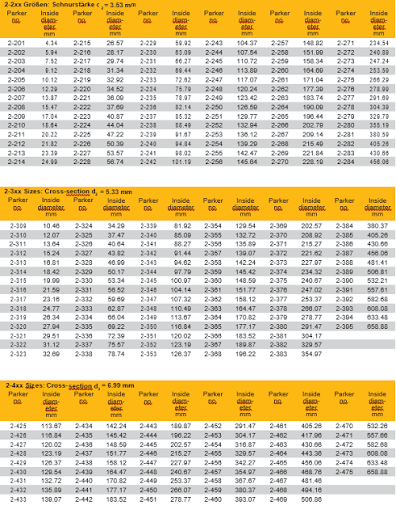
Chapter 3 covers SAE AS568, ISO 3601, DIN 3771, BS 4518, BS 1806, JIS B 2401, NF T47-501 and other international standards, and explains dimension tables include ID, cross-section CS and tolerance, and also provides a primary dimension table sorted by CS and ID, for identifying which standards a certain size exists in.
This is very key for export-oriented Chinese enterprises. Many domestic enterprises have production capability but lack "specification language conversion capability." A customer says AS568-214, DIN 3771 25×3.55, JIS P series, BS 1806, sales, engineering, warehouse and mold department often need manual inquiry, low efficiency and prone to error.
Recommended Chinese enterprises reuse this as a set of "global O-ring specification knowledge base":
Build fields: standard number, specification code, ID, CS, OD, ID tolerance, CS tolerance, near-substitute specification, whether existing mold, common material, MOQ, delivery, applicable industry.
Build "customer drawing number — international standard — enterprise internal part number" three-way mapping.
Build common cross-section libraries by common cross-section, e.g. 1.78, 2.62, 3.53, 5.33, 6.99 mm and common domestic customer metric cross-sections; for domestic market build national standard/customer non-standard/master-machine-factory corresponding tables; for export market build common standard AS568, ISO, DIN targets and corresponding tables.
Build "whether usable standard part substitution" recommendation logic for non-standard parts, to reduce new mold and inventory complexity.
Many customers not only just want to buy one O-ring, but hope the supplier can tell them clearly: does this specification have a standard piece? Is there stock? What is the alternative? What is the risk? Enterprises with this kind of mapping capability, sales efficiency and customer stickiness will be much better.
Chapter 4's positioning of elastomers explains clearly: O-rings are homogeneous rubber, their sealing capability directly depends on whether the elastomer can maintain long-term sealing force, so material selection is at least as important as dimension and groove.
Elastomers are split into types or families based on the basic polymer from which they are made. The following table contains the different elastomer types and their nomenclature used by ASTM D 1418 and ISO 1629. Within each elastomer type, the individual elastomers vary in the fillers, softeners (plasticizers), curing agents, accelerators and other additives that they contain. The types and quantities of the base polymer, the softeners, and how the elastomer is processed, are what determine the physical properties that may make a particular elastomer right or wrong for an application.
The handbook also lists Dichtomatik's standard material system, e.g. NBR 70, NBR 90, silicone 70, peroxide-cured EPDM 70, polyurethane 70/90, and uses ASTM D2000 to describe materials. This explains it is not just writing "nitrile, fluorine, ternary ethylene propylene," but rather integrates compound family, hardness, curing system, performance grade, standard material codes together.
Domestic enterprises can learn key focus in three points:
First, establish their own standard material inventory. It is not necessary that all materials be per-customer configured. Should respond with 10-20 core standard material numbers, e.g.: NBR 70 general oil resistant, NBR 90 high pressure anti-extrusion, FKM 75 heat/oil resistant, EPDM 70 water resistant/steam/refrigerant resistant, VMQ 70 food/low temperature resistant, HNBR automotive oil resistant/gas resistant, PU 90 hydraulic wear resistant. Every material must have an internal code, hardness range, color, temperature range, media range, certification status, inventory strategy and relationship.
Second, material explanations must write clearly "applicable boundaries." The handbook's explanation of NBR, EPDM, VMQ, PU and other material is not one-sided propaganda, but simultaneously lists strengths and taboos. For example, NBR is suitable for mineral oil, hydraulic oil and grease, but usually not suitable for aromatics, chlorinated agents, high-polarity fuels, extreme temperature; EPDM is resistant to hot water, steam, aging and many chemical products, but is completely unsuitable for mineral oil, lubrication oil and fuel; FKM is heat resistant, resistant to many chemicals, oil and fuel resistant, but is usually unsuitable for hot water, steam, polar solvents, ethylene glycol type brake fluid and low-molecular-weight organic acids.
Third, ASTM D2000 or similar standardized expressions should be introduced into quotations, drawings and technical coordination. The handbook uses ASTM D2000 to explain material grade, oil resistance grade, hardness, tensile strength, additional testing requirements and special Z-suffix requirements. Domestic enterprises can apply this to export parts, automotive parts, engineering machinery parts and high-end industrial parts, reducing the understanding gap caused by simply writing "FKM 75."
Chapter 5's chemical compatibility guide is very worth reusing.
It uses a rating system of 1, 2, 3, 4 and "-": grade 1 represents little or no effect, volume change less than 10%; grade 2 represents possible loss of physical properties, volume change 10%-20%, may not be suitable for static applications; grade 3 represents noticeable change, volume change 20%-40%, questionable performance in most applications; grade 4 represents excessive change, volume change greater than 40%, not suitable for service; grade "-" represents insufficient information. The handbook explains these ratings are mainly based on volume swelling, but volume swelling is only one compatibility indicator -- the polymer backbone's migration under chemical media may also manifest as tensile strength, elongation at break and hardness changes. Rising temperature and extended exposure time make the working condition more severe, so the user must independently verify actual application.
What Chinese enterprises can reuse is not simply copying this table, but building their own "media-material-temperature-time-failure mode" database. It is recommended to proceed as follows:
Data Dimension |
Recommended Field |
Media |
Chinese name, English name, CAS number, concentration, mixture composition, whether additive is present |
Working Condition |
Temperature, pressure, immersion/dynamic, exposure time, cleaning cycle |
Material |
Enterprise internal code, compound, hardness, curing system, color, batch |
Evaluation Indicator |
Volume swelling, hardness change, tensile change, compression permanent deformation, appearance crack |
Conclusion |
Recommended, can be used with caution, needs verification, not recommended, no data |
Evidence Grade |
Literature, laboratory soaking, actual field application, batch verification, failure case |
Special attention: what Chinese enterprises face are often not pure chemicals, but rather compound systems, e.g. new energy coolant, lithium battery electrolyte, urea solution, refrigerant-oil mixtures, cutting fluid, cleaning agents, food/beverage media, etc. Simply applying traditional compatibility tables can easily lead to misjudgment. Therefore the compatibility table should be used as a pre-screening tool, and then verified with one's own material through soaking, compression permanent deformation, low-temperature rebound, dynamic friction and aging tests.
Chapter 6 emphasizes that besides groove design, dimension and material, manufacturing quality systems, surface quality and storage/shelf life equally affect O-ring performance. The handbook lists manufacturing quality systems, surface quality and storage/shelf life as key factors, and also explains that most of Dichtomatik's O-rings come from ISO-9000 and/or QS9000 certified factories, citing RMA OR-1, MIL-STD-413, DIN 3771-4, SAE AS871, SAE AS708 and other surface quality standards, showing that different standards have different strictness levels.
Parting line projection is defined as a continuous ridge of material on the parting line on the ID or the OD of the O-ring. Parting line projection is often a result of mold wear causing enlarged radii at transition from the mold cavity to the flat plane of the tool. Excessive flash is a thin, film-like feature that extends beyond the parting line projection. Excessive flash is typically a result of improper or inadequate deflashing. The maximum allowed height of the parting line projection and excessive flash combined is shown in the table below.
This part is very practical for Chinese enterprises. Many domestic factories' quality disputes concentrate on flash, mold mismatch, over-grinding, impurities, flow marks, bubbles, missing rubber, cracks, parting line and other appearance issues. Without a clear standard, the customer says "not good" and the factory says "usable," and the dispute turns into a pricing and claims problem.
It is recommended Chinese enterprises reuse the following approaches:
Shelf life and storage conditions are also worth reusing. The handbook lists recommended shelf life for different elastomers, e.g. NBR, SBR, BR, NR/IR at 3-5 years, EPDM, CR, EU, ECO etc at 5-10 years, FKM, FFKM, VMQ, FVMQ, ACM up to 20 years; and recommends storage temperature 4-27°C, not exceeding 49°C, relative humidity below 65%, avoiding excessive dryness, UV/oxygen and ozone and deformation stress.
For Chinese enterprises, this section can be directly converted into a warehouse management system: batch number first-in-first-out, material life alerts, ozone source isolation, light-shielded packaging, sealed bag management, and customer inventory recommendation reports.
Chapter 7 is the core of the after-sales service system. The handbook explicitly indicates, every O-ring application involves complex parameters such as pressure, temperature, friction, environmental exposure and chemical exposure, and design groove, selecting dimension and material must be considered comprehensively; this chapter lists common failure modes and gives possible causes and corrective measures.
Description: The seal develops ragged edges, generally on the low pressure side, which appear tattered. This condition is more common with high pressure systems.
Contributing Factors: excessive clearances, excessive system pressure, irregular clearance gaps due to eccentricity, sharp groove edges, low-modulus/low-hardness elastomer, softening of elastomer due to fluid incompatibility, excessive gland fill, expansion of cylinder wall due to pressure.
Suggested Solutions: decrease clearances, decrease system pressure if possible, use back-up ring, increase rigidity and concentricity of metal components, break edges of groove to minimum of 0.004" (0.10mm), use higher-modulus/higher-hardness elastomer, use more chemically compatible elastomer, increase groove width or change O-ring size, stiffen cylinder wall to limit expansion.
This is very suitable for Chinese enterprises to build a technical service barrier. When most customers encounter a leak, their first reaction is "sealing quality is poor." If the supplier lacks structured failure analysis capability, they can only passively compensate or replace; if there is drawing and report data, one can judge whether it is caused by design, installation, media, temperature, gap, material, batch or working condition change.
Reusable failure types from the handbook include:
Failure Mode |
Typical Causes/Countermeasures in the Handbook |
Domestic Enterprise Reusable Scenario |
|
Extrusion/Nibbling |
Gap too large, pressure too high, eccentricity, groove sharp edge, hardness too low, media softening, fill rate too high; can reduce gap, add back-up ring, raise hardness, improve compatibility |
Hydraulic cylinder, valve, engineering machinery, high pressure |
|
Over-Compression/Compression Set |
Compression amount too high, temperature too high, material compression permanent deformation too large, heat resistance insufficient, curing improper |
Motors, cars, steam, chemical equipment |
|
Spiral Failure |
Eccentricity, gap, side loading, uneven surface roughness, insufficient lubrication, material too soft; can raise cross-section hardness, reduce gap, external lubrication or internal lubrication, use higher hardness or D-ring |
Long-stroke hydraulic piston seals |
|
Chemical Decomposition |
Poor compatibility with media, can switch more chemically resistant material, use PTFE-encapsulated O-ring, lower seal treatment temperature |
Natural gas, ammonia, CO₂, high-pressure gas equipment |
|
Explosive Decompression |
Rapid decompression of high-pressure gas absorbed by O-ring leads to bubble bursting, internal blistering deepened; can slow decompression speed, raise modulus/hardness or use blast-resistant material |
Deep well, high hardness, wear |
Dynamic seal surface roughness, poor lubricant guide, particle contamination; can recommend surface roughness processing, isolation wear |
Plasticizer Extraction |
Fuel, engine oil, mineral oil, solvent and reduced dependence on plasticizer; switch cold-resistant, solvent-resistant, better elasticity elastomer |
Cold cabinet, refrigerated market |
|
Installation Damage |
Sharp edges, insufficient chamfer, thread cutting, O-ring stretched too much, material too hard; can reduce chamfer angle, add lead-in sleeve, protect seat cover, re-inspect installation tool |
Assembly-heavy, replacement-heavy market |
|
Ozone/Air Ozone Cracking |
O-ring exposed to air pollution, over-stretch, air exposure; can replace ozone-resistant material, coat protection or extend shelf life |
Outdoor equipment, electrical equipment, air motion, gas leaking long-term storage |
|
Among these, the handbook gives a very direct diagnosis for extrusion/nibbling: low-pressure side edge fragmentation, ragged edges, commonly seen in high-pressure systems, with causes including excessive gap, excessive system pressure, eccentricity, sharp groove edges, low hardness or incompatibility softening; chemical decomposition, explosive decompression and wear are also each given surface characteristics, common mechanisms and suggested measures.
Chinese enterprises can turn this section into three types of deliverables: a post-customer-service questionnaire, a failure analysis report template, and sales/engineering training materials. It is recommended each failure report include at minimum: sample photos, working condition parameters, material batch, dimension re-check, hardness re-check, groove re-verification, media confirmation, failure mode judgment, root cause ranking, corrective measures and preventive measures.
Chapter 8 shows Dichtomatik's product combination thinking: besides O-rings, it also includes D-rings, X-rings, square rings, O-ring cross-section pads, rubber and Teflon coated O-rings, FEP encapsulated O-rings, T-seals, V-ring combination seals, guide bands, and more. The handbook also explains encapsulated O-rings can incentivize PTFE cover, combining PTFE's dynamic characteristics with O-ring's simple sealing method, bringing dynamic non-self-sealing, but used to maintain concentricity between rod and hole, helping other sealing elements work while avoiding uneven wear.
O-Rings: Dichtomatik offers O-rings in almost any size and in a wide range of materials. We are tooled for most standard O-ring sizes and maintain a large inventory of all AS568 sizes in eight different materials.
D-Rings: D-rings are often used as an alternative to O-rings in reciprocating dynamic applications because of their resistance to spiral failure. They can be used for sealing on the ID or the OD. Dichtomatik D-rings can be made in most sizes and materials.
X-Rings: X-rings can be used as an alternative to O-rings in dynamic applications because of their reduced friction and their resistance to spiral failure. Dichtomatik offers most AS568 equivalent sizes in NBR 70 as standards and in most sizes and materials as non-standard parts.
Square Rings: Square rings can be either molded or lathe-cut. The lathe-cut parts are often less expensive than comparably sized O-rings, especially for larger IDs. Dichtomatik can offer both molded and lathe-cut square rings in most sizes and materials.
The insight for Chinese enterprises is: don't operate the O-ring business in isolation -- what the customer truly needs is a "sealing problem solution," not a single item. Chinese enterprises can expand product combinations by scenario:
Application Scenario |
Combinable Products |
Static Seal |
O-ring, rectangular ring, encapsulated O-ring, special-shaped gasket |
High-Pressure Hydraulic |
O-ring + back-up ring, T-ring, U-ring, guide band, scraper ring |
Dynamic Reciprocating |
X-ring, D-ring, U-ring, PTFE-covered seal, guide ring |
Rotary Shaft |
Oil seal, grease seal, V-ring, radial end-face seal |
Chemical Immersion |
FEP/PFA encapsulated O-ring, FFKM, PTFE composite seal |
Large Size/Small Batch |
Rubber joint O-rings, machined seals, molded custom parts |
Custom Projects |
Molded gaskets, rubber-metal parts, special-shaped parts |
This type of product combination helps raise the per-customer order value, and can also avoid pure O-ring price wars, especially in engineering machinery, hydraulics, automotive aftermarket, chemical process management and similar fields -- if a supplier can provide one-stop solutions for O-rings, back-up rings, guide bands, dust rings and custom parts, customer switching cost will rise significantly.
It is recommended Chinese enterprises standardize customer inquiries. Fields should at minimum include:
Category |
Field |
Seal Form |
Radial internal seal, radial external seal, face seal, dynamic/static |
Working Condition |
Pressure, temperature, whether pulse, whether vacuum, whether high pressure gas |
Motion |
Static, reciprocating, rotating, oscillating, speed, stroke, frequency |
Media |
Media name, concentration, additives, cleaning agent, exposure time |
Dimension |
Groove dimension, shaft/hole dimension, tolerance, O-ring ID/CS |
Surface |
Roughness, hardened layer, plating layer, whether has installation chamfer |
Material |
Compound, hardness, color, certification, food/drinking water/automotive requirements |
Failure Information |
Leak location, sample photos, service time, failure appearance |
Convert the handbook's design logic into judgment items:
Don't just roughly classify by "oil resistant, acid-alkali resistant, high-temperature resistant" -- at minimum build the following matrix:
Material |
Main Application |
Forbidden Media |
Temperature Hardness Range |
Recommended Industry |
NBR |
Mineral oil, lubricant grease, one aromatic hydrocarbon, polar solvent, brake fluid, hydraulic oil |
|
70/90 |
Hydraulic, general machinery |
HNBR |
Hot oil, natural gas, automotive |
Strong polar solvent formulation limited |
70/80/90 |
Automotive, oil-gas |
EPDM |
Hot water, steam, coolant |
Mineral oil, gasoline, oxidizing agent |
60/70 |
Water systems, brake |
VMQ |
Wide temperature, food/pharma |
Mineral oil, oil |
0/80 |
Food, medical, electronics |
FKM |
High temp oil, fuel, solvent |
Hot water steam, low molecular organic acids, part polar solvent |
70/75/90 |
Automotive, chemical, oil |
PU |
Wear resistant, hydraulic |
High temp hydrolysis, some chemical media |
70/90 |
Hydraulic, pneumatic |
It is recommended every after-sales case output the same format:

Welcome to HOVOO, a Chinese seal factory. Production of PU, Rubber and PTFE seals. The seals include O-ring, piston seal, rod seal, Gray ring and gas seal.


 EN
EN
 AR
AR CS
CS DA
DA NL
NL FI
FI FR
FR DE
DE EL
EL IT
IT JA
JA KO
KO NO
NO PL
PL PT
PT RO
RO RU
RU ES
ES SV
SV TL
TL IW
IW ID
ID LV
LV SR
SR SK
SK VI
VI HU
HU MT
MT TH
TH TR
TR FA
FA MS
MS GA
GA CY
CY IS
IS KA
KA UR
UR LA
LA TA
TA MY
MY
