33-99No. Mufu E Rd. Gulou District, Nanjing, China [email protected] | [email protected]
33-99No. Mufu E Rd. Gulou District, Nanjing, China [email protected] | [email protected]

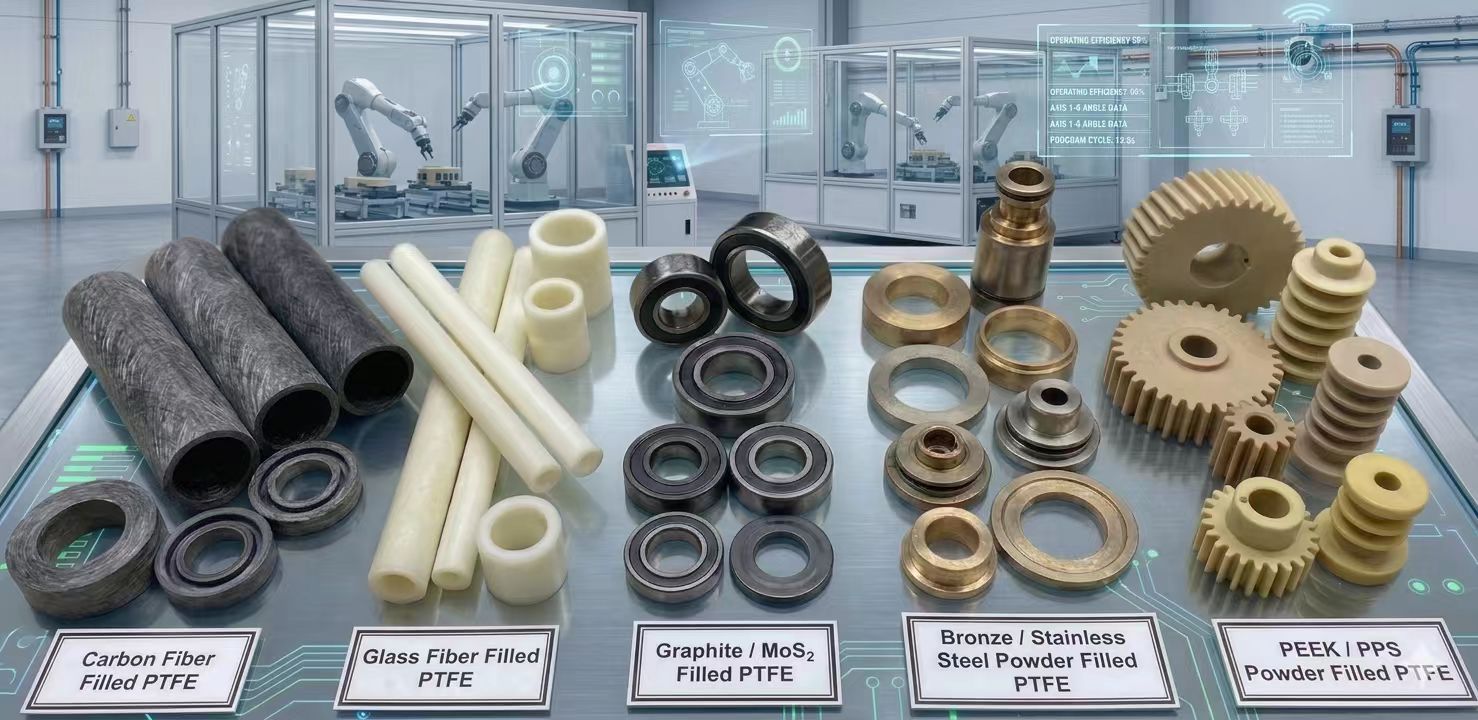
Below is a clear breakdown of the current international and Chinese testing and evaluation standards for PTFE. I follow the logical flow:
raw resin (suspension type) → filled compounds → semi-finished basic shapes → typical finished products → common performance and test method standards.
The focus is on filled PTFE products.
• ASTM D4894: Standard Specification for Polytetrafluoroethylene (PTFE) Granular Molding and Ram Extrusion Materials
This covers typical suspension-polymerized granular PTFE used for compression molding, sintering, and ram extrusion. Some versions are listed as "D4894-19 (reapproved 2024)."
• ASTM D4895: Standard Specification for PTFE Resin Produced From Dispersion
This covers PTFE dry powder made from dispersion coagulation (normally used for paste extrusion / fine powder systems). It is not exactly the same as suspension resin, but it is often listed together as a "raw powder" standard in the industry chain.
The standard lists required tests such as bulk density, particle size, moisture, DSC melt peak temperature, tensile strength and elongation, standard specific gravity, extrusion pressure, thermal instability index, and stretch void index.
If you are only talking about suspension resin / granular molding powder, the main standard is D4894. If you also work with paste extrusion or fine powder compounds, you need D4895 as well.
These are the most important updated standards for "suspension-method PTFE resin" in China (effective May 1, 2025):
• HG/T 2902-2024 《Molding PTFE Resin》
Released: October 24, 2024; Effective: May 1, 2025; Replaces HG/T 2902-1997.
• HG/T 2903-2024 《Fine Granular PTFE Resin for Molding》
Released: October 24, 2024; Effective: May 1, 2025; Replaces HG/T 2903-1997.
This applies to white powdered PTFE resin made by suspension polymerization and then crushed. It includes requirements, test methods, and inspection rules.
• HG/T 3028-2024 《PTFE Resin for Paste Extrusion》
Released: October 24, 2024; Effective: May 1, 2025; Replaces HG/T 3028-1999.
Common supporting test methods (still current):
• HG/T 2900-1997 《Test Method for Bulk Density of PTFE Resin》
• ASTM D4745: Standard Classification System and Basis for Specification for Filled PTFE Molding Compounds
This covers filled PTFE molding compounds. It uses the "Virgin PTFE resin (Type II/III)" defined in D4894 as the base and classifies the material by filler type and form.
If your filled products are made by buying filled compounds → compression molding or extrusion, then D4745 is the main international material specification standard to start with.
In China, filled PTFE is usually not covered by one single "material master standard." Instead, the rules are spread across different application standards such as mechanical seals, guide rail soft strips, and composite self–lubricating plates (see Section 4 below).
• ISO 13000-1:2021: PTFE semi-finished products – Part 1: Requirements and designation system.
• ISO 13000-2:2021: PTFE semi-finished products – Part 2: Preparation of test specimens and determination of properties.
ISO website note: ISO 13000-2:2005 has been withdrawn; the new version is ISO 13000-2:2021.
• GB/T 39714.2-2020 《Plastics – Polytetrafluoroethylene (PTFE) Semi-Finished Products – Part 2: Preparation of Test Specimens and Determination of Properties》
Released: December 14, 2020; Effective: July 1, 2021; Still current. It is a modified adoption of ISO 13000-2:2005 (note: ISO has since updated to the 2021 version).
• GB/T 39714.1-2020 《Plastics – Polytetrafluoroethylene (PTFE) Semi-Finished Products – Part 1: Requirements and Designation》
This is listed as a supporting reference in the foreword of GB/T 39714.2.
These are the standards that are closest to actual "finished products." They usually include both the product requirements and the test methods (or they refer to other test standards).
• QB/T 4877-2015 《Polytetrafluoroethylene Tubes》
Clearly states it applies to tubes made from unfilled PTFE dispersion or suspension resin (including recycled resin).
For filled tubes, you usually need enterprise standards, group standards, or other industry standards.
• QB/T 4041-2010 《Polytetrafluoroethylene Rods》
Covers technical requirements and test methods for rods.
• QB/T 4008-2022 《Polytetrafluoroethylene Unsintered Tape for Thread Sealing (Raw Tape)》
Specifies classification, requirements, inspection rules, marking, packaging, transport, and storage, plus the related test methods.
These standards are very important because they cover high PV and wear-resistant uses such as bearing liners and sliding bearings. They are basically "PTFE friction layer + metal / porous base" composite systems:
• GB/T 27553.1-2011 《Plastics – Bronze – Steel-Backed Three-Layer Composite Self-Lubricating Plates – Technical Conditions – Part 1: Plates with Modified Polytetrafluoroethylene (PTFE) Friction-Reduction Layer》 (still current)
• GB/T 39142.1-2020 《Plastics – Steel-Backed Two-Layer Bonded Composite Self-Lubricating Plates – Technical Conditions – Part 1: Plates with Modified Polytetrafluoroethylene (PTFE) Friction-Reduction Layer》 (current)…

Welcome to HOVOO, a Chinese seal factory. Production of PU, Rubber and PTFE seals. The seals include O-ring, piston seal, rod seal, Gray ring and gas seal.


 EN
EN
 AR
AR CS
CS DA
DA NL
NL FI
FI FR
FR DE
DE EL
EL IT
IT JA
JA KO
KO NO
NO PL
PL PT
PT RO
RO RU
RU ES
ES SV
SV TL
TL IW
IW ID
ID LV
LV SR
SR SK
SK VI
VI HU
HU MT
MT TH
TH TR
TR FA
FA MS
MS GA
GA CY
CY IS
IS KA
KA UR
UR LA
LA TA
TA MY
MY
