33-99No. Mufu E Rd. Gulou District, Nanjing, China [email protected] | [email protected]
33-99No. Mufu E Rd. Gulou District, Nanjing, China [email protected] | [email protected]

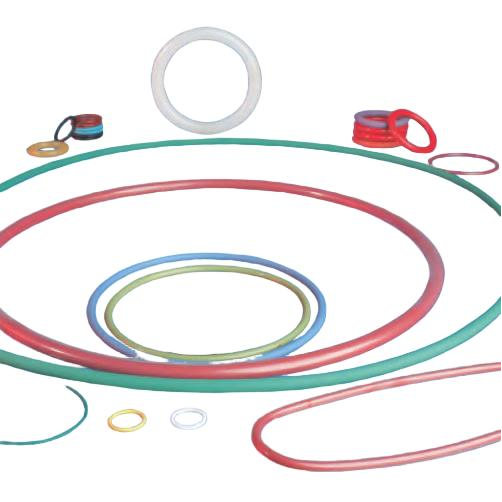
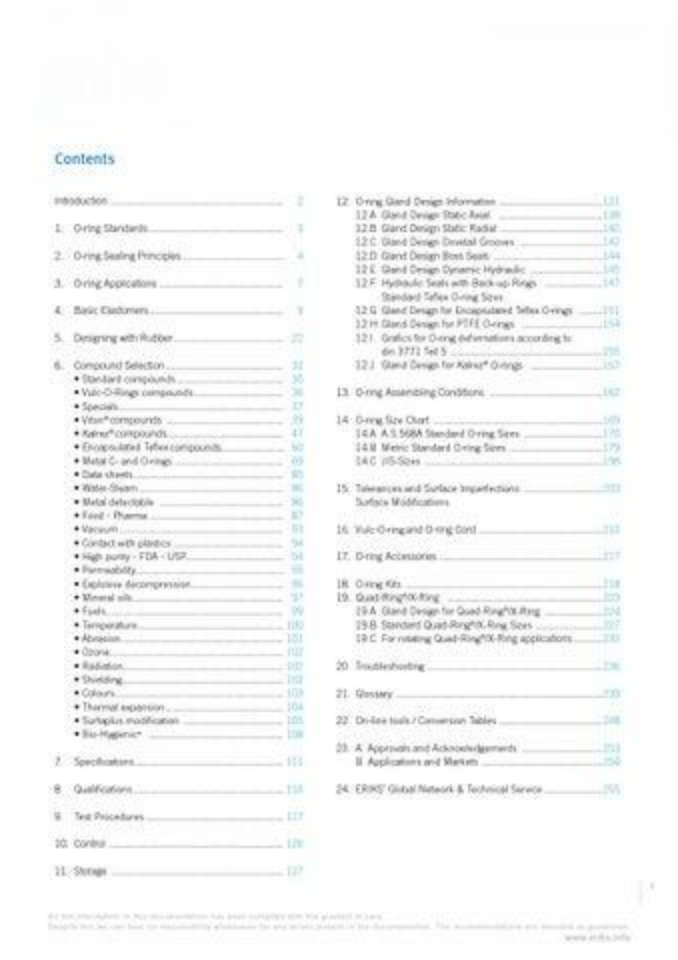
What is most worth Chinese enterprises learning from the ERIKS O-ring Technical Handbook is that it truly builds sealing parts into a business — not just selling rubber rings, but selling an "application package." The handbook discusses O-ring standards, sealing principles, groove design, dimension standards, elastomer materials, compound selection, Viton compounds, Kalrez compounds, encapsulated Teflon O-rings, metal C and O-rings, data sheets, water/steam, metal-detectable, food/pharmaceutical, vacuum, contact with plastics, high purity/FDA/USP, permeability, explosive decompression, mineral oils, fuels, temperature, abrasion, ozone, radiation, shielding, colors, thermal expansion, surface modification/bio-hygienic, specifications, qualifications, test procedures, control, storage, O-ring gland design information, gland dimensional calculations, O-ring size charts, tolerances and surface modifications, vulc-O-ring and O-ring cord, O-ring accessories, Quad-Ring/X-Ring, troubleshooting, glossary, online tools/conversion tables, approvals and acknowledgments, applications and markets, and ERIKS' global network and technical service, altogether 24 chapters, and this comprehensive coverage means Chinese enterprises can build an entire "application package" toolkit rather than a single O-ring product.
Chapter 2 is one of the highest engineering-value chapters in the whole book.
The handbook explicitly states this groove design guide is mainly used for static seals, and pressure not exceeding 1500 PSI scenarios; dynamic applications and higher pressure need separate evaluation. It also emphasizes that material name alone is not enough — maximum/minimum tolerance stacking must also be checked, that is, the extreme working condition of "large O-ring matching small groove" and "small O-ring matching large groove."
This point is very suitable for Chinese enterprises to replicate. Many domestic O-ring failures are not really material problems, but rather drawing groove, assembly chamfer, tolerance stack-up, surface roughness, and compression rate/fill rate not systematically checked. If enterprises can turn these rules into standardized tools, they can significantly improve technical service capability.
Especially recommended to replicate the following design control points:
Control Item |
Key Idea Given in the Handbook |
Concrete Action Domestic Enterprises Can Take |
Compression Rate |
Radial static seal recommends 5%–30%, target approx. 20%; face static seal recommends 10%–35%, target approx. 25% |
Use compression rate as a mandatory check item in drawing review, output correction results |
Minimum Compression Amount |
Even light compression produces compression permanent deformation, therefore must ensure minimum compression amount |
Add minimum compression amount alarm in design software |
Groove Fill Rate |
Fill rate must consider thermal expansion, media swelling and tolerance stack-up |
Set dedicated correction coefficients for fuel oil, coolant and other media |
Gap Extrusion |
High pressure, soft rubber, eccentricity, cylinder wall expansion can all lead to extrusion |
Form a recommendation table of pressure — hardness — gap — whether back-up ring is needed |
Installation Chamfer for Radial Seal |
Recommends 15° lead-in chamfer, and ensures O-ring only contacts the chamfer during installation |
Include chamfer length, deburring, thread protective sleeve into the assembly process card |
Installation Regulations |
Must not over-pull, remove sharp edges, clean, lubricate, soft installation tools, anti-twist |
Make into production line and customer on-site installation training posters |
The handbook, on pages 17-18, clearly gives the calculation logic for compression rate, compression amount, fill rate and extrusion gap, and explains dynamic seals usually should adopt a lower compression rate range, in order to balance friction and wear.
The handbook repeatedly emphasizes O-ring selection cannot only look at the material name, but must simultaneously consider media, temperature, pressure, motion form, surface condition, assembly conditions and failure consequences. Its Kalrez groove design section lists a series of applicable inquiry sheets, e.g., pressure differential direction, high-pressure end-face sealing, whether it is a standard groove, radial or vacuum position, pressure/vacuum, what the media is, the old seal's failure situation, static or dynamic, motion form, existing groove dimension and tolerance, etc.
It is recommended Chinese enterprises establish and repeatedly use an "O-ring application information collection form":
Media Information: Main media, cleaning agents, lubricants, additives, concentration, whether mixed media.
Temperature Information: Lowest, highest, common use temperature, temperature cycling, instantaneous peak, sustained time.
Pressure Information: Maximum pressure, pressure direction, pulse, vacuum, rapid decompression risk.
Motion Information: Static, reciprocating, rotating, oscillating; speed, stroke, frequency.
Structure Information: Groove type, groove width, groove depth, gap, chamfer, sealing face roughness.
Assembly Information: Whether passing over threads, ports, sharp edges, whether self-assembled, whether lubrication needed.
Regulatory Certification: Food, drinking water, pharmaceutical, gas, automotive, semiconductor, military, aerospace, etc.
Failure Consequence: Whether leaking causes downtime, safety accident, contamination, or customer complaint.
This kind of inquiry approach — asking "what quality for what characteristics" — is more valuable, and can also help domestic enterprises avoid a common low-end quotation trap: material is correct but groove is wrong; dimension is correct but compression rate is wrong; hardness is correct but cleanliness is lacking; static testing works fine but dynamic performance falls short.
The handbook's material chapter has high reference value: it lists common elastomer temperature, chemical resistance, compression permanent deformation, hardness, tensile, gas permeation, aging, ozone, and steam resistance, and emphasizes that when designing an O-ring, one should ensure recovery across the whole applicable temperature range under compression.
Chinese enterprises can replicate this as follows:
Material System |
Reference Application Logic in the Handbook |
Points Domestic Enterprises Can Draw On |
NBR |
Oil, water, air, liquid common material, affected by oil content and low temperature |
Build good ordinary NBR, low-temperature NBR, high ACN-content 90 Shore high-hardness NBR |
HNBR |
More heat, oxidation, cold, and mechanically resistant than NBR |
New energy, aerospace, cold environments, oil-gas equipment, engineering machinery focus development |
EPDM |
Water, steam, ozone; not suited to petroleum, gasoline, kerosene, petroleum oil |
Focus on water systems, avoid using for petroleum products |
VMQ/FVMQ |
Wide temperature range, good for food/pharma; fluorosilicone combines fuel oil resistance |
Aerospace, gas-oil, low-temperature seal, food/pharmaceutical |
FKM |
Oil resistant, fuel resistant, high temperature resistant, broadly chemically resistant |
Domestic FKM substitution, automotive thermal management, chemical, pump/valve, vacuum equipment |
FFKM |
High temperature, strong corrosion, semiconductor, high-end chemical sealing, must confirm formula and process |
Not suitable for casual overselling |
FEP/PFA Encapsulated |
Combines PTFE chemical inertness and elastomer resilience, applicable to chemical, pharmaceutical, food, heat exchanger, can be flex-bent |
Domestic replacement direction |
Metal O-Ring |
Chemical/high pressure, high vacuum, high radiation, aerospace, nuclear, semiconductor, wide temperature capability, long life |
Suitable for high-end scenarios |
Especially worth noting: ERIKS treats high-end materials not just as "heat resistant, corrosion resistant," but goes further into temperature-cycling application specifics — e.g., Kalrez Spectrum 6375 is broadly chemically resistant, 7075 is high hardness, high modulus, resistant to extrusion and rapid gas decompression, and 7090 is relatively high hardness, high modulus, resistant to extrusion and rapid gas decompression. Chinese enterprises should avoid treating high-end material names such as "FKM/FFKM/EPDM" as a single sellable material, and should further subdivide into scenario-oriented compounds.
The handbook's groove design section is very practical for enterprises; it emphasizes that an O-ring "can't just be put in and seal" — the key is controlling compression rate, groove fill rate, extrusion rate, surface roughness and thermal/chemical expansion. Especially under high temperature, chemical dissolution or vacuum environments, ordinary grooves are not necessarily reliable.
Several specific design parameters are especially worth replicating and converting into enterprise design specification items:
Compression rate needs separate static/dynamic control. Over-compression of a dynamic seal leads to friction and wear; static seals can be relatively higher. The handbook lists compression rate ranges for hydraulic dynamic, pneumatic dynamic, static, and end-face seals in different application tables, which can serve as reference for internal enterprise starting-point design.
Assembly stretch and use stretch should be controlled separately. The handbook points out O-ring ID installed into a groove should not stretch more than 5-6%, because over-stretching lowers compression amount; when installed, reaching the groove's critical ID expansion should not exceed 50%, and time must be given for the O-ring to recover.
Gap decides extrusion risk. The handbook gives the maximum extrusion gap for different cross-sections of a 70 Shore A O-ring, and points out pressure, hardness, cross-section and gap jointly determine whether extrusion occurs; when extrusion risk exists, harder rubber or a plastic back-up ring should be used.
The back-up ring is not an accessory, but part of a high-end sealing system. The handbook explains that to prevent extrusion, one should reduce gap, use a harder O-ring, or install a harder-material back-up ring; static applications at higher pressure and dynamic reciprocating applications at relatively higher pressure should both consider a back-up ring.
High temperature and chemical dissolution/swelling must be factored into groove volume calculation. The handbook, in the Kalrez groove design section, gives a groove volume calculation formula, and requires designing groove volume to be less than the fully-expanded O-ring volume plus 20%, otherwise the ring may over-swell, causing the seal to fail catastrophically mechanically.
Chinese enterprises can package this content into their own O-ring groove design calculator: input O-ring dimension, groove dimension, tolerance, material thermal expansion, media dissolution, temperature, pressure, hardness, and automatically output compression rate, fill rate, stretch rate, extrusion risk, back-up ring recommendation and assembly notes. The ERIKS handbook demonstrates this statistical-calculator approach, supporting calculations that factor in thermal expansion, chemical dissolution/shrinkage and other elements.
This handbook's most inspiring point for domestic enterprises is that it is not satisfied with only the material supplier's compound test-piece data, but emphasizes testing the O-ring itself. The handbook points out that a test piece and an actual O-ring, though from the same compound, have completely different curing time, temperature, post-processing and dimensions — for example, a 6mm test piece's compression permanent deformation may be 12%, while a 3.53mm cross-section O-ring under the same conditions may reach 19-25%. So ERIKS tends to display actual O-ring test values in its data tables, to reflect true sealing performance.
This is very important for Chinese enterprises. Many domestic product materials only write "hardness 70, tensile strength, elongation rate, resistant temperature -30 to 120°C," but lack:
It is recommended Chinese enterprises establish a unified data table template, at minimum including:
Data Table Field |
Recommended Requirement |
Material |
ASTM/ISO compound family number + enterprise internal brand |
Hardness |
Shore A with Micro-IRHD listed separately |
Tensile/Elongation |
State DIN/ISO/ASTM method |
Compression Permanent Deformation |
State test piece, temperature, time, compression rate |
Low-Temperature Performance |
TR10, brittleness temperature, low-temperature rebound |
Thermal Aging |
Hardness, volume, tensile, elongation change range |
Certification |
Certificate number, applicable method, effective range |
Recommended Application |
Static/dynamic, media, temperature, pressure limits |
Forbidden Scenario |
Which media or working conditions not suited |
Version |
Data table version, test date, laboratory |
The handbook also lists a whole set of items that can support enterprise lab building, including compression permanent deformation, tearing, tensile, ozone, life, chemical resistance, infrared spectrum, TGA, FDA migration, TOC and cleanroom testing, etc. These items can directly convert into a domestic enterprise's material technology center construction checklist.
The handbook emphasizes in the quality control chapter that the purpose of control is ensuring every procurement batch's consistency, not just writing a specification based on one test report; it also indicates dimension and surface quality can be checked per AS 568, AS 871A, MIL-STD-413C, DIN 3771 and similar standards; hardness is often used as a control, but the O-ring's own physical measurement is inherently difficult, with ±5 points being a common tolerance.
Insights for Chinese enterprises:
Establish batch consistency indicators. The handbook mentions using TGA to perform "fingerprint" control on the compound. Domestic enterprises can build batch consistency data for every compound: density, ash content, hardness, elongation rate, compression permanent deformation gathered together, establishing each compound's batch consistency database.
Build automated visual inspection. The handbook introduces Basler visual inspection equipment controlling O-ring dimension and appearance defects; domestic enterprises should upgrade their automated production line testing rates, especially since larger batch-size industries have particularly high investment value.
Standardize surface defect categorization. The handbook lists parting-line protrusion, flash, mold defects, flat spots, streak marks, abnormality and similar defect categories, and gives allowable values under ISO 3601-3 and similar standards. This section can be directly converted into an enterprise's O-ring appearance defect judgment guide.
Quality indicators should serve the application, not just pile up indicators. For example, dynamic seals should focus on repeated friction, wear, surface roughness and lubrication; high-pressure gas should focus more on explosive-decompression resistance; food-pharma should focus more on surface impurities, odor, migrants, TOC; semiconductor should focus more on particulate and ionic contamination.
The handbook's advice on assembly is very concrete: metal parts should avoid sharp edges; the O-ring must not be allowed to pass over threads, keyways, grooves and similar sharp edges; sharp tools should not be used; dust must be prevented; the mating surface's roughness should be checked; a dedicated tool should be used at disassembly time, avoiding damage to the metal surface and the O-ring.
This section Chinese enterprises can directly replicate as:
On the storage side, the handbook emphasizes avoiding light, ozone, radiation, deformation, liquid/semi-solid contact, and keeping different elastomers from contacting each other, and requires storage per the FIFO turnover principle. Chinese enterprises should incorporate this section into the storage management system, especially for materials such as NBR, SBR, PU and similar materials that are more sensitive to aging. For automotive, aerospace, and medical customer groups, enterprises should build an aging-date/production-date/factory-date one-piece maintenance traceability system for procurement.
The handbook's failure analysis chapter emphasizes that O-ring failure is often a combination of design, material selection, testing, and personnel training factors, and gives common failure modes — e.g., extrusion/nibbling is usually related to excessive gap, material too soft, undersized dimension, poor machining, sharp edges or excessive gap; solutions include switching to higher-modulus, harder material, rechecking compatibility, improving gap issues, and resolving/using the correct process. Spiral failure is commonly seen in long-stroke hydraulic piston seals, and can be improved by checking assembly precision, reducing gap, improving surface and lubrication, using internally-lubricated O-rings, back-up rings, X-rings or T-seals.
It is recommended Chinese enterprises build three types of failure-analysis assets:
A failure photo library. Every failure mode paired with high-definition photos, macro description, cross-section analysis, and typical working conditions.
A cause tree. Breaking problems down into material, groove, dimension, tolerance, surface, media, pressure, temperature, assembly, storage, and use/maintenance.
A corrective measures library. Corresponding material substitution, hardness adjustment, back-up ring, groove modification, surface treatment, lubrication, certified material, assembly tools, etc.
This would turn after-sales service from a "return/refund cost center" into a "technical service and product improvement entry point."
The handbook reflects a clear product tiering: standard O-rings are just the foundation; above that are four categories of high-end products — special compounds, encapsulated O-rings, and metal O-rings — covering food/pharmaceutical grade, semiconductor grade, explosion/decompression-resistant, low-extraction, high-purity, metal-detectable and so on.
Chinese enterprises can learn from this "application package" approach, rather than only selling a single O-ring.
The handbook discusses FDA, USP, KTW, WRAS, NSF, DVGW and similar certifications, and explains that food-contact rubber needs to satisfy specific regulations, with FDA 177.2600 having clear requirements for usable polymers and compounding agents. Domestic enterprises can build a food-beverage/pharmaceutical sealing series: EPDM, VMQ, FKM, FFKM, FEP/PFA encapsulated rings, metal-detectable material, low-extraction material, CIP/SIP-tolerant material. Note that certification cannot be borrowed from someone else's certificate — it must be independently retested and declared based on one's own formula, process, and product form.
The handbook mentions high-purity fluorine rubber/perfluoroelastomer used for semiconductors, focusing on particulate, extraction, differential ions, low outgassing, and cleanroom packaging indicators. If domestic enterprises want to serve semiconductor equipment and wafer fabs, they must expand from "corrosion resistance" to a system of "low particulate, low metal ions, low outgassing, clean packaging, batch consistency."
The Teflex chapter's approach is worth replicating: FEP/PFA outer shell provides near-PTFE chemical inertness, while a Viton or silicone core provides elastic rebound; but the handbook also clearly points out this is not suitable for high-speed dynamic or rough surfaces, or overly stretched or abrasive media. Domestic enterprises should make the applicable boundaries clear when producing encapsulated rings, avoiding letting one product cover all working conditions and media.
The metal C/O-ring chapter emphasizes applications where elastomer temperature, corrosion, radiation, pressure, gas permeation or service life limits are exceeded; this class of metal seal, as a high-end material, can also be participated in by domestic enterprises.
It is recommended Chinese enterprises develop parallel metal-seal and rubber-seal solutions, rather than pushing all problems onto rubber material.
The handbook points out abrasion is significantly affected by elastomer temperature and modulus; internal lubricants, PTFE, molybdenum disulfide, and surface treatments can help lower the friction coefficient, and part processing can improve friction pairs for automotive connectors, quick connectors and similar applications. Domestic auto-assembly, pneumatic components, medical devices, automotive connectors, quick connectors and similar industries can focus development on low-friction coatings and self-lubricating configured O-rings.
ERIKS' handbook opening emphasizes its technical capabilities include quality control systems, a global standard-parts network, special materials, rapid supply, Viton authorization, Kalrez distribution, high-purity materials, engineering solutions, logistics schemes and independent laboratory control. This explains that its competitiveness comes not simply from manufacturing its own O-rings, but from the combination of "product + data + inventory + certification + laboratory + application engineering."
Domestic enterprises can restructure their business model along this direction:
Traditional Domestic Model |
ERIKS-Type Model |
Recommended Direction to Upgrade |
Customer provides drawing, factory quotes |
Customer provides working condition, enterprise participates in selection |
Build an application engineering team |
Sell material names |
Sell material system and validation data |
Build a material database and validation data database |
Low-price inventory |
Standard inventory + rapid custom + special certified goods |
Do inventory strategy and rapid-response production |
After-sales bears the burden |
Failure analysis + corrective measures |
Build a failure analysis report template |
Experience relies on veteran workers |
Experience made into manuals, tools, data |
Build internal knowledge management |
Only do manufacturing |
Production + testing + certification + design support |
Build a material technology center |
Whether it's an export-oriented enterprise or one serving high-end equipment supply chains, treating a technical manual as a customer education tool, sales tool and quality barrier is worth replicating.
Ranked by input-output ratio, it is recommended to prioritize the following 12 items:

Welcome to HOVOO, a Chinese seal factory. Production of PU, Rubber and PTFE seals. The seals include O-ring, piston seal, rod seal, Gray ring and gas seal.


 EN
EN
 AR
AR CS
CS DA
DA NL
NL FI
FI FR
FR DE
DE EL
EL IT
IT JA
JA KO
KO NO
NO PL
PL PT
PT RO
RO RU
RU ES
ES SV
SV TL
TL IW
IW ID
ID LV
LV SR
SR SK
SK VI
VI HU
HU MT
MT TH
TH TR
TR FA
FA MS
MS GA
GA CY
CY IS
IS KA
KA UR
UR LA
LA TA
TA MY
MY
