33-99No. Mufu E Rd. Gulou District, Nanjing, China [email protected] | [email protected]
33-99No. Mufu E Rd. Gulou District, Nanjing, China [email protected] | [email protected]

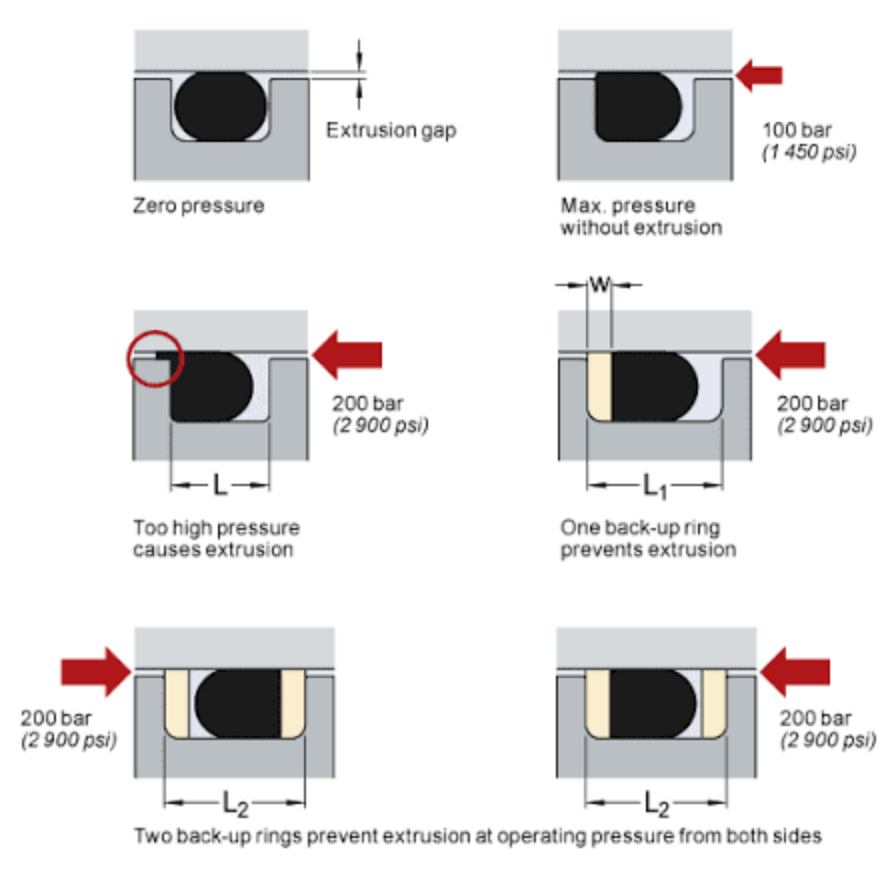
The ISO 3601 series indeed treats back-up rings as a separate topic: ISO 3601-4's scope is anti-extrusion rings / back-up rings, and lists five categories: T1 spiral type, T2 angle-cut type, T3 solid type, T4 angle-cut concave type, T5 solid concave type; these back-up ring standards work together with ISO 3601-1's O-ring dimensions and ISO 3601-2's groove dimensions. Trelleborg also treats back-up rings as an independent static sealing product, noting that it is used with O-rings and X-rings to prevent extrusion at gaps above 5 MPa / 725 psi working conditions, and provides spiral, cut, uncut and PTFE, thermoplastic material versions.
A back-up ring is not an "optional gasket" — it is a dedicated anti-extrusion element within the high-pressure sealing system that specifically controls the extrusion gap.
This is the first, most easily understood classification for customers.
Type |
Typical Structure |
Applicable Condition |
Design Focus |
Single-directional back-up ring |
O-ring places one back-up ring on the direction the pressure comes from consistently, such as unidirectional hydraulic side, unidirectional oil cylinder side, static seal plugs |
Pressure is long-term from one direction, e.g. the low-pressure/pressure-opposite side |
Recommended location is the side the O-ring is most likely to be extruded |
Bi-directional back-up ring |
O-ring has a back-up ring placed on each side, such as bi-directional oil cylinder, reversing valve, pressure pulse, oil well downhole tools |
Pressure direction reversal, e.g. bi-directional actuation and pressure pulse |
Groove width needs to be increased to avoid the O-ring and both back-up rings being over-compressed |
Quasi-bidirectional design |
Theoretically one-directional, but the other side has retained backflow, pressure-relief impact or reverse pulse |
Engineering machinery, pumps and valves, accumulators, close-static seals |
Judgment should not be based on "normal working direction" but on the worst-case pressure path |
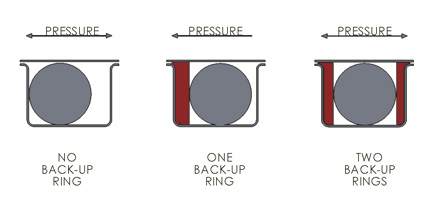
In engineering terms, single-directional pressure back-up ring placement is opposite the pressure; when pressure alternates direction, dual back-up rings are needed. AIR WATER MACH's sealing basic material also clearly states: bi-directional force is subjected when pressure is from both sides simultaneously, and both sides should be configured with back-up rings.
Judging whether a single or dual back-up ring is needed is not about looking at the product name, but at whether pressure direction reversal is possible. As long as backflow, pressure pulse, or reverse impact exists, it should be treated as a bi-directional anti-extrusion problem.
The five ISO 3601-4 categories can just be converted into a classification customers can easily understand:
ISO/Engineering Term |
Chinese Expression |
Advantage |
Weakness |
Typical Customer Scenario |
T1 Spiral type |
Spiral back-up ring |
Easy install, applicable to closed grooves, coiling direction, end-face hydraulic dynamic seal |
Compression can become locally thin; engineering machinery, oil pump, standard replacement, on-site groove-opening |
On-site groove-opening |
T2 Angle cut type |
Angle-cut open-cut ring / open-cut ring |
Easy to assemble, cost lower than uncut |
May become local weak point at cut |
Higher-end material replacing weak points; high modulus material better; PEEK opening pressure resistant |
T3 Solid type |
Solid back-up ring / uncut ring |
Continuous, strongest anti-extrusion capability, no cut risk |
Needs open assembly condition; closed grooves not easily installed |
High-pressure static seal, flange, end cap, or reciprocating seal |
T4 Angle-cut concave type |
Angle-cut concave / special-shaped open-cut ring |
Concave surface better fits O-ring, supports more sufficiently |
Machining direction requirements more precise |
High pressure, larger extrusion clearance, pressure fluctuation |
T5 Solid concave type |
Solid concave back-up ring / special-shaped solid ring |
Continuous support and combines with O-ring, applicable to demanding working conditions |
Assembly is restricted, cost higher than open cut |
Oil and gas, high-pressure static seal, key back-up ring |
Eclipse's product materials also classify solid, open-cut and spiral back-up rings from an engineering perspective: solid back-up rings are suitable for grooves that installation conditions allow; open-cut back-up rings can be assembled into closed grooves via angle cutting; spiral back-up rings use an overlapping coil structure, and are common in PTFE material.
Key judgment: solid back-up rings prioritize solving "anti-extrusion continuity"; open-cut back-up rings prioritize solving "assembly ability"; spiral back-up rings prioritize solving "closed groove assembly"; special-shaped back-up rings prioritize solving "insufficient O-ring support area under high pressure."
What high-pressure customers truly care about is not "whether or not a back-up ring exists," but whether the back-up ring can block the extrusion channel.
Cross-Section Type |
Design Logic |
Applicable Condition |
Rectangular / flat back-up ring |
Acts as a rigid support between the O-ring and the extrusion clearance |
Common high-pressure hydraulics, standard grooves |
Concave back-up ring |
Fits closely with the O-ring circular surface, increases support width |
High-pressure static seal, O-ring in relatively low-hardness, pressure pulse |
Wedge-shaped back-up ring |
Radially compensates after being pressurized, actively bridges super-high-pressure, large extrusion clearance |
Oil wells, metal parts that cannot be modified with hardness |
Dual-material composite back-up ring |
PEEK provides rigidity, PTFE contacts O-ring, reduces hard bite |
High pressure + dynamic, open-cut risk higher |
Back-up ring + guide ring co-design |
Guide friction bias and wear, back-up ring controls extrusion |
Oil cylinder, heavy-duty engineering machinery, long-stroke reciprocation |
Wedge back-up rings are especially suitable for scenarios with both ends squeezed. Parker's related wedge back-up ring materials note that its wedge structure produces radial compensation under compression, applicable to two working scenarios, both directions each configuring a set of wedge back-up rings, thus preventing static seal elastomer from being extruded. Eclipse's high-pressure case shows that at 15,000 psi, 300°F, large extrusion gap conditions, using filled-PTFE wedge back-up ring combined with PEEK wedge back-up ring improved pressure-bearing capability.
High-pressure back-up ring material selection is essentially a trade-off between low friction, hardness, modulus, temperature resistance, media resistance, cost, and installability.
Material |
Advantage |
Risk/Limitation |
Applicable Scenario |
PTFE polytetrafluoroethylene |
Low friction, good chemical resistance, suitable for dynamic seals and corrosive media |
Softer, easy to open or coil, extrusion resistance limited; can be made into open-cut or spiral back-up rings |
High-pressure passage of dynamic low-friction sealing, gas oil pumps, standard O-ring supplement |
Filled PTFE |
Glass fiber, carbon fiber, bronze filler affects friction, wear and impact resistance; after filling, resistance to abrasion and impact improves |
Filler quality affects some chemical corrosion media |
Chemical resistant media |
PA/Nylon |
Harder than PTFE, better anti-extrusion capability, lower cost than PEEK |
Absorbs water and dimensions change, not tolerant of overly high temperature engineering machinery, common hydraulics, water-glycol and similar high-pressure oil |
Higher pressure than typical projects |
PEEK polyetheretherketone |
High modulus, high hardness, high extrusion resistance capability, suitable for extreme conditions |
High cost, machining and dimension requirements strict, does not have PTFE-like cold flow compensation; open-cut PEEK may bite the O-ring at cut edge |
Oil and gas, high temperature high pressure, large extrusion gap, key equipment |
POM/Acetal, TPE etc |
Can be used as specific mid-pressure or custom scheme material |
Needs consideration of media, temperature, pressure |
Non-standard sealing, special customer projects |
Public manufacturer data gives typical material boundaries as reference: Advanced EMC describes PEEK suitable for high-pressure high-temperature, and Nylon suitable for lower-cost items, example range up to 20,000 psi and 500°F; PTFE emphasizes low friction, chemical resistance and higher temperature limits, whereas filled PTFE cold-flow resistance is better than filled PTFE. Freudenberg also notes PEEK has PTFE-like chemical resistance but better mechanical properties, continuous operating temperature can reach 260°C, and is often used with high O-ring pressure.
PEEK cannot simply be used per PTFE standard dimensions. Gallagher/Eclipse data points out PEEK has high modulus, and won't cold-flow compensate to compensate for dimension deviation like PTFE, requiring more accurate dimension, chamfer, PTFE transition back-up ring or combined structure treatment; open-cut PEEK may still bite the O-ring due to cutting edge during pressure cycling or dynamic operation.
High-pressure sealing failure is usually not simply due to "pressure too high," but because of:
Pressure × extrusion gap × O-ring hardness × material modulus × dynamic eccentricity
Among these, extrusion gap is most easily underestimated.
Extrusion gap should be evaluated according to the worst-case state.
Do not just look at the nominal clearance on the drawing; also consider:
Global O-Ring's selection guide also lists pressure, temperature, chemical compatibility, extrusion gap, dynamic/static working conditions and material hardness as key factors in back-up ring selection, and points out larger clearance gaps usually need stronger and more support.
Extrusion Gap State |
Design Tendency |
Small gap, moderate pressure |
PTFE or filled PTFE flat back-up ring is sufficient |
Moderate gap, higher pressure |
Filled PTFE, PA/Nylon, concave back-up ring |
Larger gap, higher pressure, higher temperature |
PEEK, concave back-up ring, PEEK + PTFE composite |
Very large gap, harder to modify hardware |
Wedge back-up ring, split-into-multiple wedge back-up rings, would-otherwise-be-overloaded guide function |
Obvious dynamic eccentricity |
Prioritize optimizing the guide band, then design back-up rings; otherwise the back-up ring will bear undertaken guide function |
Back-up rings are not used to "make up for all groove problems." High-pressure sealing design should first control the extrusion gap, then use the back-up ring to improve the safety margin.
Customer Type |
Concern Focus |
Recommended Direction |
High-pressure hydraulic customers |
Pressure, reciprocating speed, guide wear, oil temperature, installation protection |
Focus on single-directional/bi-directional back-up ring, open-cut back-up ring, filled PTFE, PA, PEEK |
Oil and gas customers |
High temperature high pressure, pressure impact, corrosive media, certification, non-standard groove |
Focus on PEEK, concave back-up ring, bi-directional back-up ring, special-shaped ring, large extrusion gap |
Engineering machinery customers |
Impact loading, mud water contamination, maintenance convenience, cost |
Focus on solid or open-cut ring, PA/Nylon, filled PTFE, guide band and back-up ring compatibility |
Pump and valve customers |
Static seal, valve stem dynamic, frequent opening/closing, pressure peaks |
Focus on solid ring, PEEK, concave ring, bi-directional pressure resistance |
Chemical customers |
Media compatibility, temperature, low leakage |
Focus on PTFE, filled PTFE, PEEK chemical resistance and dimension stability |
When quoting for customers, don't just ask "how much pressure." High-pressure back-up rings should at least ask these fields:
Parameter |
Why It Matters |
Working pressure / peak pressure |
Determines whether single or dual back-up rings are needed, and whether PEEK is needed |
Pressure direction |
Determines single-directional or bi-directional back-up ring |
Extrusion gap |
Determines back-up ring material, cross-section and quantity |
Temperature range |
Determines whether PTFE, PA, PEEK is applicable |
Media |
Determines material chemical compatibility |
Static seal/dynamic seal |
Determines friction, wear, open-cut risk |
Motion form |
Reciprocating, rotating, oscillating correspond to different back-up ring configurations |
Whether groove is closed |
Determines solid, open-cut, spiral ring is installable |
O-ring material and hardness |
Determines the anti-extrusion capability of the supported object |
Shaft/bore/groove dimensions and tolerances |
Determines actual maximum extrusion gap |
Whether there is a guide ring |
Affects eccentricity and lateral loading |
Whether there are certification requirements |
Oil and gas, food, aerospace, military may require material certificates |

Welcome to HOVOO, a Chinese seal factory. Production of PU, Rubber and PTFE seals. The seals include O-ring, piston seal, rod seal, Gray ring and gas seal.


 EN
EN
 AR
AR CS
CS DA
DA NL
NL FI
FI FR
FR DE
DE EL
EL IT
IT JA
JA KO
KO NO
NO PL
PL PT
PT RO
RO RU
RU ES
ES SV
SV TL
TL IW
IW ID
ID LV
LV SR
SR SK
SK VI
VI HU
HU MT
MT TH
TH TR
TR FA
FA MS
MS GA
GA CY
CY IS
IS KA
KA UR
UR LA
LA TA
TA MY
MY
