33-99No. Mufu E Rd. Gulou District, Nanjing, China [email protected] | [email protected]
33-99No. Mufu E Rd. Gulou District, Nanjing, China [email protected] | [email protected]

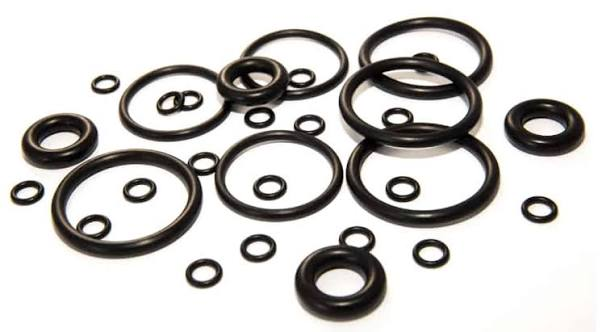
NBR suits the scenario of "conventional temperature + oil-class media + cost sensitivity + general-purpose sealing."
If the media is mineral oil, lubricating oil, petroleum-based fuel, general hydraulic oil, and the working temperature is roughly -30 to +100°C, briefly up to +120°C, NBR is generally the most economical primary material among O-rings. Dichtomatik/Freudenberg's O-ring material notes NBR is marked applicable for mineral oil, lubricants, H/HL/HLP hydraulic oil, temperature range -30 to +100°C; Trelleborg also describes NBR as primarily used for mineral-oil-based hydraulic oil, normal range -30 to +100°C, briefly +120°C.
NBR, i.e. nitrile-butadiene rubber, is a copolymer of acrylonitrile and butadiene. Its core advantage is oil resistance, low cost, wide supply, and balanced mechanical properties. GMORS describes NBR as the most commonly used seal elastomer, the reason being it has good resistance to petroleum-based fuels and lubricants, and its relative cost rating is also listed as Low.
From a purchasing, sales, and engineering selection perspective, NBR's commercial value lies in: it can cover a large amount of general oil circuits, hydraulic, pneumatic, pump/valve, mechanical equipment and automotive maintenance scenarios, without needing more costly materials like FKM, HNBR, FFKM.
Selection logic in one sentence: as long as the operating condition is not high temperature, strong ozone, strong UV, strongly polar solvent, or a strongly corrosive chemical environment, and primarily contacts mineral oil or general hydraulic oil, NBR is often the best cost-performance O-ring material.
This is NBR's most typical application. NBR shows good applicability against mineral oil, mineral-oil-based lubricants, general petroleum-based oils, fuel and common oil-based hydraulic oil media. Dichtomatik/Freudenberg's O-ring material clearly lists NBR as applicable for mineral oil, oil, H/HL/HLP hydraulic oil; HFA and HFB flame-resistant hydraulic liquids need extra temperature-limit caution.
Application Scenario |
Is NBR Suitable |
Notes |
Hydraulic cylinders, hydraulic valves, hydraulic joints |
Suitable |
Especially mineral-oil-based hydraulic oil |
Gearboxes, oil pumps, oil-circuit seals |
Suitable |
One of the top choices for general oil seals |
Pneumatic, pneumatic seals |
Suitable |
Low cost, common stock spec |
Automotive fuel, lubricant-related seals |
Generally usable, but need to confirm oil quality |
General fuel oil usable, aromatic or special fuel needs caution |
General mechanical-equipment maintenance O-rings |
Suitable |
Cost and versatility advantage obvious |
NBR's conventional temperature range is generally read as -30 to +100°C, briefly can reach +120°C, but the disparity is not exactly stated. Trelleborg's material compatibility guide gives an NBR range of -30 to +100°C, briefly +120°C; Dichtomatik's O-ring page also marks NBR as -30 to +100°C.
Product pages recommend not overstating; the more stable expression is: standard NBR O-rings apply to conventional-temperature oil-class media, long-term above 100°C, frequent proximity to 120°C or higher temperature, recommend evaluating HNBR, FKM or another heat-resistant material.
This is very important for sales. Many customers ask: "can NBR withstand 120°C?" Recommended reply: short-term acceptable per the formula, long-term high-temperature not recommended to directly use general NBR.
One of NBR's core selling points is low cost + large volume of standard specs + short delivery time. GMORS material lists NBR's relative cost as low, and notes it's due to petroleum-based fuel and lubricant resistance, lower price, and becoming a common general seal elastomer.
Requirement |
NBR Advantage |
Bulk purchasing |
Low unit price, suits stocking |
After-sales maintenance |
Common specs easy to have on hand |
General-purpose equipment |
Covers a large amount of non-extreme-condition oil materials |
Price-competitive projects |
Can serve as the default oil-resistant material quote |
Standard O-ring package |
NBR is one of the most common configurations |
From a purchasing perspective, NBR is one of the "default materials"; from a sales perspective, NBR is the "general oil-resistant product"; from an engineering perspective, NBR is the "baseline solution for general oil media."
NBR's mechanical properties are relatively balanced, and it's often used for static seals and part of dynamic seals. Wyatt Seal's description of NBR O-rings notes it has cost-efficiency, versatility, mechanical strength, and lists low compression set, tear strength, general-purpose, wear resistance and other advantages.
But note: NBR's wear resistance is not the strongest among all materials. If it's high-frequency reciprocating, high-speed sliding, high-pressure extrusion, sand/mud abrasion, or engineering-machinery harsh dynamic seal, TPU/PU, HNBR, or a dedicated seal structure may be more suitable. NBR is more suited to "general friction, general compression, general oil media" balanced scenarios.
One of NBR's shortcomings is limited ozone, UV, and weathering resistance. Trelleborg's industrial rubber sheet material clearly states NBR has excellent resistance to oils, fats, and petroleum-based products, but limited resistance to weathering, ozone, UV.
Therefore, the following scenarios are not recommended to directly use general NBR:
Scenario |
Risk |
Substitution Recommendation |
Long-term outdoor exposure |
Cracking, hardening, aging |
HNBR, FKM, EPDM |
Near motor, electrical-spark equipment |
Ozone aging |
HNBR, FKM |
Strong UV environment |
Surface aging |
FKM, EPDM |
Sun-exposed warehouse storage |
Material pre-aging |
Light-avoiding sealed storage |
If the media is oil while also involving outdoor ozone, preferentially consider HNBR or FKM, not EPDM, because although EPDM has good weathering resistance, it is not suited for mineral oil.
General NBR under long-term high temperature easily hardens, compression set rises, and sealing rebound drops. Trelleborg's NBR data notes its conventional temperature range is -30 to +100°C, briefly +120°C; HNBR can reach -30 to +140°C at mineral-oil/grease contact, briefly +160°C.
Temperature Condition |
Recommendation |
≤100°C, oil-class media |
NBR generally suitable |
100–120°C, short-term or intermittent |
Special NBR selectable, but formula must be confirmed |
Long-term around 120°C |
Preferentially HNBR or FKM |
Above 150°C |
Usually switch to FKM, FFKM, PTFE etc. |
High temperature + strengthened chemical |
FKM, FFKM or PTFE-encapsulated |
NBR cannot be simply promoted as "chemical resistant." It is mainly resistant to oil, especially petroleum-based oil; when encountering strongly polar solvents, part of the aromatic hydrocarbons and chlorinated hydrocarbons, risk is high. GMORS's NBR material lists aromatic hydrocarbon, automotive brake fluid, chlorinated hydrocarbons and other media as poor NBR performance categories.
Common not-recommended media include:
Not-Recommended Media |
Typical Example |
Substitution Direction |
Ketones |
Acetone, MEK |
EPDM, FKM, FFKM, must confirm per media |
Esters |
Ethyl acetate etc. |
FKM, FFKM, PTFE |
Ethers |
Some organic ethers |
FKM, FFKM, PTFE |
Aromatic hydrocarbons |
Benzene, toluene, xylene |
FKM, FVMQ, FFKM |
Chlorinated hydrocarbons |
Trichloroethylene |
FKM, FFKM, PTFE |
Phosphate ester hydraulic oil |
HFD-R class |
EPDM generally more suitable |
Ethylene-glycol-based brake fluid |
DOT brake fluid |
EPDM generally more suitable |
Sales pages should avoid the over-broad expression "solvent resistant/chemical resistant." A more accurate expression: NBR suits oil-class and part of non-polar media, and does not suit strongly polar solvent and harsh chemical environments.
NBR is not a single fixed-performance material — ACN content usually affects oil resistance and low-temperature flexibility. GMORS notes NBR's ACN content can vary from 18% to 50%: low ACN has better low-temperature performance but weaker oil and polar-lubricant resistance; high ACN has better fuel and polar-lubricant resistance, but low-temperature performance is worse.
Simple understanding:
NBR Type |
Advantage |
Disadvantage |
Applicable Direction |
Low ACN NBR |
Good low-temperature flexibility |
Relatively weaker oil/fuel resistance |
Low-temperature oil-class seal |
Mid ACN NBR |
Balanced performance |
No extreme advantage |
General O-ring |
High ACN NBR |
Better oil, fuel resistance |
Poorer low-temperature flexibility |
Fuel, oil seal |
Product pages can write "can select different NBR formulas per low temperature, fuel, compression-set requirement," but not recommended to promote all NBR as the same grade.
NBR O-rings commonly have 70 Shore A hardness, but can also select 80A, 90A per pressure and groove condition. GMORS's NBR hardness range given is 40–90 Shore A; Wyatt Seal also notes NBR O-ring standard hardness is commonly 70A, range can be 40–90A.
Practical recommendation:
Operating Condition |
Common Choice |
General static seal |
NBR 70A |
General hydraulic, pneumatic |
NBR 70A or 80A |
Higher pressure, larger clearance |
NBR 80A/90A, add back-up ring if necessary |
Low pressure, needs soft fitting |
60A/70A |
Complex dynamic seal |
Need to combine friction, speed, lubrication and groove design |
General NBR is mostly sulfur-cured. GMORS explains sulfur-cured NBR generally has better low-temperature performance, but more easily hardens at high temperature; peroxide-cured NBR has better heat resistance and lower compression set, but is higher cost and more difficult processing.
This matters for both engineers and purchasing. An inquiry cannot only write "NBR 70A" — if the project has requirements on high-temperature aging, compression set, or long-term life, it should specify formula grade or performance criteria.
What purchasing cares about most is price, lead time, spec, quality consistency, and substitution risk. NBR's advantage is many standard specs, low cost, suits batch stocking. But purchasing cannot just order per "black O-ring," should at least confirm the following fields:
Purchasing Field |
Recommended Fill-in |
Material |
NBR / nitrile rubber / Buna-N |
Hardness |
Common 70 Shore A, special condition 80A/90A |
Spec |
ID × wire diameter, or AS568/ISO 3601/JIS spec |
Media |
Mineral oil, hydraulic oil, fuel oil, water, air etc. |
Temperature |
Long-term temperature, short-term peak temperature |
Operating condition |
Static seal/dynamic seal/hydraulic/pneumatic |
Color |
Black common, special color needs confirmation |
Certification |
RoHS, REACH, FDA, NSF, drinking-water etc. per need |
Quantity |
Sample, small batch, batch, annual usage |
Purchasing conclusion: general oil-class seal priority NBR; high temperature, strong solvent, outdoor ozone environment should not just look at price, should upgrade material.
When sales recommends NBR, can use the following logic:
If the customer's media is mineral oil, general hydraulic oil, lubricant, and temperature is within the conventional industrial range, with no strong solvent and no long-term outdoor ozone, NBR is the most economical, most commonly used O-ring material.
But when the customer mentions the following terms, should proactively prompt a switch:
Customer Keyword |
Sales Should Follow Up |
High temperature, hot oil, above 120°C |
Long-term or short-term? Consider HNBR/FKM |
Outdoor, sun-exposed, ozone |
General NBR risk high, consider HNBR/FKM/EPDM |
Acetone, ester, solvent, cleaning agent |
NBR not recommended for use |
Brake fluid, cutting oil |
Mostly consider EPDM |
Phosphate-ester hydraulic |
NBR not recommended for default use, must confirm material |
Chemical pipeline, strong acid/alkali |
Need to check compatibility, may use FKM/FEPM/PTFE |
Food, drinking water, medical |
Need to specify approved formula, not general NBR |
Sales pages should avoid "resistant to all oils and chemicals." The correct selling point: general oil-class sealing cost-performance is high.
Engineering selection cannot look only at the material name. Trelleborg mentions in its material compatibility guide that chemical compatibility data is largely based on lab immersion testing, and the temperature, additives, impurities, and long-term usage conditions in actual operation may differ; also need to consider compression set, hardness, wear resistance, thermal expansion and other physical properties.
Engineers should screen in this order:
Is it mineral-oil-based? Does it contain aromatics, ketones, esters, ethers, chlorinated solvents, phosphate ester?
Long-term temperature, peak temperature, low-temperature startup temperature.
Is there high-pressure extrusion risk? Is the groove clearance too large?
Static seal, reciprocating, rotary, oscillating, or pneumatic?
Does it need to maintain rebound after long-term compression?
Is it exposed to ozone, UV, outdoors, cleaning agent?
ACN content, cure system, hardness, certification, batch consistency.
Engineering conclusion: NBR can serve as the default preliminary selection for general oil-class media, but the final decision must be jointly determined by media compatibility, temperature, and sealing structure.
Material |
Suitable Scenario |
Advantage Relative to NBR |
Shortfall Relative to NBR |
NBR |
Mineral oil, hydraulic oil, general mechanical seal |
Cost low, general-purpose, oil resistant |
Weak ozone, high temperature, strong solvent resistance |
HNBR |
High temperature, automotive, engineering-machinery oil-class media |
More heat, ozone, and aging resistant than NBR |
Higher cost |
FKM |
High temperature, fuel, chemical media |
Higher temperature, oil, and chemical resistance |
Weaker low-temperature and cost |
EPDM |
Hot water, steam, brake fluid, part of the ozone class media |
Better weathering, ozone, hot-water resistance |
Not oil resistant |
VMQ silicone rubber |
Wide temperature, food/medical, high-temperature seal |
Better temperature range |
Worse oil resistance, tear resistance than NBR |
FFKM |
Strong corrosion, high-temperature chemical |
Top chemical and high-temperature resistance |
Extremely high cost |
PTFE/encapsulated |
Strong solvent, chemical resistance |
Chemically inert |
Elasticity, assembly, cost, and groove requirement higher |

Welcome to HOVOO, a Chinese seal factory. Production of PU, Rubber and PTFE seals. The seals include O-ring, piston seal, rod seal, Gray ring and gas seal.


 EN
EN
 AR
AR CS
CS DA
DA NL
NL FI
FI FR
FR DE
DE EL
EL IT
IT JA
JA KO
KO NO
NO PL
PL PT
PT RO
RO RU
RU ES
ES SV
SV TL
TL IW
IW ID
ID LV
LV SR
SR SK
SK VI
VI HU
HU MT
MT TH
TH TR
TR FA
FA MS
MS GA
GA CY
CY IS
IS KA
KA UR
UR LA
LA TA
TA MY
MY
