33-99No. Mufu E Rd. Gulou District, Nanjing, China [email protected] | [email protected]
33-99No. Mufu E Rd. Gulou District, Nanjing, China [email protected] | [email protected]

This handbook is most worth studying by Chinese O-ring manufacturers because it upgrades O-ring business from "selling rubber rings" into a complete system of engineering selection, application verification, quality control, failure analysis, standards alignment, and sales support.
Parker's approach has three core values. First, it places material, dimension, groove, media, temperature, pressure, and failure mode into the same system, so customer engineers can directly use it as a design reference. Second, it externalizes internal enterprise capability into customer tools, e.g. material compatibility tables, design software, problem-description forms, failure-analysis tables, spec comparison tables, dimension conversion tables. Third, it makes a standard-part product into an "engineering service entry point." O-rings themselves are easily submerged in price competition, but if a company can offer selection basis, test data, failure diagnosis, replacement solutions and standardization exchange, it can escape pure low-price competition.
The opening chapters first define O-ring, sealing structure, advantages, applicable range and limits. It emphasizes O-ring advantages including compact structure, low cost, reusability, and generally low failure occurrence; it also clearly states limits, e.g. high speed, high friction speed, cross-port motion, large clearance, media incompatibility and similar scenarios need caution.
More critically, Parker provides a "Statement of Problem" problem-collection form: seal type, media, temperature, pressure direction, groove dimension, surface roughness, assembly issues, dynamic motion parameters, leak tolerance, friction requirement, lubrication, cleanliness, expected maintenance cycle are all included in the form. This point is very worth reusing, because it turns a sales inquiry into an engineering diagnostic input.
For Chinese manufacturers, this table can be directly transformed into: a customer inquiry technical support form, an FAE technical support form, a sample development input form, a failure analysis input form, and an application database field in a CRM.
The manual lays out commonly used elastomer material families by material category: NBR, XNBR, AEM, EPDM, IIR, CR, FKM, FVMQ, HNBR, FFKM, ACM, PU, VMQ, FEPM etc., and explains each one's heat resistance, cold resistance, media resistance, mechanical properties and unsuitable applications.
Its strong point is not simply saying "FKM is heat resistant, NBR is oil resistant," but repeatedly emphasizing: under the same base polymer, performance across different formulas can differ greatly. That is to say, what a customer really purchases is not "NBR" — it is a verified specific compound.
Parker also established a material-coding logic: the prefix represents the material family, the suffix represents hardness, the mid-number represents specific formulation, and part of the secondary letter represents special properties, e.g. low compression set, oil resistance, FDA/NSF/WRAS, lubricated, low temperature, non-migration, etc. This system is very worth Chinese manufacturers referencing, but the numbering itself cannot be copied.
It's recommended Chinese manufacturers build their own numbering system, for example: NBR-GP-70: general-purpose nitrile 70A. NBR-LT-70: low-temperature nitrile 70A. FKM-FUEL-75: fuel-oil-grade fluoroelastomer 75A. EPDM-WATER-70: hot-water/steam-grade EPDM 70A. HNBR-HP-90: high-temperature abrasion-resistant HNBR 90A. FKM-LUBE-75: internally lubricated fluoroelastomer 75A. The number must be bound to formula, batch, performance report, applicable media, production process, and cannot be just a marketing name.
Chapter three of the manual puts O-rings into specific application scenario discussion, including automotive engine, brake system, fuel system, transmission, cooling system, air conditioning refrigeration, food and drink water, aerospace, nuclear industry, oil and gas, hydraulic oil, gas transmission, vacuum, gas permeation, high-pressure gas, acid, semiconductor, transmission belt etc.
This part is most worth Chinese manufacturers learning: "the ability to organize the product catalog by application scenario." Many domestic enterprises still organize their catalog by "material+dimension," e.g. NBR, FKM, EPDM, silicone, fluorosilicone, HNBR. But high-value customers care more about: what should I use for engine oil? What should I use for ethylene-glycol coolant? What should I use for R134a or a new-type refrigerant? What should I use for DOT brake fluid? How does vacuum sealing lower leak rate? How does high-pressure gas prevent explosive decompression? Are food/drink products at migration risk? Is semiconductor process low-outgassing, low-contamination?
Parker's catalog logic is more oriented toward the customer engineer's thought process. Chinese manufacturers should gradually upgrade from "material catalog" to "application catalog."
The static-seal section provides design and dimension tables for radial seal, face seal, dovetail groove, half-dovetail groove, crushed seal, tube fitting boss seal, vacuum seal etc.
The dynamic-seal section discusses hydraulic, pneumatic, rotary, oscillating, and valve-stem seals. It doesn't just give dimensions — it also discusses surface roughness, side load, pressure direction, impact pressure, high-frequency vibration, friction, wear, and spiral failure.
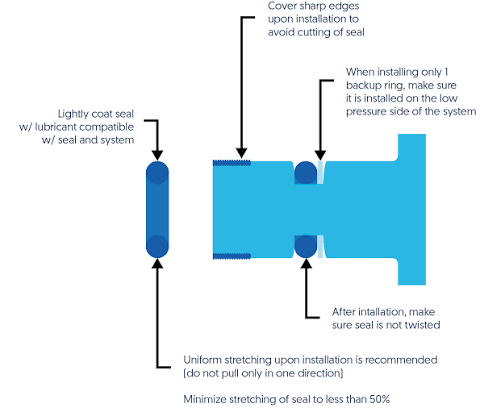
The set of design principles reused most in this part: dynamic seals are more sensitive than static seals — material excessive expansion easily leads to friction and wear; excessive shrinkage brings leak risk and can quicken wear. Dynamic contact faces cannot be too rough — it damages the lubricant film — but also cannot be too smooth; the manual recommends the dynamic-seal surface must retain a lubricating oil film, and excessive glossiness instead cuts the lubrication. Assembly stretch should be controlled — post-installation ID stretch is usually not more than 5%. Groove fill rate needs headroom — the manual recommends most O-ring grooves have a fill rate of 60%–85%, an optimal value around 75%, and reserve at least about 10% space. A dynamic seal's extrusion amount, friction, material hardness, clearance and surface roughness must all be considered together, and cannot be judged by just one metric.
These principles can be converted into an internal enterprise "O-Ring Groove Design Handbook" and an online calculator.
Parker's back-up ring package is very worth studying. It doesn't just treat the back-up ring as an accessory — it makes the back-up ring a complete product line: usage scenario, material, dimension series and its correspondence to AS568 dimensions, comparison of PTFE/leather back-up rings, advantages/disadvantages, installation method, temperature and pressure applicability.
If a Chinese manufacturer only sells O-rings, it very easily loses solution voice in high-pressure hydraulic, oil/gas, engineering machinery, injection molding machine, hydraulic cylinder and similar scenarios. It's recommended to fold back-up rings into the standard product system: NBR 90A back-up ring, FKM back-up ring, PTFE open back-up ring, PU anti-extrusion ring, combination sealing kit (O-ring + double back-up ring), high-pressure hydraulic sealing set. This can lift the customer's order value, and also reduce O-ring extrusion failures caused by excessive customer groove clearance.
Media compatibility is one of the core assets of the entire manual. Parker uses 1–4 and X to represent compatibility grades: 1: satisfactory. 2: general, usually usable for static seal. 3: doubtful, some static seal may be usable. 4: not satisfactory. X: data insufficient.
A recommended Parker compound is also given for each media. This kind of database has commercial value. Chinese manufacturers should establish their own Chinese-language media compatibility library, and must support it with actual measured data from this company's own formula, not simply translate a foreign database.
The specification chapter matches material specification, military standard, AMS, NAS, ASTM, SAE etc. against Parker compound. The dimension chapter covers AS568, ISO 3601, JIS B2401 and other dimension systems. For Chinese manufacturers, this should add cross-references to GB/T 3452, ISO 3601, AS568, JIS, DIN, and pay special attention to conversion between customer non-standard dimensions.
The appendix is very practical. It lists common O-ring failure modes: compression set, extrusion and nibbling, spiral failure, explosive decompression, wear, installation damage, cleanliness, chamfer, penetrating hole, sharp edge, over-stretch, roll assembly and other issues.
It also gives the pass/fail logic for cosmetic defects, e.g. flash, flow marks, foreign matter, mold defect, missing rubber, wrong mold, backrind, and gives allowable limits by cross-section dimension. Chinese manufacturers should convert this part into their own "O-Ring Cosmetic Judgment Illustrated Guide" for use in QC, customer communication and supplier training.
Referenceable Module |
Parker's Approach |
How Chinese Manufacturers Reproduce |
Technical inquiry form |
Uses "Statement of Problem" to collect media, temperature, pressure, groove, dynamic/static, leak requirement etc. |
Make into a standard RFQ form, web form, sales-staff training form, sample development input form |
Compound coding system |
Prefix represents material family, suffix represents hardness, mid-number represents specific formula, secondary letter represents special performance |
Establish own compound code, don't use Parker's number; assign a TDS, SDS, batch, and post-processing status to each compound |
Media compatibility library |
Chinese-language database, priority covering large-volume gas, liquid, solid media, and giving recommended compound |
Establish a Chinese-language media database, prioritize covering hydraulic oil, fuel, coolant, refrigerant, cleaning agents, food media, new-energy media |
Groove design handbook |
Complete tables for static, dynamic, vacuum, rotary, boss seal, dovetail groove etc. |
Make a Chinese design handbook and calculator, compatible with GB/T 3452, ISO 3601, AS568, JIS |
Failure analysis library |
Organized by failure appearance, cause, corrective action |
Make a sales diagnostic tool: customer photo + operating-condition input + failure judgment + improvement recommendation |
Cosmetic quality standard |
Uses images and dimension limit descriptions to attach acceptable/rejectable |
Establish an enterprise-version visual inspection standard, reduce customer disputes over flash, defects |
Batch traceability system |
Emphasizes Controlled Batch Identification, establishes traceability from raw material to finished product |
Establish a QR-code batch system: formula, mixing, curing, post-processing, inspection, complete packaging chain traceable |
Application scenario handbook |
Automotive, aerospace, food, water, oil/gas, semiconductor organized independently |
Turn the product catalog into an industry solution catalog, raise sales conversion |
Online tools |
inPHorm design software, dimension conversion, groove recommendation, problem diagnosis |
Make a Chinese mini-program/webpage tool, serve customer engineers |
Accessory product line |
Lubricant, PTFE coating, internal lubricated compound, back-up ring, tools, kits |
Expand from single O-ring to sealing accessories and assembly-solution sales |
The content below is not recommended to be mechanically copied dimensionally, but is well suited as a framework for a Chinese manufacturer's internal engineering specification.
Recommended to adopt Parker's order: media → temperature → time → pressure → mechanical motion form → groove structure → assembly method → leak tolerance → test verification.
Don't first ask "what material does the customer want" — instead ask first "what media, how much temperature, static or dynamic, is there pressure pulsation, is there repeated disassembly."
The manual repeatedly emphasizes that volume change, hardness change, tensile strength change, compression set, and low-temperature performance all affect sealing lifespan. For Chinese manufacturers, the minimum test combination that should be established includes: 70h/168h media immersion; volume change rate; hardness change rate; tensile strength and elongation change; compression set; low-temperature TR-10 or similar low-temperature recovery test; heat-air aging; dynamic wear or friction test; explosive decompression test, vacuum outgassing test if necessary.
Particularly important: static seal can tolerate a certain amount of swelling, but dynamic seal is more sensitive to swelling and shrinkage. Material shrinkage is often more dangerous than swelling, because shrinkage directly lowers sealing contact stress.
The following parameters should be input into the calculator and drawing review: O-ring cross-section dimension; ID stretch rate; compression rate; groove depth; groove width; groove fill rate; clearance; eccentricity; chamfer; surface roughness; pressure direction; whether a back-up ring is needed; whether repeated disassembly is allowed; whether thermal expansion, media swelling, and volume-expansion superposition exist.
Many domestic leak problems are not the O-ring itself being non-compliant — they are groove, chamfer, roughness, clearance, assembly lubrication and material compatibility not being jointly controlled.
Parker's failure-analysis section can be directly converted into an after-sales SOP. It's recommended Chinese manufacturers establish the following process: the customer provides — failure photo, usage time, media, temperature, pressure, assembly method, groove diagram, whether lubricated, whether repeatedly disassembled. Internal judgment — compression set, extrusion, nibbling, spiral cut, wear, explosive decompression, chemical corrosion, thermal aging, ozone cracking, installation cutting. Output report — failure mode, possible cause, verification recommendation, corrective action, replacement compound, groove modification recommendation.
NBR 70, NBR 90, FKM 75, EPDM 70, VMQ, HNBR — these basic products are still the sales-volume core, but must use data and service to raise the threshold. It's recommended every core compound is matched with: TDS; media recommendation table; temperature range; compression set data; common dimension stock table; typical application; not-recommended application; alternative solution.
The manual has application breakdowns for engine, brake, fuel, transmission, cooling, air conditioning, power steering etc. Chinese manufacturers can further add for domestic customers: new-energy thermal-management coolant; motor drive oil; battery-pack waterproof seal; charging interface seal; electronic water pump seal; A/C refrigerant and PAG/POE oil; methanol, ethanol, biodiesel and other alternative fuels; urea solution-related seals. These scenarios need material verification and customer coordination even more than ordinary hydraulic parts.
If the customer has high pressure, large clearance, or pulsation, selling an O-ring alone easily results in extrusion and nibbling failure. Should promote: O-ring + single back-up ring; O-ring + double back-up ring; HNBR/FKM high-pressure combination; PU or PTFE back-up ring; matching maintenance kit. This can reduce failure liability disputes, and also raise the per-unit price.
The manual lists food, drink water, semiconductor, vacuum independently, indicating the key to these industries is not color — it is migration, extraction, contamination, low outgassing, low particulates, low metal ions, clean packaging, and certification documents. Chinese manufacturers entering these industries must first establish inspection and documentation systems, otherwise they easily fall into the trap of "looking like food-grade/semiconductor-grade" but not passing customer audit.
The manual discusses vacuum leak rate, gas permeation, surface roughness, lubrication, double O-rings, compression rate and other issues. This class of content has value for vacuum equipment, instrumentation, semiconductor equipment, gas valves, hydrogen/helium-related systems. Recommend establishing specialized materials: low-permeation material comparison; helium leak-detection case; vacuum lubricated and non-lubricated options; face seal groove recommendation; high-pressure gas explosive-decompression risk statement; effect of small and large cross-section on explosive decompression.
First, don't copy Parker's compound numbers directly — those numbers are Parker's product system and cannot serve as one's own factory's capability proof.
Second, don't directly translate Parker's compatibility table into one's own compatibility table. Compatibility is compound-level, not polymer-level. Same as FKM, different fluorine content, cure system, and filler system can have noticeable differences.
Third, don't only adopt US standards — Chinese customers also need GB/T 3452, ISO 3601, AS568, JIS, DIN and other multi-system coexistence, especially domestic hydraulic, automotive, home appliance, and instrument customers who often mix standards.
Fourth, don't over-promise high-end scenarios. FFKM, semiconductor, oil/gas high-pressure gas, explosive decompression, aerospace, food/drink water certifications all need real testing, certification, and quality-system support.
Fifth, don't treat the design handbook as a disclaimer. The Parker manual repeatedly emphasizes actual operating-condition testing is needed. Chinese manufacturers should also clearly state in their materials: recommended type selection is only a preliminary suggestion, and the key application must be verified through actual customer testing.

Welcome to HOVOO, a Chinese seal factory. Production of PU, Rubber and PTFE seals. The seals include O-ring, piston seal, rod seal, Gray ring and gas seal.


 EN
EN
 AR
AR CS
CS DA
DA NL
NL FI
FI FR
FR DE
DE EL
EL IT
IT JA
JA KO
KO NO
NO PL
PL PT
PT RO
RO RU
RU ES
ES SV
SV TL
TL IW
IW ID
ID LV
LV SR
SR SK
SK VI
VI HU
HU MT
MT TH
TH TR
TR FA
FA MS
MS GA
GA CY
CY IS
IS KA
KA UR
UR LA
LA TA
TA MY
MY
