33-99No. Mufu E Rd. Gulou District, Nanjing, China [email protected] | [email protected]
33-99No. Mufu E Rd. Gulou District, Nanjing, China [email protected] | [email protected]

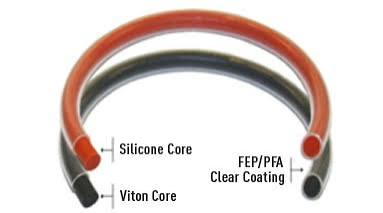
FEP/PFA-encapsulated O-rings are more suitable for scenarios where the media is very corrosive, but the seal still needs elastic compensation; solid PTFE O-rings are more suitable for scenarios that are static-seal only, groove easy to install, compression force controllable, and prioritize extreme chemical resistance and cleanliness. Neither is a complete substitute for an ordinary rubber O-ring, and especially should not be casually intended for high-frequency dynamic seals, abrasive slurry, or scenarios requiring large stretch installation.
FEP/PFA-encapsulated O-rings are usually composed of an outer FEP or PFA fluoroplastic encapsulation layer, plus an internal VMQ silicone or FKM fluorine rubber elastic core. The outer skin provides PTFE-like chemical resistance, the elastomer inner core provides compression rebound and sealing pre-tension; industry data also clearly defines it as the encapsulation layer providing compression rebound and sealing preload, the outer layer chemically resistant, and the inner core as a static sealing element with no weld line.
Solid PTFE O-rings are integral PTFE material, itself chemically resistant, cleanliness good, but they are not rubber elastomers and lack the elastic rebound recovery ability of rubber, mainly used for shaft static seal, flange sealing, or in structures where the elastic rebound deficiency can be treated as a controllable limitation with attention paid at design and installation.
Therefore, when the customer asks "which is better between encapsulated O-ring and solid PTFE O-ring," it should not directly answer which is better, but first determine: does this position need elastic compensation? Is the installation space sufficient? Is the media corrosive or abrasive? Are there frequent disassembly/reassembly needs?
This is the classic application of encapsulated O-rings. Many chemical media would cause NBR, EPDM, FKM to swell, harden, dissolve or compression permanent deform; but directly using solid PTFE O-rings can lead to insufficient rebound-induced late-stage leaks, thermal cycling later leakage or installation instability. The encapsulated O-ring is precisely between the two: outer layer isolation, corrosion, solvent, cleaning liquid, inner layer VMQ or FKM continues to provide elastic sealing.
Suitable positions include: chemical pipeline flanges, reaction vessel covers, filter housings, pump body static seals, valve body connections, viewing windows, end caps, cartridge connections, sampling ports, instrument ports, etc.
FEP/PFA encapsulation layer surface is clean, low-adhesion, low-friction, and material itself is available for hygiene, disinfection related medical applications. Supplier data also positions encapsulated O-rings applicable to chemical, pharmaceutical, food and other industries, the reason is its chemical compatibility, physiological safety, and lower permeability.
Typical applications include: CIP/SIP cleaning systems, pharmaceutical piping, food beverage valve, sanitary-grade fittings, filter, filling equipment, sampling valve and similar sealing.
In the valve industry, FEP/PFA encapsulated O-rings are suitable for valve covers, valve connections, end caps, valve body flanges, actuator interfaces and similar static or low-frequency dynamic seals. Supplier data widely positions encapsulated O-rings as mainly used for axial or radial static sealing.
But it is not suitable to directly act as high-frequency reciprocating valve stem seals, rotating shaft seals or particle-media dynamic seals. Reason is the FEP/PFA outer skin is corrosion resistant but relatively thin, dynamic friction, sharp corners, stretching, twisting, abrasion and mold marks can all cause the encapsulation layer to be damaged.
If a seal face has slight machining error, temperature fluctuation, pressure fluctuation, low-pressure startup, repeated disassembly, solid PTFE's insufficient rebound can become a risk point, at this time the encapsulated O-ring is because the internal has elasticity, usually more able to maintain contact stress than solid PTFE. Supplier data also points out the encapsulated structure's outer skin provides shielding, inner core provides compression, rebound and sealing force.
In these applications, the encapsulated O-ring is often understood by customers as "more chemically resistant than rubber, more elastic than PTFE" compromise solution.
FEP encapsulation is usually a more common, more economical solution, applicable to most conventional chemical, food, pharmaceutical static seals, FEP material continuous use temperature commonly upper limit approximately 205°C, different manufacturers, structures and cores vary.
PFA encapsulation is suitable for higher temperature, cleaning more stringent, thermal cycling more obvious scenarios demanding higher tear resistance performance; supplier data usually emphasize PFA has better mechanical strength, better anti-tear-crack performance, working temperature can reach up to 260°C.
Simple judgment:
Scenario |
Priority Selection |
Conventional acid-alkali, solvent, food/pharma static seal |
FEP/VMQ or FEP/FKM |
Temperature close to or exceeding 200°C |
PFA encapsulation |
Thermal cycling, cleaning strict, tear cracking resistance requirements high |
PFA/VMQ or PFA/FKM, per media re-determine |
Need low compression, low softness |
VMQ core or hollow silicone core |
More concerned with compression permanent deformation, oil, solvent and seal life |
FKM core |
VMQ silicone core is soft, low compression force, low-temperature softness good, suitable for low pressure, food, pharma, cleanroom equipment, glass or plastic material more fragile fitting structures; solid silicone core and hollow core are both common, hollow silicone core compression is lower, applicable to structures with limited or sealing more sensitive scenarios.
FKM fluorine rubber core compression permanent deformation performance is usually better, more resistant to oil, fuel, part solvent and high-temperature long-term static seal. Some data also points out that if the encapsulation layer is damaged, FKM core can better resist chemical attack.
But it needs to be emphasized: the encapsulated O-ring's chemical resistance capability primarily comes from the outer FEP/PFA, and should not assume the inner core can long-term directly contact the media.
Solid PTFE O-rings are most suited to end faces, flanges, viewing windows, inspection ports, pipe joints and similar static sealing positions, Trelleborg positions PTFE O-rings as facing axial static or flange type applications, characteristic is resistant to nearly all chemicals and high temperature, and can be machined precisely.
In other words, solid PTFE O-rings are more like a circular PTFE gasket, not a traditional rubber O-ring; only need the groove opening, compressibility, sealing face flat, no need for large stretch installation, then can play their good corrosion resistance and clean advantage well.
Some customers do not wish for their sealing part to contain any rubber ingredient, or worry about rubber extract, contamination, dissolution, aging, media permeation attacking the inner core. At this time solid PTFE O-rings are more suitable. PTFE O-rings often used because the elastomer completely cannot meet chemical or thermal stability requirements' working condition, and widely applied to chemical, petrochemical, medical and food industries.
Typical applications include: strong acid-alkali pipeline, solvent system, high-purity chemical equipment, laboratory installation, semiconductor wet process equipment, food and pharma equipment static gasket sealing.
Solid PTFE O-rings can usually be manufactured through machine processing, not necessarily relying on rubber molds, therefore special dimensions, non-standard cross-sections, small batch demand more flexible. Data also points out PTFE O-rings can provide special dimensions via mechanical processing.
This is very valuable for maintenance parts, old equipment replacement, non-standard flange, special specification, imported equipment localization replacement.
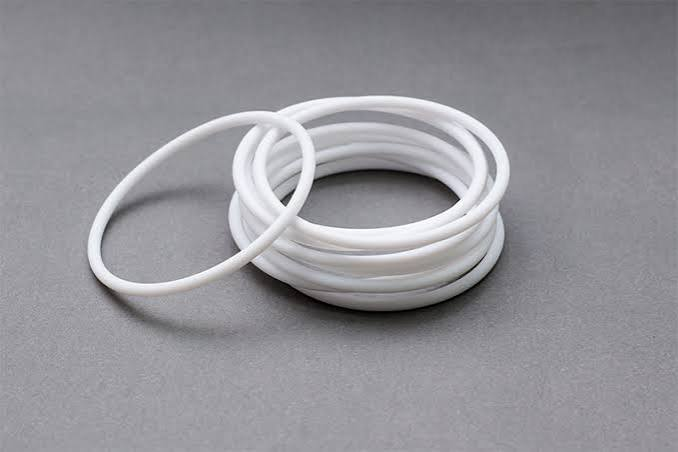
PTFE does not have the recovery ability of rubber elastomer, data explicitly points out PTFE O-ring elastic recovery is very weak, sealing system and installation design must target this point of handling.
This means: once the sealing face has scratches, flatness insufficient, thermal expansion cold contraction, pressure fluctuation, bolt preload decay, solid PTFE may not be able to auto-compensate like a rubber O-ring.
PTFE itself has low friction, but solid PTFE O-rings lack elastic rebound, data holds this insufficient rebound essentially basically rules out its use as a dynamic seal.
If it is a valve stem, piston rod, rotating shaft, cylinder piston and similar dynamic position, more should consider PTFE lip seal, spring-energized seal, filler, combination seal or compatible material, rather than directly using solid PTFE O-rings.
Solid PTFE is not suitable for large stretch installation, data recommends it be preferably used for flange connection or cover plate gasket, and warns that closed groove installation is often more restricted, compression amount usually needs strict control.
Therefore, it is not recommended to use solid PTFE O-rings for deep closed groove, needing to be forced over threads or shaft shoulder positions, and not recommended to pry with sharp tools.
Comparison Item |
FEP/PFA Encapsulated O-Ring |
Solid PTFE O-Ring |
Structure |
FEP/PFA outer skin + VMQ/FKM elastic core |
Integral PTFE material |
Core Advantage |
Chemical resistance + rubber-like rebound |
Extremely high chemical resistance, clean, no rubber ingredient |
Sealing Capability |
Good for low pressure, high temperature, minor assembly error friendly |
Depends on compression force and groove precision |
Rebound Capability |
Clearly better than solid PTFE, but lower than ordinary rubber O-ring |
Very weak |
Typical Application |
Chemical, food, pharma, valve, pump, filter housing static seal |
Repair, high purity chemical, low-temperature static seal |
Dynamic Working Condition |
Generally not recommended, dynamic seal needs separate verification |
Generally not recommended |
Corrosion/Abrasive Media |
Not recommended, outer layer easily worn with particulate matter |
Also cautious, viscosity filler and structure dependent |
Installation Requirements |
Cannot twist, twist, over-stretch, avoid scratched sealing face, groove needs open, compression amount controllable |
Same, but sensitivity is stronger |
Cost |
Usually higher than ordinary rubber and part solid PTFE |
Depends on size and processing method |
Selection Logic |
"Rubber not corrosion resistant, but need elasticity" |
"Only static seal, prioritize corrosion resistance and cleanliness" |
Priority consider FEP/PFA encapsulated O-rings used for pump body, valve, filter housing, reaction vessel, pipeline joints and similar static sealing positions, especially acid, alkali, solvent-frequently-changing operating conditions. If equipment structure is flat flange, cover plate, inspection port, installation space open, compression force sufficient, can select solid PTFE O-rings.
FEP/PFA encapsulated O-rings are suitable for clean surfaces requiring hygiene, low sticking, low friction, and material still needs elastic compensation cartridge, valve and filtration equipment. Solid PTFE O-rings are suitable for static cover plates, flanges or scenarios not wanting rubber ingredient contact with the product part.
If sealing reliability requires elasticity, cleaning/sterilization after still needing rebound, usually priority encapsulated O-ring; if customer stresses ultra-low extraction, no-rubber core, high purity contact, sealing is limited to static compression, then consider solid PTFE O-rings.
Valve cover, end cap, valve seat periphery static seal is common with FEP/PFA encapsulated O-rings or solid PTFE O-rings; valve stem, rotating shaft, frequent opening/closing position should not simply use these two types of O-rings, should reconsider dynamic seal design selection.
Can use this logic to communicate with chemical customers:
If high-frequency reciprocating, rotating or abrasive particle friction, both encapsulated O-rings and solid PTFE O-rings need caution, prioritize dedicated dynamic seal.
When rebound, low-pressure sealing, thermal cycling compensation, assembly error tolerance is needed, priority FEP/PFA encapsulated O-ring.
If it's flange, cover plate, inspection port, groove open, compression force sufficient, solid PTFE O-ring is feasible.
At conventional temperature, FEP encapsulation is more economical; high temperature, thermal cycling, more stringent cleaning scenarios prioritize PFA encapsulation.
Low compression force, low temperature, cleanliness equipment select VMQ; more concerned with compression permanent deformation, oil products/solvent and long-term stability select FKM.

Welcome to HOVOO, a Chinese seal factory. Production of PU, Rubber and PTFE seals. The seals include O-ring, piston seal, rod seal, Gray ring and gas seal.


 EN
EN
 AR
AR CS
CS DA
DA NL
NL FI
FI FR
FR DE
DE EL
EL IT
IT JA
JA KO
KO NO
NO PL
PL PT
PT RO
RO RU
RU ES
ES SV
SV TL
TL IW
IW ID
ID LV
LV SR
SR SK
SK VI
VI HU
HU MT
MT TH
TH TR
TR FA
FA MS
MS GA
GA CY
CY IS
IS KA
KA UR
UR LA
LA TA
TA MY
MY
