33-99No. Mufu E Rd. Gulou District, Nanjing, China [email protected] | [email protected]
33-99No. Mufu E Rd. Gulou District, Nanjing, China [email protected] | [email protected]

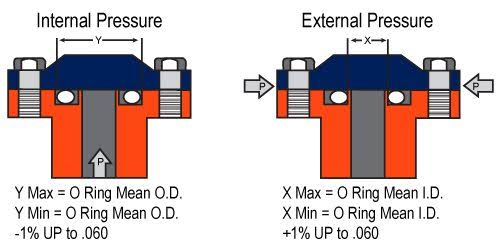
The same O-ring design cannot be directly applied to both static and dynamic seals — the fundamental reason is: a static seal mainly needs to solve "compress enough, seal well"; a dynamic seal must simultaneously solve "seal well, move well, not wear out, not too much running resistance, acceptable startup resistance."
An O-ring essentially relies on the pre-compression amount and the contact stress triggered by media pressure to achieve sealing.
In static seals, the O-ring assembly basically no longer moves relative to metal; a larger compression margin, rougher surface, and looser dimensional allowance are all typically acceptable. In dynamic seals, the O-ring slides against a shaft, bore, or piston rod repeatedly or rotates, so the sealing part design must additionally consider speed, friction, lubricating film, wear, heat generation, breakout resistance, clearance/extrusion, and surface roughness. Parker's radial-seal design material also clearly separates static and dynamic radial seals: a static seal has no relative motion, while a dynamic seal or reciprocating seal undergoes rotation or reciprocating motion; a static seal is generally more tolerant of larger clearances and rougher surfaces.
Typical scenarios: flanges, end caps, valve covers, pump covers, inspection covers, housing end faces.
Sealing form: the O-ring sits in the end-face groove, and is compressed axially by the two facing planes.
The primary design goals of a face static seal are:
The O-ring needs to be compressed a certain amount by the end face to form initial contact stress. Once the media pressure acts, the O-ring is further pushed toward the low-pressure side, reinforcing the seal.
The groove cannot completely "fill up" the O-ring. Rubber has thermal expansion and media swelling, so the groove needs to reserve deformation space, otherwise over-compression, shearing, extrusion or difficult assembly can occur.
The main failure mode of long-term face static seals is rubber aging, compression set, or media corrosion — not sliding wear.
If bolt arrangement, flange stiffness, or flatness is insufficient, uneven local compression may cause localized leaks.
In face static seals, the O-ring only bears short-term friction during assembly, and generally has no sustained motion during operation. Therefore, to ensure static sealing reliability, face static seals typically use a relatively high compression rate. Angst+Pfister's O-ring technical material also points out that under a static condition the O-ring compression may be higher than in a dynamic condition, because there's no continuous sliding-surface friction and wear consideration — even softer material may be selected if the contact surface is rougher or slightly damaged.
The design mindset of a face static seal is "tight." If this high-compression, high-contact-stress mindset is used repeatedly for a rotating or reciprocating dynamic seal, friction force, startup resistance, and frictional heat will increase significantly, causing O-ring surface wear, scratches, burn marks, adhesion, or even sticking to the shaft.
Typical scenarios: plug/bore fits, valve stem fits, tube fittings, static plungers, static sleeves, OD static seals.
Sealing form: the O-ring is compressed radially between the inner and outer circumference, and the sealing direction is radial.
The distinction between radial static seals and face static seals is that face static seals are compressed axially in the upper-lower direction, while radial static seals are compressed radially between the ID and OD. Parker's radial static-seal material notes that the compression of a radial seal acts on the ID and OD direction of the O-ring, whereas the compression of a face seal acts on the upper-lower direction of the end face.
The primary design goals of a radial static seal are:
Too small a compression will leak; too large will make assembly difficult, produce excessive stress, or accelerate compression set.
When the O-ring is fitted over a shaft it may be stretched; when fitted into a bore it may be compressed. Excessive stretching thins the cross-section, and actual compression amount decreases; excessive compression may cause buckling or assembly shear.
Although a radial static seal doesn't move after assembly, it often must pass over chamfers, threads, bores, and sharp edges during installation. Field failures common on maintenance sites are often not that the design compression is insufficient, but that the O-ring gets scratched, twisted, or bitten during assembly.
Under high pressure, the O-ring may get extruded into the mating clearance. Consider a back-up ring when pressure is high, clearance is large, temperature is high, or rubber hardness is low.
A radial static seal still belongs to a static seal category. It can tolerate a larger clearance and rougher surface than a dynamic seal, because there is no continuous sliding friction — but this doesn't mean the radial static seal design has no verification requirements at all; a static design only guarantees "seals in the immobile state," and doesn't verify whether friction, wear, lubrication, and breakout resistance during repeated dynamic motion are acceptable.
The risk profile of a static plug/bore seal and a reciprocating piston seal is completely different. A static plug/bore only needs to prevent leakage; a piston seal must handle every cycle of the reciprocating motion. A radial static-seal groove compression rate tends to be higher, which directly translates into friction torque and heat generation on a rotating shaft; on a reciprocating piston seal it may mean: short-term no leak, but running heats up, the O-ring burns, and surface bites — eventually forming a more severe leak.
Typical scenarios: hydraulic cylinder pistons, pneumatic cylinder pistons, valve stem reciprocating, plungers, piston rod seals.
Sealing form: the O-ring functions as a piston seal or rod seal, sliding straight-line reciprocating along the bore wall or rod surface.
A piston reciprocating seal belongs to a typical dynamic seal. It cannot simply be judged by "can it hold pressure" — it must also consider the following issues:
The higher the reciprocating speed, the greater the unit-time friction power, and the more obvious the O-ring temperature rise. Excessive speed can cause thermal aging, hardening, cracking, or burning on the rubber surface. Too-low speed may instead make it difficult to form a stable lubricating film, leading to dry friction and creeping.
Parker's O-ring handbook notes that dynamic seal friction is jointly influenced by many factors, including sealing geometry, pre-load, material hardness, dry/wet friction coefficient, lubricating film formation, media viscosity, working pressure, sliding speed, and mating surface material and roughness.
A dynamic seal's compression amount cannot simply be set the same as a static seal's. The greater the compression amount, the higher the contact pressure, the greater the friction, and the higher the startup resistance and wear rate. Angst+Pfister's material also clearly points out that in dynamic application, O-ring cross-section deformation should be lower than in static application, to lower friction, wear and temperature rise; the contact surface of a dynamic seal also needs to be smoother to control abrasion.
This is exactly what maintenance sites often encounter: "replacing an O-ring of the same size, it doesn't leak at first, but the operation slows down, heats up, has insufficient push force, and leaks again a few days later." The reason is usually not that the size is off by a grade, but that the static-seal design thinking was applied to a dynamic sealing position: compression amount is excessive, material friction coefficient is too high, and lubrication is insufficient or the groove doesn't suit dynamic operation.
A piston reciprocating seal needs to maintain a very thin lubricating film on the sealing face. If the lubricating film is too thin, the O-ring directly contacts the metal surface, and wear increases sharply; if the lubricating film is too thick, it can manifest as external seepage or internal leakage. Parker's material also notes the lubricating film gets scraped away and running becomes more brittle, insufficient lubricant film thickness may bring undesirable leakage, so a dynamic seal needs to be balanced between friction and leakage.
Hydraulic reciprocating seals especially should not pursue "perfectly clean without oil." Dichtomatik's O-ring material points out dynamic hydraulic seals with slight micro-leakage are instead conducive to forming a lubricating film, lowering friction and wear.
A dynamic seal must distinguish between startup friction and running dynamic friction. Parker's handbook notes dynamic applications need to overcome static friction at motion start and dynamic friction during the motion process; the handbook indicates startup static friction is especially important in reciprocating and cylinder applications; the handbook also notes the elastomer seal's static break-out friction is typically markedly higher than dynamic friction.
This is very important for equipment maintenance personnel. Excessive breakout resistance can cause: a small cylinder to not move or return sluggishly; a pneumatic cylinder to have low-pressure malfunction; a hydraulic cylinder to creep or jitter; a servo or proportional system to have unstable positioning; higher motor, pump, air-source load; difficulty on the first motion after long shutdown.
When the piston reciprocates, the O-ring may exhibit: flattened sliding face; surface pulled or peeled; spiral twist failure; high-pressure edge nibbling; extrusion cut edge; oil-scorch damage; contamination particle abrasion.
Under dynamic conditions, clearance, pressure peaks, and speed superimpose, and the O-ring more easily gets pulled into the clearance. Angst+Pfister's material notes dynamic applications, due to clearance and high-pressure impact, must periodically inspect fluid compatibility, lubricant compatibility, and friction heat and contamination effects.
A piston reciprocating seal is not "press the O-ring tighter and it's more reliable." Too tight compression can instead cause faster failure. Correct design must balance sealing force, friction force, startup resistance, lubricating film, and lifespan.
Typical scenarios: low-speed rotating shafts, rotary valves, rotary joints, low-speed adjustment shafts, short-run rotary mechanisms.
Sealing form: continuous circumferential-direction friction exists between the O-ring and the rotating shaft or rotary hole.
Compared with a piston reciprocating seal, a shaft-rotation seal carries even higher risk, because rotary motion has no clear "stroke endpoint" — the contact band is continuously frictioned for extended time, heat concentrates on the same sealing band; if lubrication is poor or speed is high, the O-ring is very prone to burning, hardening, wearing, sticking, or generating permanent deformation.
Special considerations required for rotary O-ring design:
The larger the shaft diameter and the faster the rotation, the higher the linear speed, and the greater the friction heat. It's not enough to look only at rpm — the shaft surface linear speed must be calculated.
A rotary seal usually requires lower compression than a static seal. Parker's rotary O-ring groove chart shows different cross-sections have markedly different recommended compression under rotary operating conditions, e.g. some specification tables give 0–11% or lower ranges.
A rotary seal should try to have a lubricant near the sealing contact zone, avoiding dry friction; Parker's rotary O-ring groove chart also specifically notes the sealing should try to stay close to lubricating media.
The shaft's roundness runout, eccentricity, roughness, hardness and machining lines all affect oil-film stability; excessive polishing or improper machining marks may also break the lubricating film.
Parker's rotary O-ring material notes that, due to centrifugal force effects, the groove should not be arranged on the shaft.
At high-speed or continuous rotation, general rubber O-rings are often not the best primary seal. Consider dedicated rotary shaft lip seals, PTFE lip seals, mechanical seals, combination seals, or using an O-ring only as an elastic loading element.
The groove of a static radial seal can afford a larger radial compression amount, which on a rotating shaft directly converts into friction torque and heat generation. The consequence may be: doesn't leak in the short term, but heats up sharply, the O-ring burns, and the surface scores, eventually forming a more severe leak.
Item |
Face Static Seal |
Radial Static Seal |
Piston Reciprocating Seal |
Shaft-Rotation Seal |
Relative motion |
None |
None, except during assembly |
Yes, straight-line reciprocating |
Yes, continuous rotation |
Primary compression direction |
Axial |
Radial |
Radial |
Radial |
Core goal |
Static, no leak |
Static, no leak, resist extrusion |
Sealing and friction balance, low torsion, low temperature |
Sealing, low torque, temperature control |
Compression thinking |
Can be relatively higher |
Can be relatively higher |
Generally lower than static seal |
Usually lower |
Surface requirement |
Moderate |
Moderate, mind assembly chamfer |
High, dynamic surface quality is critical |
Very high, must control shaft runout |
Lubrication requirement |
Mainly for assembly |
Mainly for assembly |
Must consider lubricating film throughout operation |
Must ensure continuous lubrication and heat dissipation |
Primary failure mode |
Compression set, aging, flange loosening |
Assembly cutting, extrusion, aging |
Wear, creep, startup resistance, burning, twisting |
Heat generation, burning, shaft wear, torque too large |
Directly swappable design? |
No |
No |
No |
No, highest risk |
In static seals, raising compression amount usually enhances initial sealing reliability. But in dynamic seals, raising compression directly increases contact pressure, further increasing friction, heat generation, startup resistance, and wear. Angst+Pfister's material clearly states dynamic applications should lower cross-section deformation to reduce friction, wear, and temperature rise.
A static-seal surface only needs long-term contact — it does not need long-term sliding. Roughness, machining marks, and cleanliness all affect life. A static-seal-acceptable surface roughness may quickly wear an O-ring on a dynamic seal.
Static seals pursue tight, close contact. A dynamic seal must maintain an appropriate lubricating film — without an oil film, it burns; too thick an oil film may leak. "Completely no leak" as the target static-seal thinking applied to a reciprocating or rotary seal may instead cause a dry sealing face, higher friction, and shortened lifespan.
A static seal has no motion — no need to care about breakout friction. A dynamic seal must be concerned about breakaway friction, i.e. the resistance overcome upon the first motion after a shutdown. Excessive startup resistance can cause a small cylinder to not move, a hydraulic cylinder to creep, a valve stem to jam or a servo response to lag. Parker's handbook notes elastomer static break-out friction is typically markedly higher than dynamic friction, and is affected by shutdown time, material, geometry, and surface state.
A static seal's lifespan is mainly determined by compression set, temperature, media, ozone, aging, and assembly state. A dynamic seal's lifespan must additionally account for sliding distance, speed, pressure, lubrication, contaminant particles, and friction heat. That is to say, a dynamic seal's lifespan is not judged by "does it leak after installation," but by "how many strokes of running, how many hours of static rest, and still no leak or low friction."
A shaft-rotation seal cannot simply be designed by processing a radial static-seal groove. When rotating, the O-ring bears continuous circumferential friction; linear speed, shaft runout, centrifugal force, and lubricant supply all affect life. Parker's rotary O-ring material notes speed, pressure, compression amount, and groove position all carry unique requirements, and this itself indicates a rotary seal cannot directly borrow a general static radial groove.
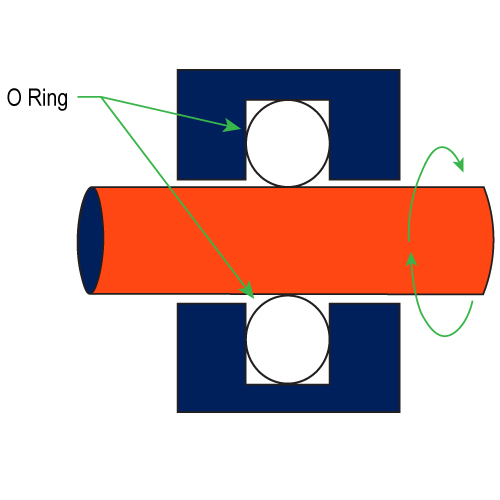
When troubleshooting on-site, don't first ask "how big is this O-ring" — ask first:
If there's no motion, it can only be a static-seal design; if there's reciprocation, rotation, or oscillation, a dynamic-seal design must be followed.
Reciprocating seals and rotary seals cannot be lumped together. A reciprocating seal cares about stroke, frequency, speed, startup resistance and lubricating film; a rotary seal cares about linear speed, shaft runout, friction heat, torque and lubrication supply.
Whether hydraulic oil, lubricating oil, mist, or the media itself, can form a stable lubricating film. Air, dry, cleaning agents, and dusty environments are especially prone to oil-film shortage.
Check compression amount, groove width, groove fill rate, chamfer, surface roughness, clearance, whether a back-up ring is used and the assembly path. Do not simply replace by ID and cross-section.
Static seals prioritize media compatibility and compression set; dynamic seals also need to consider wear resistance, friction coefficient, low-temperature elasticity, heat resistance, and lubricant compatibility.
If the O-ring surface is worn flat, glossy, powder shedding, hardened, burned, spiral-twisted, or has partial bite marks — it usually isn't solvable by "swap for another O-ring of the same size" — the seal design itself is wrong.
A static-seal O-ring and a dynamic-seal O-ring may look completely identical, but the design logic differs.
Face static seals can focus on compression amount, flange stiffness, groove capacity, media and temperature.
Radial static seals can focus on radial excess amount, assembly chamfer, extrusion clearance, and back-up ring.
Piston reciprocating seals must additionally verify speed, friction, lubrication, wear, startup resistance and pressure peak.
Shaft-rotation seals must additionally verify linear speed, torque, friction heat, lubrication supply, shaft runout and groove position; continuous high-speed rotation is generally not recommended to use a general O-ring as the primary seal.
The most common mistake in engineering is: seeing the same dimension and assuming it's interchangeable; seeing no static leak and assuming the design is qualified.
The correct judgment should be: a static seal looks at "can it stay sealed long-term after compression"; a dynamic seal looks at "can it stay sealed and run smoothly long-term under speed, pressure, lubrication and wear conditions."

Welcome to HOVOO, a Chinese seal factory. Production of PU, Rubber and PTFE seals. The seals include O-ring, piston seal, rod seal, Gray ring and gas seal.


 EN
EN
 AR
AR CS
CS DA
DA NL
NL FI
FI FR
FR DE
DE EL
EL IT
IT JA
JA KO
KO NO
NO PL
PL PT
PT RO
RO RU
RU ES
ES SV
SV TL
TL IW
IW ID
ID LV
LV SR
SR SK
SK VI
VI HU
HU MT
MT TH
TH TR
TR FA
FA MS
MS GA
GA CY
CY IS
IS KA
KA UR
UR LA
LA TA
TA MY
MY
