33-99No. Mufu E Rd. Gulou District, Nanjing, China [email protected] | [email protected]
33-99No. Mufu E Rd. Gulou District, Nanjing, China [email protected] | [email protected]

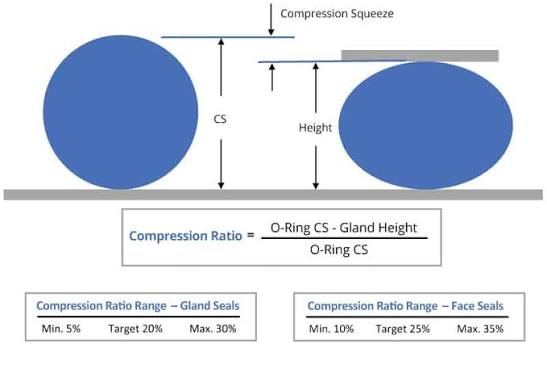
An O-ring doesn't seal by "plugging a gap" — it relies on the elastic deformation produced by pre-compression after installation, forming continuous contact stress between the groove and mating face; once media pressure rises, it further pushes the O-ring toward the low-pressure side, making the sealing contact even stronger — this is called self-energizing sealing effect.
An O-ring can be understood as an elastic element that "actively presses tightly against the sealing face after being pre-compressed."
Many entry-level customers think the O-ring's role is to seal shut the gap between the groove and component.
This understanding isn't precise enough.
The actual situation is: micro-gaps, surface roughness, assembly tolerance and thermal expansion/cold contraction always exist between mechanical mating faces. An O-ring cannot fill all space completely like water — what it actually does is: through elastic compression, form sufficient contact stress on the sealing face, blocking the media's leak channel.
That is to say, O-ring sealing relies on three basic conditions:
Condition |
Function |
Pre-compression |
Installation squashes the O-ring to a certain proportion |
Elastic deformation |
After compression, the O-ring tries to recover its original shape, thereby maintaining pressure against the sealing face |
Contact stress |
O-ring's compression force against the groove and mating face, blocking the leak channel |
Without pre-compression, the O-ring is only sitting in the groove; only with pre-compression does it begin to possess sealing capability.
The O-ring is originally circular in cross-section. Once installed into the groove and the mating component is pressed on, the O-ring gets compressed.
This can be simply understood as:
Before installation: O-ring cross-section is round.
After installation: O-ring cross-section is compressed flat, the upper-lower or inner-outer sealing face is pressed tightly.
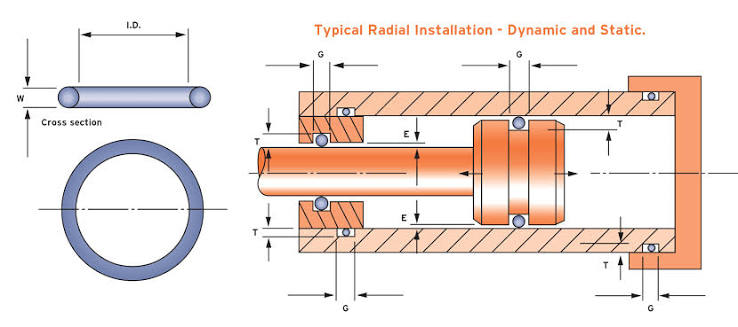
Taking a radial seal as an example, on the low-pressure side and high-pressure side, in between is the mating face, and the O-ring pressed against the groove generates contact stress — this contact stress is very critical.
The O-ring after being compressed produces elastic rebound force. This rebound force converts into contact stress on the sealing interface. As long as the contact stress on the sealing interface is sufficient, media finds it difficult to permeate through the micro-gap between metal, plastic parts, or other mating parts.
Pre-compression, also called compression amount, compression rate, squeeze, is the degree to which the O-ring gets compressed flat after installation.
For example, an O-ring with a 3.00 mm cross-sectional diameter, if after installation it's actually compressed to 2.55 mm, then the compression amount is: 3.00 mm - 2.55 mm = 0.45 mm. The compression rate is: 0.45 ÷ 3.00 = 15%.
This compression rate directly affects sealing performance.
Compression State |
Result |
Insufficient pre-compression |
Insufficient contact stress, easily leaks |
Appropriate pre-compression |
Stable sealing, good elastic rebound |
Excessive pre-compression |
Difficult assembly, large friction resistance, O-ring easily permanently deformed or damaged |
So an O-ring is not the more compressed the better. It needs a reasonable compression amount. For sales and purchasing, this point is very important: don't let customers only look at O-ring dimension — must simultaneously understand groove dimension, mating clearance, and usage pressure.
The key to O-ring sealing is not "is there contact," but "is the contact tight enough."
When the O-ring gets compressed flat, it forms a ring of continuous contact area with the sealing face; the compressive stress on this area is the contact stress.
This can be understood as: media wants to drill through the gap; the O-ring uses contact stress to press this gap shut; as long as contact stress is sufficient, media can't get through.
If contact stress is too low, media may permeate along surface micro-pits, scratches or similarly-rough traces. If contact stress is sufficient, the O-ring can compress these micro-leak channels shut. Therefore, O-ring sealing is not relying on "the shape just happening to fill it," but relying on "sustained compression."
O-rings are generally made of rubber or elastomer material, e.g. NBR, FKM, EPDM, VMQ, HNBR etc.
This class of materials has an important characteristic:
After being compressed it deforms, but still tends to recover its original shape.
This recovery tendency is elasticity.
After installation, the O-ring is compressed flat, but it continues to try to recover its circular cross-section. Because it's constrained by the surrounding groove and mating face, it cannot fully recover, so it continues to exert pressure toward the sealing face.
This is the sealing force brought by elastic deformation.
If the material loses elasticity, such as aging, hardening, low-temperature embrittlement, or excessive compression set, the O-ring cannot continue to press tightly against the sealing face, and the sealing force declines.
This is also why an O-ring can fail after a period of use: not because it's "not in the original position," but because it has lost sufficient elastic-rebound capability.
O-ring sealing has a very important characteristic: it gets activated by media pressure.
In a system with pressure, media will enter the groove clearance from the high-pressure side, exerting a thrust force on the O-ring.
This thrust pushes the O-ring toward the low-pressure side, causing it to press even more tightly against the sealing face and low-pressure-side groove edge.
A simple diagram: on the high-pressure side, media pressure pushes the O-ring toward the low-pressure side.
As pressure rises, the O-ring produces a stronger compaction effect.
This is the so-called self-energizing seal, also called pressure-assisted seal, pressure-activated seal.
Its core logic is: initial sealing force = generated by pre-compression; sealing force after pressure rise = further strengthened by media pressure.
So within a reasonable design range, the higher the pressure, the stronger the O-ring's contact at the low-pressure side, the tighter the seal.
Here it needs particular emphasis:
The higher the media pressure, the stronger the sealing contact, but this does not mean the O-ring can withstand infinitely high pressure.
Self-energizing sealing has a design limit.
When media pressure exceeds the allowable range of the O-ring, groove and mating clearance, the O-ring may fail.
Typical failure modes include:
Failure Mode |
Cause |
Manifestation |
Extrusion failure |
Excessive pressure, excessive clearance, insufficient rubber hardness |
O-ring gets extruded into the mating clearance |
Bite/nibbling |
Repeated high-pressure extrusion and rebound |
Edge shows notch, cracking |
Compression set |
Long-term high temperature, high pressure or unsuitable material |
O-ring cannot recover shape after deforming |
Media corrosion or dissolution |
Material and media incompatible |
Softens, hardens, swells, cracks |
Low-temperature failure of elasticity |
Temperature below material's applicable range |
O-ring hardens, contact stress drops |
Dynamic-seal wear |
Friction wear in a dynamic seal |
Surface wear, scratches, leak |
So sales or technical staff cannot simply tell customers: the higher the pressure, the more sealed the O-ring is.
The more accurate statement should be: within the design-allowed range, media pressure will strengthen the O-ring's sealing contact; but after exceeding material, groove, clearance and operating-condition limits, the O-ring can extrude, permanently deform, or get damaged, ultimately causing leakage.
O-ring sealing can be divided into four stages.
The O-ring is placed into the groove. At this time, if there's still no mating-component compression, it is only an elastic element, not necessarily yet formed effective sealing.
After the mating component is installed, the O-ring is compressed, producing elastic deformation. At this point, initial contact stress forms, and the O-ring begins to possess basic sealing capability.
Media enters the high-pressure side, exerting thrust on the O-ring. The O-ring is pushed toward the low-pressure side, sealing contact further strengthens.
If the design is reasonable, the O-ring stably seals under pressure action. If pressure, temperature, clearance, material or groove design exceeds the range, failure may occur.
The saying "blocking the gap" easily creates three misconceptions.
Wrong.
O-ring dimension is only the foundation. What truly decides sealing effect also includes: groove dimension; compression rate; stretch rate; material hardness; mating clearance; surface roughness; media pressure; temperature range; media compatibility; whether it's a static seal or dynamic seal.
The same O-ring, placed in a different groove, sealing effect may be completely different.
Wrong.
A thicker cross-section O-ring usually has more deformation tolerance capacity, but this doesn't mean necessarily better.
If the groove isn't co-designed, an excessively thick O-ring can cause: assembly difficulty; excessive compression rate; excessive friction force; O-ring cutting/damage; groove-fill overload; deformation or media expansion with no space to release.
An O-ring needs to be co-designed with the groove — it's not a single specification pursued alone that "looks more solid."
Not completely correct.
Within a reasonable range, pressure brings a self-energizing sealing effect. But when pressure is too high, the O-ring gets pushed toward the clearance, and extrusion failure may occur.
When it's necessary to increase design pressure range, usually need to specially consider: higher-hardness O-ring; smaller mating clearance; more suitable groove structure; adding a back-up ring; selecting a material with better extrusion resistance; re-evaluating the sealing structure.
O-ring sealing can be divided into static seal and dynamic seal.
A static seal is where the sealing faces basically have no relative motion between each other, e.g. flanges, end caps, tube connectors, valve body connections etc.
In static seals, the O-ring mainly relies on: pre-compression + media-pressure self-energizing.
Static seals have relatively low friction-related requirements, so a relatively looser compression amount can be tolerated.
A dynamic seal is where relative reciprocating, rotary or oscillating motion exists between sealing faces, e.g. piston, valve stem, shaft-class seals etc.
In dynamic seals, besides sealing, must also consider: friction; wear; lubrication; speed; temperature rise; startup resistance; surface roughness; groove-edge chamfer; material wear resistance.
A dynamic seal cannot purely pursue larger pre-compression.
Because compression too tight, though initial sealing may be better, friction and wear will increase, in turn shortening life.
For sales and purchasing, O-ring sealing mechanism can be summarized into five sentences:
An O-ring relies on pre-compression to begin sealing. After assembly it's compressed flat, producing initial contact stress.
An O-ring relies on elastic rebound force to sustain sealing. Material must have sufficient elasticity, to be able to long press against the sealing face.
An O-ring relies on contact stress to prevent leakage. It's not simply filling a gap, but compressing shut the leak path.
Media pressure rise strengthens sealing. Pressure pushes the O-ring toward the low-pressure side, forming self-energizing sealing.
Exceeding the design limit will fail. Pressure, temperature, clearance, material, groove design mismatch will all lead to leakage or damage.

Welcome to HOVOO, a Chinese seal factory. Production of PU, Rubber and PTFE seals. The seals include O-ring, piston seal, rod seal, Gray ring and gas seal.


 EN
EN
 AR
AR CS
CS DA
DA NL
NL FI
FI FR
FR DE
DE EL
EL IT
IT JA
JA KO
KO NO
NO PL
PL PT
PT RO
RO RU
RU ES
ES SV
SV TL
TL IW
IW ID
ID LV
LV SR
SR SK
SK VI
VI HU
HU MT
MT TH
TH TR
TR FA
FA MS
MS GA
GA CY
CY IS
IS KA
KA UR
UR LA
LA TA
TA MY
MY
