33-99No. Mufu E Rd. Gulou District, Nanjing, China [email protected] | [email protected]
33-99No. Mufu E Rd. Gulou District, Nanjing, China [email protected] | [email protected]

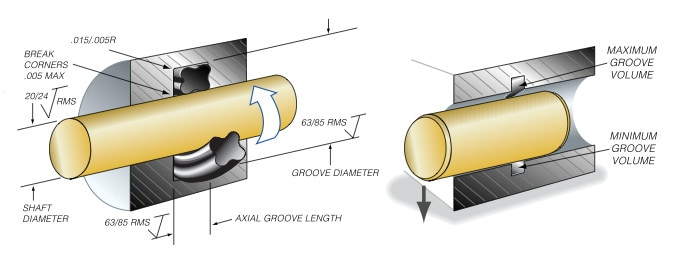
O-rings "can" do rotary sealing, but should usually not be the first choice for continuous rotary shaft sealing
Let's first clarify a key point: if the O-ring is installed at an end cover, flange, housing, plug and similar position, and there is no relative motion between the sealing faces, it is still a static seal; this scenario is used quite correctly for O-rings. What truly requires caution is:
The O-ring inner diameter directly hugging the rotating shaft, or the outer diameter having relative sliding with the rotating bore, which is using the O-ring as a rotary dynamic seal.
The essence of an O-ring is a sealing part that produces contact pressure through "compression deformation"; the core of rotary shaft seals is "maintaining an oil film under controlled contact pressure, reducing friction heat, and compensating for wear and shaft runout." These two design logics are not fully matched.
When an O-ring does rotary shaft sealing, the shaft passes through the O-ring inner diameter, and the O-ring's inner surface is in long-term contact with the rotating shaft. Apple Rubber's O-ring design instructions clearly state that a rotating operating condition subjects the O-ring's inner diameter to continuous friction heat, since rubber elastomer itself has poor heat resistance; if heat-generation speed is higher than dissipation speed, the O-ring can fail.
This is why customers who only ask "how fast is the rotation speed" is not enough — shaft diameter + rotation speed must be examined.
For example, when a 30 mm shaft is at 1000 rpm, surface speed is approximately 1.57 m/s; when a 50 mm shaft is at 1500 rpm, surface speed is approximately 3.93 m/s. The larger the shaft diameter, the greater the friction heat at the same rotation speed.
Parker's explanation on O-ring dynamic seal wear also points out that dynamic seal O-rings are easily affected by wear and friction, and friction is related to contact surface pressure and sealing contact zone temperature rise.
Skeleton oil seals, radial shaft seals, PTFE lip seals and other rotary sealing parts, the core value is not just "blocking oil," but continuously forming a controllable contact zone through lip geometry, contact force, spring or pre-tension structure.
Freudenberg's rotary seal technology data explains: after the lip's opening angle is elaborately designed, the oil film formed by the axial angle and spring rod's radial force distribution is asymmetric contact pressure distribution, and through post-run-in micro-deformation of the lip edge, produces a return-oil or "micro-pumping" effect, which is very critical to sealing function.
O-rings simply have their circular cross-section pressed on the shaft. It has no specially designed oil inclination angle, air inclination angle, return oil, or elastic loading lip edge geometry. The result is: the lubricating film is more difficult to stabilize, friction is less controlled, and contact pressure also easily fluctuates with pressure, temperature, out-of-round, and shaft jump.
This is also why oil seals, lip seals, V-rings and mechanical end-face seals will be independently designated as rotary sealing solutions. Trelleborg's definition of rotary shaft seals is: components used to seal fluid at rotating or oscillating parts, while blocking dust, water and other external contaminants from entering; its product line includes radial oil seals, radial/shaft oil seals, O-ring-activated PTFE rotary seals, V-rings and mechanical end-face seals, etc.
Rotary sealing is not a simple matter of "rubber sticking to metal." As long as there is contact friction, lubrication and heat dissipation are needed.
Freudenberg's rotary shaft seal materials clearly emphasize: how sufficiently the seal is lubricated is very important to life and reliability, and the more sufficient the lubrication, the less wear; the same material also indicates that parameters influencing radial force and lubrication state also affect sealing friction consumption.
When O-rings are used for rotary shafts, a common misconception is "assembly with a little grease is enough." Actually, initial installation of grease can only resolve the startup stage, and cannot guarantee long-term stable oil film. Especially during long-term operation, the O-ring easily enters boundary lubrication or even dry friction.
Condition |
Effect on O-Ring Rotary Seal |
Higher shaft speed |
Friction heat rises, rubber softens, hardens, permanent deformation or scorches |
Water content is high in media, cleaning liquid, low lubricity liquid |
Oil film hard to maintain, wear increases |
External dust, mud, sand, particles |
Form abrasive wear, shaft and O-ring both damaged |
Intermittent operation, frequent starts/stops |
Each startup lacks oil film consistent lubrication, later grinding results in local hot spots |
Lubricant cannot be replenished |
Effective initially, later worn or forms local dry grease |
The O-ring cross-section is round, and in dynamic seals is easily affected by uneven friction force, leading to local rolling and twisting. Parker's analysis of O-ring spiral failure causes includes: part out-of-round, eccentricity, rough surface finish, unlubricated or lubricant deficiency, material too soft, cross-section to inner diameter ratio not suitable, and improper assembly stretch, etc.; preventive measures include reducing out-of-round and eccentricity, reducing cross-section variation, ensuring proper surface quality, using harder material and reasonable cross-section-to-inner-diameter ratio.
This problem is more prominent on rotary shafts. The ideal state is: the O-ring fixed in the groove, only relative motion occurs at the O-ring inner diameter. But in reality, if groove design, surface roughness, compression amount or lubrication is inappropriate, the O-ring may "drag along the shaft," twist, and partially roll in the groove, eventually presenting as:
Failure Manifestation |
Possible Cause |
O-ring is worn flat on one side |
Continuous friction, excessive compression amount, insufficient lubrication |
Surface has spiral scratches or slice cuts |
Assembly error |
Grooves worn into the shaft |
Contact pressure too high, over-lubrication error |
Contact pressure too high, lubricant contamination |
Particle wear |
Initially not leaking, leaking after operation |
Aging, wear, compression set or hardening |
Operating temperature significantly raised |
Joule effect, rubber heat absorption or collection |
Apple Rubber especially emphasizes in rotary O-ring design that rotating or oscillating applications should avoid stretching the O-ring on the shaft; the elastomer being subjected to and under stretched heat may cause shrinkage, that is the Joule effect, thereby increasing contact heat and failure risk.
Rotary shaft seals must handle shaft runout, coaxiality, shaft surface roughness, hardness, radial dynamic manufacturing error. Skeleton oil seals commonly have lip geometry and spring assistance, able to compensate within a certain range for radial displacement and maintain sealing. Freudenberg data points out that the seal's radial force comes from the installed state's drop-down force and spring; the design intends to lower radial force to reduce friction and wear, but must also be sufficient to ensure sealing.
O-rings don't have this dedicated spring-loading structure. If eccentric, one side compression is too large, causing heat generation and wear increase; the other side has insufficient compression, easily leaking. Apple Rubber's protection design for rotary O-rings also mentions that relative motion should only occur between the O-ring inner diameter and the rotating shaft, and this must be avoided by controlling shaft concentricity, shaft surface finish and groove surface condition.
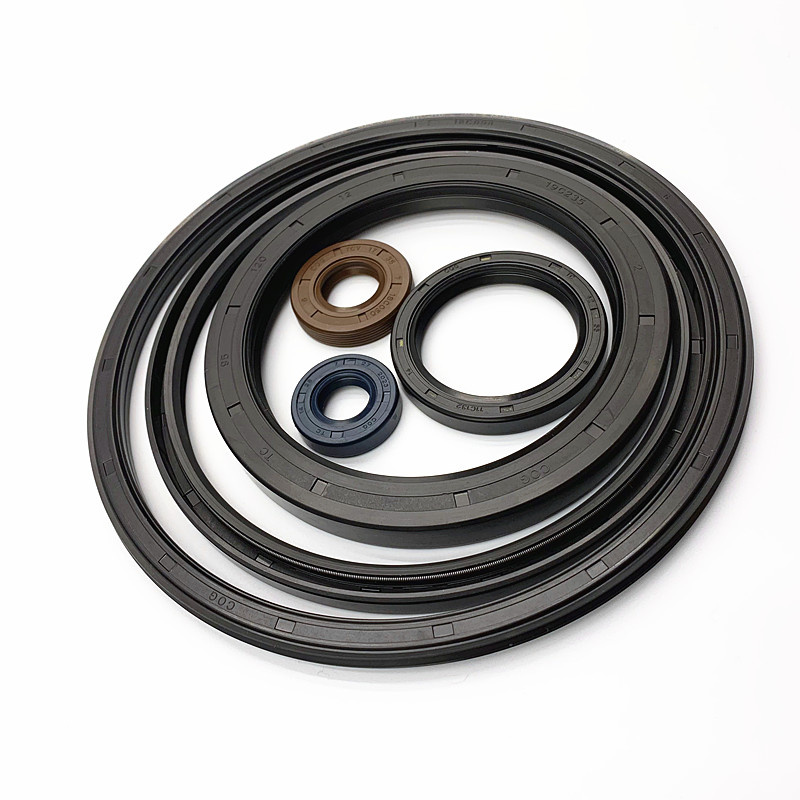
It's possible, but boundary conditions must be strict, and confirmed through actual life testing preferably. Relatively suitable scenarios include:
Scenario to Consider Using O-Ring |
Condition |
Low speed, low surface linear speed |
Shaft diameter small, rotation speed slow, friction heat controllable |
Intermittent rotation or short-term rotation |
Not long-time continuous operation |
Low pressure differential |
Not relying on high-pressure oil seal to die on the shaft |
Sufficient lubrication |
Oil bath, oil mist, grease replenishment or homogeneous material self-lubrication is good |
Environment clean |
No sand, mud, agglomerated, fiber or coarse particles |
Moderate temperature |
No compression permanent deformation, friction heat surplus |
Structure tolerant |
No standard oil seal or die-off shaft seal installation space |
Apple Rubber's rotary O-ring design recommendations list measures to reduce failure risk, such as increasing fluid flow to dissipate heat, selecting quality self-lubricating material, limiting pressure, avoiding extreme temperature, and trying to keep lubricating fluid close. Its data mentions 180 surface feet per minute as an above-value that requires special design measures for mechanical design to prevent this specific setting scenario; this value corresponds to approximately 0.91 m/s; these values should be understood as guidance for specific design, not universal limits for all materials and all structural combinations.
The following situations recommend directly turning to skeleton oil seals, V-rings, lip seals, PTFE rotary seals or mechanical seals:
Working Condition |
Reason O-Ring Not Recommended |
More Suitable Solution |
Continuous high-speed rotation |
Friction heat hard to control |
Skeleton oil seal, PTFE lip seal |
Gearbox, motor, pump shaft need long-term oil retention, dust prevention |
O-ring wears easily |
Skeleton oil seal / radial shaft seal |
Dry running or low-lubrication media |
O-ring wears quickly |
PTFE lip seal, special dry-running seal |
External water ingress, dust, particles, more severe wear |
Abrasive wear intensified |
V-ring, anti-dust oil seal, combination seal |
Higher pressure |
Contact pressure rises, more heat and wear |
Pressure-type rotary seal, mechanical seal |
Obvious shaft jump or eccentricity |
Uneven contact, local leakage and local wear intensified |
Spring-loaded oil seal, floating seal, mechanical seal |
Very strict leak requirements |
O-ring rotary seal stability insufficient |
Mechanical seal, end-face seal |
Long life requirements, difficult maintenance |
Uncontrollable failure, high risk |
Dedicated rotary seal |
Suitable for most common rotary shafts: reducers, motors, pumps, wheel hubs, agricultural machinery, engineering machinery. Its advantage is structural maturity, controllable cost, standardized installation, providing oil retention, dust prevention, and relatively stable contact via lip and spring maintenance. Freudenberg's technical description of radial shaft seals states, achieving reliable sealing, highly reliable, media compatibility, low friction and easy installation are important requirements for radial shaft seals.
Suitable for dust prevention, mud-water resistance, water resistance, axial end-face sealing and external contamination protection. V-rings usually rotate with the shaft, and the lip contacts axially against a fixed end face; not suitable for bearing high pressure differential, but very suitable for auxiliary external protection or auxiliary sealing.
Suitable for high speed, low friction, high temperature, chemical media, low leakage or space-limited scenarios. Especially O-ring-energized PTFE rotary seals, essentially not directly the "bare O-ring against the shaft," but the O-ring providing elastic preload, and the PTFE lip is responsible for forming friction with the rotating shaft. Trelleborg's rotary seal product line does include O-ring-energized PTFE rotary seals.
Suitable for pumps, agitators, compressors and other rotating equipment demanding higher leak, pressure, corrosive media or long-term operation requirements. It provides sealing via end-face friction pairs, not by rubber ring directly dragging against the rotating shaft. O-rings can be used inside mechanical seals, but usually as auxiliary static seals or compensating seals, not usually as the main rotary friction seal.
Before judging whether an O-ring can be used for rotary sealing, at least confirm the following information:
Parameter |
Why It Matters |
Shaft diameter |
Determines surface linear speed and friction heat |
Rotation speed rpm |
Determines shaft speed together with shaft diameter |
Continuous operation or intermittent operation |
Affects heat accumulation |
Media |
Determines material compatibility and lubricity |
Whether there is oil bath or oil-immersed lubrication |
Determines whether dry friction |
Pressure differential |
Higher pressure, higher contact pressure and heat generation |
Temperature |
Needs to be superimposed with ambient temperature and friction temperature rise |
Shaft surface roughness and hardness |
Affects wear and heat generation |
Shaft jump, eccentricity, coaxiality |
Affects local over-compression and wear |
External environment |
Dust, mud water, particles will accelerate wear |
Allowed leak amount |
Determines whether must select mechanical seal or dedicated rotary seal |
Target life |
Determines whether can accept O-ring trial-use risk |
O-rings are not incapable of doing rotary sealing, but are not suitable to be defaulted as the primary rotary shaft seal. Its main risk concentrates on: friction heat, insufficient lubrication, twisting/rolling, wear and scratches, shaft jump causing uneven contact, compression permanent deformation and unstable life.
The more sound principle in engineering is:
Static seal priority O-ring; continuous rotary shafts prioritize lip seal, skeleton oil seal, V-ring or mechanical seal; bare O-rings are only used in low-speed, low-pressure, sufficiently lubricated, verifiable-risk scenarios.

Welcome to HOVOO, a Chinese seal factory. Production of PU, Rubber and PTFE seals. The seals include O-ring, piston seal, rod seal, Gray ring and gas seal.


 EN
EN
 AR
AR CS
CS DA
DA NL
NL FI
FI FR
FR DE
DE EL
EL IT
IT JA
JA KO
KO NO
NO PL
PL PT
PT RO
RO RU
RU ES
ES SV
SV TL
TL IW
IW ID
ID LV
LV SR
SR SK
SK VI
VI HU
HU MT
MT TH
TH TR
TR FA
FA MS
MS GA
GA CY
CY IS
IS KA
KA UR
UR LA
LA TA
TA MY
MY
